Backed by market attractiveness analysis, total addressable market sizing, company benchmarking matrices, interactive Excel dashboards, wider supply chain intelligence, emerging startup coverage, and detailed product-level insights, The Business Research Company’s 2026 market reports are designed to offer research that is more actionable and strategically valuable than ever.
Extended Reality (XR) Optic And Display Market Value Analysis: What Growth Lies Ahead Over The Forecast Period?
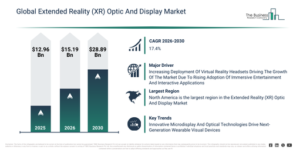
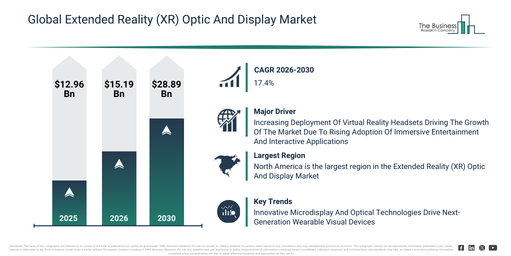
The extended reality (XR) optic and display market size has experienced rapid growth in recent years. It is anticipated to expand from $12.96 billion in 2025 to $15.19 billion in 2026, marking a compound annual growth rate (CAGR) of 17.2%. The historical growth of this market can be attributed to factors such as the increasing adoption of VR and AR devices, the demand for immersive gaming experiences, early advancements in optical components, the growth of consumer electronics integrating HMDs, and the emergence of simulation and training applications.
The extended reality (xr) optic and display market size is projected to experience substantial growth in the upcoming years. It is forecast to expand to $28.89 billion in 2030, at a compound annual growth rate (CAGR) of 17.4%. This anticipated expansion over the forecast period is driven by advancements in holographic and pancake lens technologies, the increasing application of XR in healthcare and education, the integration of AI for display optimization, the broadening of mixed reality commercial applications, and a rising demand for compact and lightweight XR optics. Significant trends during this period are expected to include high-resolution micro-displays, advanced waveguide and lens technologies, eye-tracking integration, light engine optimization, and the development of hybrid display modules.
Get A Free Sample Report With In-Depth Market Insights:
Extended Reality (XR) Optic And Display Market Growth Momentum: What Factors Are Shaping Demand?
The increasing adoption of virtual reality headsets is set to propel the expansion of the extended reality (XR) optic and display market in the future. Virtual reality headsets are wearable devices that position screens or optics directly before the eyes to immerse users in a virtual environment. The deployment of VR headsets is escalating as more consumers embrace immersive entertainment and interactive applications, thereby fueling the demand for immersive hardware experiences. Extended Reality (XR) optics and displays enhance VR headsets by improving image clarity, brightness, and field of view while simultaneously reducing distortion and latency, which collectively results in a more immersive, comfortable, and realistic virtual reality experience. For example, in January 2023, the Consumer Technology Association (CTA), a US-based tech industry association, projected that 3.3 million VR headsets would be shipped that year. This indicates that the growing deployment of virtual reality headsets is anticipated to drive the growth of the extended reality (XR) optic and display market.
Extended Reality (XR) Optic And Display Market Segment Landscape And Growth Outlook
The extended reality (xr) optic and display market covered in this report is segmented –
1) By Type: Augmented Reality Or Mixed Reality Optics, Virtual Reality Optics, Augmented Reality Or Mixed Reality Micro-Displays, Virtual Reality Micro-Displays
2) By Technology: Augmented Reality, Virtual Reality, Mixed Reality
3) By Display Type: Head-Mounted Displays, Optical See-Through Displays, Video See-Through Displays
4) By Application: Commercial Applications, Individual Consumer
5) By End Use: Gaming, Education, Healthcare, Retail, Military
Subsegments:
1) By Augmented Reality Or Mixed Reality Optics: Waveguide Optics, Birdbath Optics, Holographic Optics, Reflective Combiner Optics
2) By Virtual Reality Optics: Fresnel Lenses, Pancake Lenses, Aspheric Lenses, Hybrid Lens Systems
3) By Augmented Reality Or Mixed Reality Micro-Displays: Micro Organic Light Emitting Diode Displays, Micro Light Emitting Diode Displays, Liquid Crystal On Silicon Displays, Digital Light Processing Micro Displays
4) By Virtual Reality Micro-Displays: Organic Light Emitting Diode Displays, Liquid Crystal Displays, Fast-Switching Liquid Crystal Display, Active Matrix Organic Light Emitting Diode Displays
Extended Reality (XR) Optic And Display Market Trends Redefining Industry Growth
Leading firms within the extended reality (XR) optic and display market are prioritizing the creation of novel solutions, including high-brightness microdisplays, with the aim of enhancing visual quality, decreasing power usage, and facilitating the development of lightweight, market-ready XR devices. High-brightness microdisplays represent compact, energy-saving display panels capable of generating highly luminous visuals for superior clarity in AR/XR devices. Concurrently, sophisticated waveguide optics function as clear optical components that direct and project these visuals into the wearer’s line of sight, packaged in a light, spectacle-like design. As an illustration, in May 2025, Vuzix Corporation, a US-based producer of AI-powered smart glasses, collaborated with Himax Technologies Inc., a Taiwan-based expert in semiconductors and displays, to unveil an integrated AR display module. This module merges Himax’s exceptionally bright, tiny dual-edge front-lit LCOS microdisplay with Vuzix’s slender 0.7 mm waveguides, offering optics ready for production that exhibit minimal eye glow, extensive FOV support, and adaptability for prescription lenses. This module is engineered to provide intense brightness and sharp visual clarity, simultaneously ensuring minimal power draw and a lightweight construction suitable for continuous daily wear. Its application scope encompasses both enterprise and consumer AR applications, by making possible small, industry-ready smart glasses capable of dependable operation across indoor and outdoor settings. Such a partnership underscores the participating companies’ dedication to expediting the market introduction of scalable, comfortable, and high-performance AR display solutions.
Extended Reality (XR) Optic And Display Market Competitive Overview And Top Companies
Major companies operating in the extended reality (xr) optic and display market are Samsung Display Co. Ltd., Meta Platforms Inc., Sony Semiconductor Solutions Corporation, 3M Company, BOE Technology Group Co. Ltd., LG Display Co. Ltd., Goertek Optical Technology Co. Ltd., Himax Technologies Inc., Shanghai Jade Bird Display Technology Co. Ltd., Shenzhen SeeYA Technology Co. Ltd., Kopin Corporation, Dispelix Oy, MICROOLED S.A., CREAL SA, Luminit LLC, Vuzix Corporation, Optinvent S.A., Compound Photonics Group Ltd., WaveOptics Ltd., Lumus Ltd.
View The Full Extended Reality (XR) Optic And Display Market Report:
Extended Reality (XR) Optic And Display Market Leading Geography: Which Region Contributes The Most Revenue?
North America was the largest region in the extended reality XR optic and display market in 2025. Asia-Pacific is expected to be the fastest-growing region in the forecast period. The regions covered in the extended reality (xr) optic and display market report are Asia-Pacific, South East Asia, Western Europe, Eastern Europe, North America, South America, Middle East, Africa.
Reach Out To Our Team:
The Business Research Company: https://www.thebusinessresearchcompany.com/
Americas: +1 310-496-7795
Asia: +44 7882 955267 & +91 8897263534
Europe: +44 7882 955267
Email us at: marketing@tbrc.info
Follow us on:
LinkedIn: https://in.linkedin.com/company/the-business-research-company
YouTube: https://www.youtube.com/channel/UC24_fI0rV8cR5DxlCpgmyFQ
Global Market Model: https://www.thebusinessresearchcompany.com/global-market-model

Wasay has over a decade of experience in market research, data modelling, and analytics, with prior experience at GlobalData and Decision Tree Consulting Services. At The Business Research Company , he leads research operations across syndicated studies, customized consulting engagements, and the Global Market Model platform. His professional experience includes supporting organizations such as Boston Consulting Group, KPMG, and Ernst & Young. Wasay holds a degree in Electronics and Communications Engineering, postgraduate management qualifications from International Management Institute Belgium and Indian School of Business and Entrepreneurship, and completed the Integrated Program in Business Analytics from Indian Institute of Management Indore.