Built to provide research that’s more actionable and strategically valuable, The Business Research Company’s 2026 market reports include market attractiveness analysis, total addressable market sizing, company benchmarking matrices, interactive Excel dashboards, broader supply chain intelligence, emerging startup tracking, and in-depth product insights.
Synchronizing Systems Market Size Outlook: How Quickly Will Revenue Expand Through 2030?
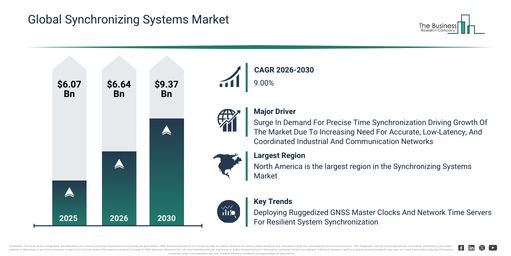
The synchronizing systems market has experienced substantial growth in recent years. It is projected to expand from $6.07 billion in 2025 to $6.64 billion in 2026, demonstrating a compound annual growth rate (CAGR) of 9.3%. The market’s historical development has been driven by factors such as the increasing integration of industrial automation, a heightened need for precise time coordination, greater deployment within telecommunications networks, the advancement of smart grid and power systems, and a stronger emphasis on minimizing operational errors.
The synchronizing systems market size is projected to experience significant expansion over the forthcoming years. Its value is anticipated to reach $9.37 billion by 2030, exhibiting a compound annual growth rate (CAGR) of 9.0%. This growth during the forecast period can be attributed to several factors, including increasing integration with the industrial internet of things, a rising adoption of connected and autonomous systems, a growing demand for high-accuracy synchronization, the expansion of digital infrastructure in manufacturing, and a rise in investment for real-time monitoring solutions. Throughout this forecast period, key trends encompass technology-driven innovations in timing systems, advancements in network synchronization protocols, developments in both hardware- and software-based synchronization, increasing research and development in precision timing solutions, and innovation in automated and intelligent synchronization systems.
Get A Free Sample Report With In-Depth Market Insights:
Synchronizing Systems Market Growth Momentum: What Factors Are Shaping Demand?
The future expansion of the synchronizing systems market is anticipated due to an increasing need for accurate time synchronization in industrial and communication networks. This precise time synchronization involves aligning clocks and timing signals throughout devices and networks, vital for ensuring accurate data exchange and harmonious operations, particularly in areas like industrial automation, telecommunications, smart grids, and time sensitive networking applications. This escalating demand stems from the rapid rollout of 5G networks and associated infrastructure, which necessitate more stringent timing accuracy and advanced synchronization equipment to satisfy evolving operational benchmarks. Synchronizing systems facilitate precise time alignment through technologies and standards that guarantee deterministic communication, minimal latency, and reliable coordination among diverse network components. As an illustration, in July 2025, the International Telecommunication Union (ITU T), a United Nations-affiliated global standards organization, introduced an updated ITU T G.8272.1 recommendation. This update defined enhanced primary reference time clocks (ePRTCs) with specific time and phase synchronization needs, allowing for timing accuracy specifications that support sub-100 nanosecond alignment within packet networks. TSN, meanwhile, was valued at approximately 1.42 billion in 2024 and is projected to increase to about 4.15 billion by 2033. Consequently, the increasing requirement for precise time synchronization across industrial and communication networks is fueling the expansion of the synchronizing systems market.
Synchronizing Systems Market Segment Landscape: Which Areas Lead Development?
The synchronizing systems market covered in this report is segmented –
1) By Component: Hardware, Software, Services
2) By Synchronization Type: Time Synchronization, Frequency Synchronization, Phase Synchronization
3) By Deployment Mode: On-Premises, Cloud
4) By Application: Generator Synchronization, Grid Synchronization, Busbar Synchronization, Microgrid Synchronization, Renewable Energy Integration
5) By End Use Industry: Power Generation Industry, Oil And Gas Industry, Manufacturing Industry, Data Center Industry, Marine And Shipbuilding Industry, Commercial Buildings, Industrial Facilities
Subsegments:
1) By Hardware: Synchronization Controllers, Network Interface Devices, Timing Modules
2) By Software: System Management Software, Monitoring And Analytics Software, Configuration And Control Software
3) By Services: Installation And Integration Services, Maintenance And Support Services, Consulting And Training Services
Synchronizing Systems Market Trends Redefining Industry Growth
Key entities active in the synchronizing systems market are concentrating on introducing advanced resilient timing solutions, such as reinforced GNSS master clocks and network time servers. The aim is to ensure accurate time coordination across intricate systems, sustain precise timing signals despite adverse environmental circumstances, and deliver continuous synchronization even in situations where GNSS signals are absent. These reinforced GNSS master clocks and network time servers are hardware components that offer reliable and exact global navigation satellite system time references, transmit synchronized time and frequency signals to connected systems, support standard timing protocols like Network Time Protocol (NTP) and Precision Time Protocol (PTP), and preserve synchronization integrity during interruptions to satellite signals. For example, in September 2025, Safran Electronics & Defense, a French defense electronics firm, unveiled VersaSync, their refined GNSS master clock and network time server. This device features improved frequency stability when subjected to extreme temperatures, shock, and vibration; enhanced holdover capabilities for extended periods without GNSS signals; and increased resilience to power supply disturbances, thereby maintaining timing continuity during disruptions. This makes it appropriate for defense communications and critical mission systems.
Synchronizing Systems Market Key Players Shaping Industry Direction
Major companies operating in the synchronizing systems market are Google LLC, Microsoft Corporation, Dropbox Inc., Siemens AG, Cisco Systems Inc., Schneider Electric SE, Microchip Technology Inc, OpenText Corporation, Citrix Systems Inc., EndRun Technologies Inc., Box Inc., Safran Electronics & Defense, Egnyte Inc., Huawei Technologies Co. Ltd., Nextcloud GmbH, Syncplicity LLC, CTERA Networks Ltd., Acronis International GmbH, Oscilloquartz SA, Meinberg Funkuhren GmbH & Co. KG, SugarSync Inc., National Instruments Corporation
View The Full Synchronizing Systems Market Report:
Synchronizing Systems Market Regional Analysis: Which Geography Leads On Revenue?
North America was the largest region in the synchronizing systems market in 2025. Asia-Pacific is expected to be the fastest-growing region in the forecast period. The regions covered in the synchronizing systems market report are Asia-Pacific, South East Asia, Western Europe, Eastern Europe, North America, South America, Middle East, Africa.
Reach Out To Our Team:
The Business Research Company: https://www.thebusinessresearchcompany.com/
Americas: +1 310-496-7795
Asia: +44 7882 955267 & +91 8897263534
Europe: +44 7882 955267
Email us at: marketing@tbrc.info
Follow us on:
LinkedIn: https://in.linkedin.com/company/the-business-research-company
YouTube: https://www.youtube.com/channel/UC24_fI0rV8cR5DxlCpgmyFQ
Global Market Model: https://www.thebusinessresearchcompany.com/global-market-model

Wasay has over a decade of experience in market research, data modelling, and analytics, with prior experience at GlobalData and Decision Tree Consulting Services. At The Business Research Company , he leads research operations across syndicated studies, customized consulting engagements, and the Global Market Model platform. His professional experience includes supporting organizations such as Boston Consulting Group, KPMG, and Ernst & Young. Wasay holds a degree in Electronics and Communications Engineering, postgraduate management qualifications from International Management Institute Belgium and Indian School of Business and Entrepreneurship, and completed the Integrated Program in Business Analytics from Indian Institute of Management Indore.