
Delivering more actionable and strategically valuable research, The Business Research Company’s 2026 market reports feature market attractiveness analysis, total addressable market evaluation, company benchmarking matrices, interactive Excel dashboards, expanded supply chain intelligence, emerging startup coverage, and detailed product insights.
Synchronizing Systems Market Growth From $6.64 Billion In 2026 To $9.37 Billion By 2030 At A CAGR Of 9%
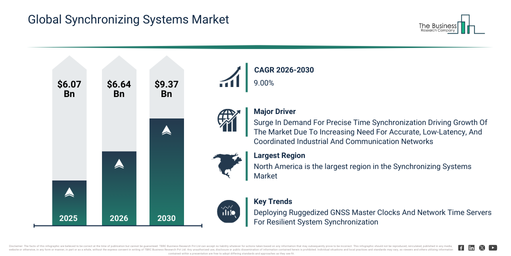
The synchronizing systems market has seen robust expansion in recent years. Its valuation is set to climb from $6.07 billion in 2025 to $6.64 billion in 2026, exhibiting a compound annual growth rate (CAGR) of 9.3%. This growth observed historically can be attributed to growing adoption of industrial automation, increasing demand for precise time coordination, rising use in telecommunications networks, expansion of smart grid and power systems, and growing focus on reducing operational errors.
The synchronizing systems market size is anticipated to undergo significant expansion in the coming years. It is projected to reach $9.37 billion by 2030, exhibiting a compound annual growth rate (CAGR) of 9.0%. This growth during the forecast period can be attributed to heightened integration with the industrial internet of things, the increasing adoption of connected and autonomous systems, a rising demand for high accuracy synchronization, the broadening of digital infrastructure in manufacturing, and an uptick in investment for real-time monitoring solutions. Key trends expected in the forecast period involve technology-driven innovations in timing systems, further advancements in network synchronization protocols, continuous developments in hardware and software-based synchronization, increased research and development in precision timing solutions, and innovation in automated and intelligent synchronization systems.
Download A Free Sample Report For Comprehensive Market Insights:
#Synchronizing Systems Market Demand Drivers Creating New Revenue Opportunities
The anticipated expansion of the synchronizing systems market is set to be fueled by an increasing need for accurate time synchronization in industrial and communication networks. This precise time synchronization involves aligning clocks and timing signals across various devices and networks, vital for ensuring accurate data transmission and organized operations, particularly crucial in sectors like industrial automation, telecommunications, smart grids, and applications involving time sensitive networking. This growing requirement stems from the rapid deployment of 5G networks and associated infrastructure, which mandate more stringent timing accuracy and advanced synchronization equipment to comply with developing operational benchmarks. Synchronizing systems facilitate exact time alignment through technologies and standards that guarantee deterministic communication, minimal latency, and reliable coordination among dispersed network components. For example, in July 2025, the International Telecommunication Union (ITU T), a UN-affiliated global standards organization, updated its ITU T G.8272.1 recommendation. This update specified requirements for enhanced primary reference time clocks (ePRTCs) that ensure precise time and phase synchronization, allowing for timing accuracy specifications capable of achieving sub-100 nanosecond alignment within packet networks. TSN, had an approximate valuation of 1.42 billion in 2024 and is projected to increase to approximately 4.15 billion by 2033. Consequently, the increased need for precise time synchronization across industrial and communication networks is propelling the expansion of the synchronizing systems market.
Synchronizing Systems Market Segment Outlook: Which Categories Are Expanding The Fastest?
The synchronizing systems market covered in this report is segmented –
1) By Component: Hardware, Software, Services
2) By Synchronization Type: Time Synchronization, Frequency Synchronization, Phase Synchronization
3) By Deployment Mode: On-Premises, Cloud
4) By Application: Generator Synchronization, Grid Synchronization, Busbar Synchronization, Microgrid Synchronization, Renewable Energy Integration
5) By End Use Industry: Power Generation Industry, Oil And Gas Industry, Manufacturing Industry, Data Center Industry, Marine And Shipbuilding Industry, Commercial Buildings, Industrial Facilities
Subsegments:
1) By Hardware: Synchronization Controllers, Network Interface Devices, Timing Modules
2) By Software: System Management Software, Monitoring And Analytics Software, Configuration And Control Software
3) By Services: Installation And Integration Services, Maintenance And Support Services, Consulting And Training Services
Synchronizing Systems Market Trends Driving Strategic Industry Expansion
Leading companies in the low-fermentable oligosaccharides, disaccharides, monosaccharides, and polyols (FODMAP) food market are concentrating on developing novel products, including dairy-free and lactose-free alternatives. This initiative is designed to accommodate diverse dietary needs, boost accessibility, and satisfy the growing preference for plant-based options. Dairy-free and lactose-free alternatives refer to food and beverage items formulated without ingredients derived from milk, allowing individuals with lactose intolerance, milk allergies, or vegan dietary preferences to enjoy similar tastes and textures. An example of this is Natural Lawson, a Japan-based manufacturer of cargo and baggage loading systems, which launched My Flora Free in November 2025. This line of dairy-free and lactose-free products is specifically engineered to enable more people to experience the full, savory flavor of dairy without discomfort. The initial release featured products like a lactose-free version of their popular “Uchi Cafe” cream-filled roll cake and a dairy-free café au lait. This endeavor aims to offer inclusive choices for customers with dietary restrictions, ensuring convenient access to suitable products at their local convenience stores.
Synchronizing Systems Market Key Companies And Competitive Benchmarking
Major companies operating in the synchronizing systems market are Google LLC, Microsoft Corporation, Dropbox Inc., Siemens AG, Cisco Systems Inc., Schneider Electric SE, Microchip Technology Inc, OpenText Corporation, Citrix Systems Inc., EndRun Technologies Inc., Box Inc., Safran Electronics & Defense, Egnyte Inc., Huawei Technologies Co. Ltd., Nextcloud GmbH, Syncplicity LLC, CTERA Networks Ltd., Acronis International GmbH, Oscilloquartz SA, Meinberg Funkuhren GmbH & Co. KG, SugarSync Inc., National Instruments Corporation
Access The Complete Synchronizing Systems Market Report:
Synchronizing Systems Market Regional Analysis And Leading Geography
North America was the largest region in the synchronizing systems market in 2025. Asia-Pacific is expected to be the fastest-growing region in the forecast period. The regions covered in the synchronizing systems market report are Asia-Pacific, South East Asia, Western Europe, Eastern Europe, North America, South America, Middle East, Africa.
Get in touch with us:
The Business Research Company: https://www.thebusinessresearchcompany.com/
Americas: +1 310-496-7795
Asia: +44 7882 955267 & +91 8897263534
Europe: +44 7882 955267
Email us at: marketing@tbrc.info
Follow us on:
LinkedIn: https://in.linkedin.com/company/the-business-research-company
YouTube: https://www.youtube.com/channel/UC24_fI0rV8cR5DxlCpgmyFQ
Global Market Model: https://www.thebusinessresearchcompany.com/global-market-model

Wasay has over a decade of experience in market research, data modelling, and analytics, with prior experience at GlobalData and Decision Tree Consulting Services. At The Business Research Company , he leads research operations across syndicated studies, customized consulting engagements, and the Global Market Model platform. His professional experience includes supporting organizations such as Boston Consulting Group, KPMG, and Ernst & Young. Wasay holds a degree in Electronics and Communications Engineering, postgraduate management qualifications from International Management Institute Belgium and Indian School of Business and Entrepreneurship, and completed the Integrated Program in Business Analytics from Indian Institute of Management Indore.