Featuring market attractiveness scoring, total addressable market sizing, company benchmarking matrices, interactive Excel dashboards, deeper supply chain intelligence, emerging startup tracking, and granular product-level insights, The Business Research Company’s 2026 market reports are built to deliver research that is both more actionable and more strategically valuable.
Multi-Modal Emotional Digital Human Market Size, Value And Growth Trajectory Through 2030
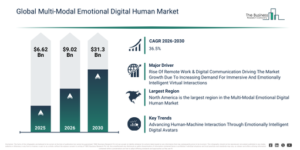
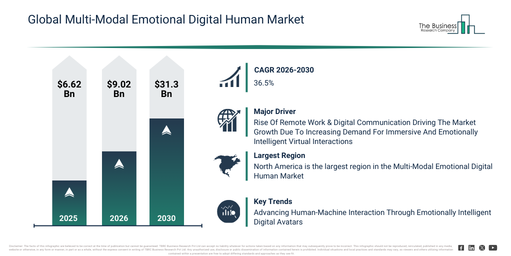
The multi-modal emotional digital human market has witnessed substantial expansion in recent years. Its valuation is expected to climb from $6.62 billion in 2025 to $9.02 billion in 2026, exhibiting a compound annual growth rate (CAGR) of 36.2%. This historical growth can be linked to factors such as the increasing demand for tailored digital experiences, wider adoption of virtual customer service, innovations in speech synthesis technology, higher investments in human-computer interaction research, and the initial deployment of interactive kiosks and smart screens.
The multi-modal emotional digital human market is projected for substantial expansion over the next few years. It is forecast to reach $31.3 billion by 2030, exhibiting a compound annual growth rate (CAGR) of 36.5%. This growth during the forecast period is attributable to the expanded application of emotion recognition in healthcare, the increasing adoption of digital humans in educational platforms, a greater integration of multimodal AI analytics, a rising demand for empathetic corporate engagement tools, and advancements in edge AI devices and sensor technologies. Key trends anticipated within the same period encompass emotion-aware virtual assistants, sophisticated avatar customization, the design of real-time multimodal interactions, lifelike speech and facial animation, and services for integrating affective computing.
Get A Free Sample Report With In-Depth Market Insights:
Multi-Modal Emotional Digital Human Market Growth Momentum: What Factors Are Shaping Demand?
The future expansion of the multi modal emotional digital human market is anticipated to be driven by the increasing prevalence of remote work and digital communication. These terms define a work model where individuals operate beyond conventional office settings, leveraging digital instruments and platforms for collaboration, interaction, and task execution. This surge in remote and digital communication stems from the broader embrace of adaptable employment structures and sophisticated digital technologies, empowering employees to interact and cooperate efficiently irrespective of their location. By fostering virtual settings, remote work and digital communication stimulate the need for multi modal emotional digital humans, as these environments benefit from lifelike, emotionally attuned digital avatars that improve teamwork, facilitate captivating interpersonal exchanges, and mimic the social signals inherent in direct interactions. As an illustration, in March 2025, data from the U.S. Bureau of Labor Statistics, a US-based federal government agency, revealed that approximately 35.5 million people engaged in paid remote work or telework during the first quarter of 2024, marking an increment of 5.1 million over the prior year. This demographic constituted 22.9% of the total employed workforce in that period, an increase from 19.6% recorded in the corresponding quarter of the preceding year. Consequently, the expanding trend of remote work and digital communication is fueling the expansion of the multi modal emotional digital human market.
Multi-Modal Emotional Digital Human Market Segment Breakdown: Which Categories Lead On Revenue?
The multi-modal emotional digital human market covered in this report is segmented –
1) By Component: Software Platforms, Hardware Modules, Professional Services
2) By Interaction Mode: Text-Based, Voice-Based, Visual-Based, Gesture-Based
3) By Technology: Natural Language Processing, Computer Vision, Speech Synthesis, Emotion Recognition, Machine Learning And Artificial Intelligence (AI) Analytics, Multimodal Integration Platforms
4) By Application: Healthcare, Customer Service, Entertainment, Education
5) By End Use: Corporate, Personal, Educational Institutes
Subsegments:
1) By Software Platforms: Conversation Management Software, Emotion Analysis Software, Avatar Animation Software, Speech Processing Software, Interaction Orchestration Software
2) By Hardware Modules: Cameras And Sensors, Microphones And Audio Devices, Processing Units, Display Systems, Motion Tracking Devices
3) By Professional Services: Consulting Services, System Integration Services, Customization Services, Training And Support Services, Maintenance And Update Services
Multi-Modal Emotional Digital Human Market Trends Redefining Industry Growth
Major companies within the multi-modal emotional digital human market are concentrating on crafting advanced solutions, such as emotionally intelligent metahuman interfaces, to elevate user engagement and provide tailored, human-like interactions across diverse industries. An emotionally intelligent metahuman interface is a digital human platform adept at recognizing, interpreting, and reacting to human emotions in real time, employing realistic visual, auditory, and behavioral cues, which helps businesses deliver more empathetic, personalized, and compelling interactions compared to conventional chatbots or static interfaces. For instance, in March 2025, Pantheon Lab, a Hong Kong-based provider of digital human and agentic AI technologies, unveiled its Metahuman Interface (MHI), an innovative emotionally intelligent digital human platform. The MHI features lifelike digital avatars powered by agentic AI for independently executing goal-oriented tasks, real-time emotional awareness to sense and respond to human concerns, and voice-activated interactions that eliminate the requirement for physical input devices. Its applications encompass customer service, healthcare appointment management, retail engagement, and public services, delivering empathetic, fluid, and scalable experiences that foster trust and engagement.
Multi-Modal Emotional Digital Human Market Company Landscape And Competitive Strategy
Major companies operating in the multi-modal emotional digital human market are Amazon Web Services Inc., Google LLC, Microsoft Corporation, International Business Machines Corporation, NVIDIA Corporation, Epic Games Inc., Uniphore Technologies Inc., Synthesia Ltd., D-ID Ltd., Reallusion Inc., Hume AI Inc., HeyGen Ltd., Anam Labs Inc., Beyond Presence GmbH, Emotibot Inc., Siena AI, UneeQ Digital Humans Ltd., VERN AI, Mimic Minds Inc., UNITH Ltd.
View The Full Multi-Modal Emotional Digital Human Market Report:
Multi-Modal Emotional Digital Human Market Largest Region: Which Geography Holds The Highest Market Share?
North America was the largest region in the multi-modal emotional digital human market in 2025. The regions covered in the multi-modal emotional digital human market report are Asia-Pacific, South East Asia, Western Europe, Eastern Europe, North America, South America, Middle East, Africa.
Reach Out To Our Team:
The Business Research Company: https://www.thebusinessresearchcompany.com/
Americas: +1 310-496-7795
Asia: +44 7882 955267 & +91 8897263534
Europe: +44 7882 955267
Email us at: marketing@tbrc.info
Follow us on:
LinkedIn: https://in.linkedin.com/company/the-business-research-company
YouTube: https://www.youtube.com/channel/UC24_fI0rV8cR5DxlCpgmyFQ
Global Market Model: https://www.thebusinessresearchcompany.com/global-market-model

Wasay has over a decade of experience in market research, data modelling, and analytics, with prior experience at GlobalData and Decision Tree Consulting Services. At The Business Research Company , he leads research operations across syndicated studies, customized consulting engagements, and the Global Market Model platform. His professional experience includes supporting organizations such as Boston Consulting Group, KPMG, and Ernst & Young. Wasay holds a degree in Electronics and Communications Engineering, postgraduate management qualifications from International Management Institute Belgium and Indian School of Business and Entrepreneurship, and completed the Integrated Program in Business Analytics from Indian Institute of Management Indore.