Featuring market attractiveness scoring, total addressable market sizing, company benchmarking matrices, interactive Excel dashboards, deeper supply chain intelligence, emerging startup tracking, and granular product-level insights, The Business Research Company’s 2026 market reports are built to deliver research that is both more actionable and more strategically valuable.
Nighttime Lights Analytics Market Value Growth And Long-Term Outlook
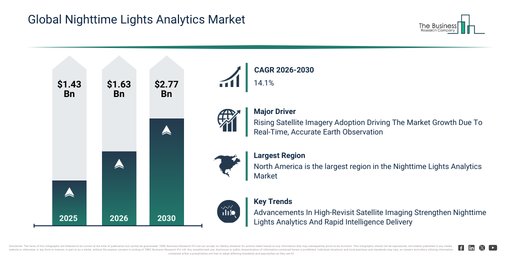
The nighttime lights analytics market size has experienced rapid expansion over recent years. This market is projected to expand from $1.43 billion in 2025 to $1.63 billion in 2026, demonstrating a compound annual growth rate (CAGR) of 13.9%. Historically, this growth has been driven by several factors, including an increase in satellite imaging programs, the spread of urbanization throughout developing economies, a rise in government utilization of geospatial intelligence, an uptick in disaster monitoring efforts, and the need for economic proxy indicators in areas lacking extensive data.
The nighttime lights analytics market is projected to experience substantial growth over the next few years. This market is set to reach a value of $2.77 billion by 2030, demonstrating a compound annual growth rate (CAGR) of 14.1%. Several factors will drive this expansion during the forecast period, including progress in high-resolution night-sensing satellite technology, the proliferation of smart city initiatives, a growing demand for monitoring energy consumption, an increase in mandates for climate and environmental oversight, and the integration of geospatial analytics by businesses. Key developments anticipated during this timeframe involve an expanding utilization of nighttime light data to estimate economic activity, a greater uptake of nighttime analytics for overseeing urban growth, an increasing deployment in mapping energy infrastructure and electrification, an enlarging function in evaluating disaster impact and recovery, and the merging of various geospatial datasets for identifying temporal changes.
Get A Free Sample Report With In-Depth Market Insights:
Nighttime Lights Analytics Market Growth Momentum: What Factors Are Shaping Demand?
The expanding integration of satellite imagery is anticipated to drive the future expansion of the nighttime lights analytics market. Satellite imagery involves gathering pictures of Earth or other celestial bodies taken from space by satellites for purposes such as observation, analysis, and mapping. The increasing uptake of satellite imagery is attributed to its capability to deliver precise, real-time information, allowing businesses and governmental bodies to track planetary changes and react more swiftly to requirements in environmental, agricultural, and urban planning. Nighttime lights analytics observes artificial light emitted from space to map human activities, offering perspectives on development status, energy access, impacts of disasters, and population shifts, particularly in areas with limited data. For example, in June 2025, the UK Space Agency, a government department in the UK, announced a funding program worth $12.34 million (£2 million), offering up to $478,524 (£400,000) for each project aimed at commercializing space-based solutions. Consequently, the increased adoption of satellite imagery is propelling the growth of the nighttime lights analytics market.
Nighttime Lights Analytics Market Segmentation: How Does The Market Break Down By Category?
The nighttime lights analytics market covered in this report is segmented –
1) By Component: Software, Hardware, Services
2) By Data Source: Satellite Imagery, Aerial Imagery, Ground-Based Sensors, Other Data Sources
3) By Application: Urban Planning, Environmental Monitoring, Disaster Response, Economic Analysis, Defense And Security, Other Applications
4) By End User: Government And Public Sector, Research Institutions And Academia, Defense And Intelligence Agencies, Commercial Enterprises, Non-Governmental Organizations (NGOs) And Development Organizations
Subsegments:
1) By Software: Robot Operating Systems And Firmware, Simulation And Digital-Twin Software, Motion Planning And Path Optimization, Artificial Intelligence (AI) And Machine Learning Software, Vision And Perception Software, Cell And Fleet Management Software, Manufacturing Execution System (MES) Or Enterprise Resource Planning (ERP) Integration Software, Predictive Maintenance And Analytics, Cybersecurity Software, Low-Code Or No-Code Programming Tools
2) By Hardware: Robot Arms And Manipulators, Collaborative Robots, End-Effectors And Grippers, Sensors And Perception Hardware, Actuators And Drives, Machine Vision Systems, Controllers And Programmable Logic Controllers (PLCs), Autonomous Mobile Robots (Autonomous Mobile Robots) And Automated Guided Vehicles (AGVs), Safety Systems And Fencing, Power And Cabling Infrastructure
3) By Services: System Design And Engineering, Integration And Commissioning, Maintenance And Field Support, Training And Skill Development, Retrofit And Modernization Services, Custom Application Development, Robotics-As-A-Service (RaaS), Validation And Testing Services, Consulting And Return On Investment (ROI) Analysis, Research And Development And Co-Innovation Services
Nighttime Lights Analytics Market Trends Redefining Industry Growth
Leading companies in the nighttime lights analytics market are concentrating on deploying next-generation satellite constellations to boost nighttime lights analytics, expedite data access, and refine the oversight of human and economic activity. These next-generation satellite constellations are made up of advanced clusters of compact, high-capability satellites, engineered for quick deployment, frequent global coverage, and nearly real-time data availability, supporting Earth observation, communication services, and intelligence tasks. For instance, in December 2025, BlackSky Technology Inc., a US-based provider of real-time geospatial intelligence, declared that its third-generation Gen-3 satellite began commercial operations just three weeks after its launch. This rapid activation highlights BlackSky’s proficiency in delivering high-resolution, high-frequency imagery promptly, which encompasses improved low-light and nighttime imaging, thereby enabling faster, analytics-driven intelligence for uses such as economic activity monitoring, security evaluations, and infrastructure analysis.
Nighttime Lights Analytics Market Competitive Landscape: Who Leads The Industry?
Major companies operating in the nighttime lights analytics market are Google LLC, BlackSky Technology Inc., Airbus Defence and Space GmbH, L3Harris Technologies Inc., World Bank Group, Environmental Systems Research Institute Inc., Marble Imaging GmbH, CARTO Inc., SpaceKnow Inc., Kayrros SAS, Skylight Digital Inc., SatSure Analytics India Private Limited, New Light Technologies Inc., Ursa Space Systems Inc., Kontur Inc., Atlas AI PBC, Geoinfotech Resources Limited, Sparkgeo Consulting Inc., GeoIQ, and Sentinel Hub.
View The Full Nighttime Lights Analytics Market Report:
Nighttime Lights Analytics Market Geographic Landscape: Which Region Leads Industry Growth?
North America was the largest region in the nighttime lights analytics market in 2025. Asia-Pacific is expected to be the fastest-growing region in the forecast period. The regions covered in the nighttime lights analytics market report are Asia-Pacific, South East Asia, Western Europe, Eastern Europe, North America, South America, Middle East, Africa.
Reach Out To Our Team:
The Business Research Company: https://www.thebusinessresearchcompany.com/
Americas: +1 310-496-7795
Asia: +44 7882 955267 & +91 8897263534
Europe: +44 7882 955267
Email us at: marketing@tbrc.info
Follow us on:
LinkedIn: https://in.linkedin.com/company/the-business-research-company
YouTube: https://www.youtube.com/channel/UC24_fI0rV8cR5DxlCpgmyFQ
Global Market Model: https://www.thebusinessresearchcompany.com/global-market-model

Wasay has over a decade of experience in market research, data modelling, and analytics, with prior experience at GlobalData and Decision Tree Consulting Services. At The Business Research Company , he leads research operations across syndicated studies, customized consulting engagements, and the Global Market Model platform. His professional experience includes supporting organizations such as Boston Consulting Group, KPMG, and Ernst & Young. Wasay holds a degree in Electronics and Communications Engineering, postgraduate management qualifications from International Management Institute Belgium and Indian School of Business and Entrepreneurship, and completed the Integrated Program in Business Analytics from Indian Institute of Management Indore.