Featuring market attractiveness scoring, total addressable market sizing, company benchmarking matrices, interactive Excel dashboards, deeper supply chain intelligence, emerging startup tracking, and granular product-level insights, The Business Research Company’s 2026 market reports are built to deliver research that is both more actionable and more strategically valuable.
Network Slicing Policy Engine Market Growth From $1.79 Billion In 2026 To $4.6 Billion By 2030 At A CAGR Of 26.7%
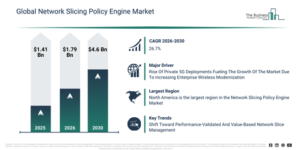
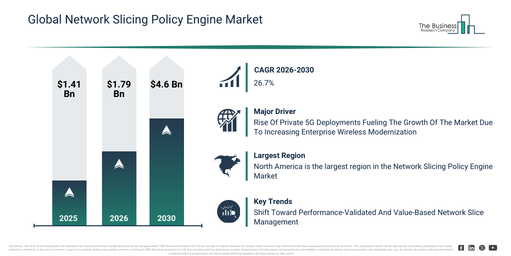
The network slicing policy engine market size has experienced significant expansion recently. It is anticipated to grow from $1.41 billion in 2025 to $1.79 billion in 2026, exhibiting a compound annual growth rate (CAGR) of 26.4%. This historical growth can be attributed to several factors such as the swift deployment of 4G and early 5G technologies, an increase in mobile data traffic and demand for bandwidth, the rise of virtualization and software-defined networking (SDN), a growing need for quality of service (QoS) management, and telecom operators’ focus on enhancing network efficiency and optimizing costs.
The network slicing policy engine market is anticipated to experience substantial growth over the next few years. It is projected to grow to $4.6 billion in 2030 at a compound annual growth rate (CAGR) of 26.7%. This expansion during the forecast period is fueled by the widespread adoption of private 5G networks across industries, the increasing integration of edge computing infrastructure, a heightened demand for ultra reliable low latency communication (URLLC), the proliferation of network as a service (NaaS) models, and a growing requirement for automated network policy and security enforcement. Prominent trends for the forecast period include dynamic policy-driven network slice orchestration, real-time network slice performance monitoring, automated resource allocation across virtualized networks, multi-tenant policy enforcement for private and public networks, and network slice customization for enterprise use cases.
Get A Free Sample Report With In-Depth Market Insights:
Network Slicing Policy Engine Market Industry Drivers: What’s Behind The Revenue Growth?
The projected growth of the network slicing policy engine market is expected to be propelled by the increasing number of private 5G deployments. Private 5G refers to dedicated mobile networks set up by enterprises to deliver secure, high-performance, and low-latency connectivity for specialized applications. The volume of private 5G deployments is on the rise, primarily due to more enterprises adopting these dedicated wireless networks to support industrial, logistics, campus, and other specific use cases that demand reliable and secure communication. The network slicing policy engine facilitates this trend by enabling tailored allocation and automated management of network resources across multiple logical slices, ensuring that diverse performance, security, and service-level requirements are met. For instance, in December 2023, according to Ofcom, a UK-based communications regulator, as of September 2023, over 18,500 5G deployments had been activated across approximately 81,000 sites in the UK, showing a significant increase from the roughly 12,000 deployments recorded in 2022. Therefore, the expansion of private 5G deployments is a key driver for the growth of the network slicing policy engine market.
Network Slicing Policy Engine Market Segment Performance And Emerging Opportunities
The network slicing policy engine market covered in this report is segmented –
1) By Component: Software, Hardware, Services
2) By Deployment Type: Cloud, On Premises, Hybrid
3) By Network Type: Fifth Generation (5G) Network, Fourth Generation (4G) Network, Private Network
4) By Application: Enhanced Mobile Broadband Services, Ultra Reliable Low Latency Communication, Massive Machine Type Communication, Fixed Wireless Access Solutions, Network As A Service Offerings
5) By End-User: Banking Financial Services And Insurance (BFSI), Healthcare, Manufacturing, Information Technology (IT) And Telecom, Automotive, Other End-Users
Subsegments:
1) By Software: Policy Management Platform, Network Slice Orchestration Software, Performance Monitoring Software, Analytics And Optimization Software
2) By Hardware: Network Processing Units, Edge Computing Devices, Network Interface Equipment
3) By Services: Consulting Services, Integration And Deployment Services, Managed Network Services
#Network Slicing Policy Engine Market Growth Trends: What’s Shaping The Future Outlook?
Companies operating in the network slicing policy engine market are concentrating on advancing technological innovation, specifically through capabilities like policy-driven performance analytics. This advancement aims to facilitate intelligent, service-level agreement (SLA)-driven management and commercialization of 5G network slices. Policy-driven performance analytics are defined as software systems that constantly monitor slice behavior in real time, evaluate it against established service-level objectives, and initiate automated policy, orchestration, or billing responses based on the actual performance delivered and customer benefits. An illustrative example is Telstra, an Australia-based telecommunications company, which introduced its inaugural proof-of-value engine for 5G slicing in February 2024. This system verifies live slice performance against enterprise SLAs and directly correlates service quality with billing and commercial results. It enables adaptable slice customization, pricing based on performance, and automatic verification of service obligations. Consequently, this introduction empowers businesses to compensate solely for the performance they genuinely receive, thereby enhancing clarity, confidence, and the revenue generation potential of 5G slicing offerings.
Network Slicing Policy Engine Market Competitive Analysis Of Leading Industry Participants
Major companies operating in the network slicing policy engine market are Samsung Electronics Co. Ltd., Huawei Technologies Co. Ltd., Nippon Telegraph and Telephone Corporation (NTT), Cisco Systems Inc., Qualcomm Incorporated, Fujitsu Limited, Telefonaktiebolaget LM Ericsson, NEC Corporation, Nokia Corporation, ZTE Corporation, Rakuten Symphony Inc., HCL Technologies Limited, Wipro Limited, Hewlett Packard Enterprise Company, Tech Mahindra Limited, Amdocs Limited, Mavenir Systems Inc., Sterlite Technologies Limited, Parallel Wireless Inc., and Comba Telecom Systems Holdings Limited.
View The Full Network Slicing Policy Engine Market Report:
Network Slicing Policy Engine Market Geographic Spread And Regional Opportunities
North America was the largest region in the network slicing policy engine market in 2025. Asia-Pacific is expected to be the fastest-growing region in the forecast period. The regions covered in the network slicing policy engine market report are Asia-Pacific, South East Asia, Western Europe, Eastern Europe, North America, South America, Middle East, Africa.
Reach Out To Our Team:
The Business Research Company: https://www.thebusinessresearchcompany.com/
Americas: +1 310-496-7795
Asia: +44 7882 955267 & +91 8897263534
Europe: +44 7882 955267
Email us at: marketing@tbrc.info
Follow us on:
LinkedIn: https://in.linkedin.com/company/the-business-research-company
YouTube: https://www.youtube.com/channel/UC24_fI0rV8cR5DxlCpgmyFQ
Global Market Model: https://www.thebusinessresearchcompany.com/global-market-model

Wasay has over a decade of experience in market research, data modelling, and analytics, with prior experience at GlobalData and Decision Tree Consulting Services. At The Business Research Company , he leads research operations across syndicated studies, customized consulting engagements, and the Global Market Model platform. His professional experience includes supporting organizations such as Boston Consulting Group, KPMG, and Ernst & Young. Wasay holds a degree in Electronics and Communications Engineering, postgraduate management qualifications from International Management Institute Belgium and Indian School of Business and Entrepreneurship, and completed the Integrated Program in Business Analytics from Indian Institute of Management Indore.