
Backed by market attractiveness analysis, total addressable market sizing, company benchmarking matrices, interactive Excel dashboards, wider supply chain intelligence, emerging startup coverage, and detailed product-level insights, The Business Research Company’s 2026 market reports are designed to offer research that is more actionable and strategically valuable than ever.
Robotic Hemming Systems Market Size And Revenue Outlook Through 2030
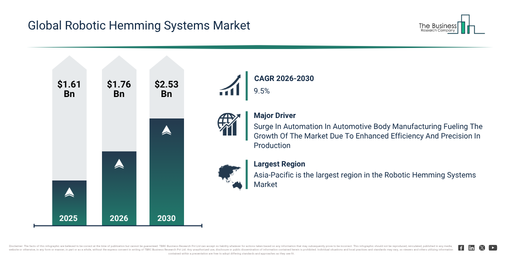
The robotic hemming systems market has demonstrated robust expansion in recent years. This market is projected to expand from $1.61 billion in 2025 to reach $1.76 billion in 2026, exhibiting a compound annual growth rate (CAGR) of 9.2%. Factors contributing to its historical growth include an increase in automotive production volumes, the use of manual and semi-automated hemming techniques, a growing need for uniform panel quality, the expansion of tier 1 supplier networks, and the establishment of new automotive OEM manufacturing facilities.
The robotic hemming systems market is projected to experience substantial expansion over the upcoming years. Its size is forecast to reach $2.53 billion by 2030, demonstrating a compound annual growth rate (CAGR) of 9.5%. This anticipated growth during the forecast period is primarily driven by factors such as the increasing implementation of fully robotic hemming lines, the greater uptake of AI-enabled process simulation, enhanced integration with Industry 4.0 systems, the broadening scope of electric vehicle manufacturing, and the escalating need for predictive maintenance and real-time quality surveillance. Key trends expected within this period encompass the increased use of roller and press hemming technologies, a rising need for robotic arms and sophisticated hemming tools, intensified integration of process simulation and quality monitoring software, the expansion of automated conveyor and control systems, and an elevated emphasis on training, installation, and technical support offerings.
Get A Free Sample Report With In-Depth Market Insights:
Robotic Hemming Systems Market Growth Drivers: What’s Behind The Acceleration?
The market for robotic hemming systems is anticipated to advance due to the increasing adoption of automation within automotive body manufacturing. This automation involves deploying machines and robotic solutions for tasks like body assembly, welding, and material handling, thereby minimizing human involvement. The expansion of automation in this sector is driven by its ability to boost efficiency, shorten production cycles, and reduce assembly errors. Robotic hemming systems contribute to this automation by accurately folding and joining metal panels, which in turn improves production speed, consistency, and overall assembly quality while lessening dependence on manual labor. For instance, according to the International Federation of Robotics (IFR), a Germany-based non-profit organization representing the global robotics industry, robot density in the United States increased from 285 units per 10,000 employees in 2022 to 295 units per 10,000 employees in 2023, as observed in November 2024, demonstrating a steady rise in industrial automation across manufacturing sectors. Consequently, the rising automation in automotive body manufacturing is a key factor propelling the growth of the robotic hemming systems market. The expansion of robotic hemming systems is expected to be propelled by increasing vehicle production volumes. These volumes represent the total number of vehicles produced over a specific timeframe, typically measured annually or quarterly. The rise in vehicle output is primarily fueled by increasing consumer demand, as a growing preference for personal and commercial vehicles stimulates greater manufacturing activity. Robotic hemming systems support this increase by automating the precise folding and joining of metal panels, which leads to quicker assembly, uniform quality, and greater throughput on production lines. For example, in August 2025, according to the Government of Canada, a Canada-based federal administration, revenues from automobile and light-duty motor vehicle manufacturing reached $60.0 billion in 2023, up from $45.0 billion in 2022, marking a 33.2% increase. Similarly, total industry revenues grew to $60.1 billion in 2023 from $45.1 billion in 2022. Therefore, expanding vehicle production volumes are a key factor driving the growth of the robotic hemming systems market.
Robotic Hemming Systems Market Segment Breakdown: Which Categories Lead On Revenue?
The robotic hemming systems market covered in this report is segmented –
1) By Component: Hardware, Software, Services
2) By Technology: Roller Hemming, Press Hemming, Tabletop Hemming, Other Technologies
3) By Application: Doors, Hoods And Deck Lids, Wheel Arches, Sunroofs And Panoramic Roofs
4) By End-User: Original Equipment Manufacturers (OEMs), Tier 1 Suppliers, Other End-Users
Subsegments:
1) By Hardware: Robotic Arms, Hemming Tools, Conveyor Systems, Control Units
2) By Software: Process Simulation Software, Programming And Control Software, Quality Monitoring Software, Maintenance Management Software
3) By Services: Installation Services, Training Services, Technical Support Services, Consulting Services
Robotic Hemming Systems Market Competitive Landscape: Who Leads The Industry?
Major companies operating in the robotic hemming systems market are Thyssenkrupp AG, ABB Ltd., Gestamp Automoción S.A., Kawasaki Heavy Industries, Ltd., Bosch Rexroth AG, Dürr AG, Yaskawa Electric Corporation, Stäubli International AG, ESTUN Automation, Tooling Systems Group, Affordable Robotic & Automation Limited (ARAPL), Nachi Robotics Systems, Fox Controls Pvt. Ltd., EBZ Gruppe, Doosan Robotics, Hyundai Robotics, Tünkers Maschinenbau GmbH, Encon Systems International, Modern Body Engineering, HIROTEC Group, EngRoTec-Solutions, Aevitas Automation And Robotics Technologies Pvt. Ltd.
View The Full Robotic Hemming Systems Market Report:
Robotic Hemming Systems Market Geographic Landscape: Which Region Leads Industry Growth?
Asia-Pacific was the largest region in the robotic hemming systems market in 2025. Asia-Pacific is expected to be the fastest-growing region in the forecast period. The regions covered in the robotic hemming systems market report are Asia-Pacific, South East Asia, Western Europe, Eastern Europe, North America, South America, Middle East, Africa.
Reach Out To Our Team:
The Business Research Company: https://www.thebusinessresearchcompany.com/
Americas: +1 310-496-7795
Asia: +44 7882 955267 & +91 8897263534
Europe: +44 7882 955267
Email us at: marketing@tbrc.info
Follow us on:
LinkedIn: https://in.linkedin.com/company/the-business-research-company
YouTube: https://www.youtube.com/channel/UC24_fI0rV8cR5DxlCpgmyFQ
Global Market Model: https://www.thebusinessresearchcompany.com/global-market-model

Wasay has over a decade of experience in market research, data modelling, and analytics, with prior experience at GlobalData and Decision Tree Consulting Services. At The Business Research Company , he leads research operations across syndicated studies, customized consulting engagements, and the Global Market Model platform. His professional experience includes supporting organizations such as Boston Consulting Group, KPMG, and Ernst & Young. Wasay holds a degree in Electronics and Communications Engineering, postgraduate management qualifications from International Management Institute Belgium and Indian School of Business and Entrepreneurship, and completed the Integrated Program in Business Analytics from Indian Institute of Management Indore.