
Built to provide research that’s more actionable and strategically valuable, The Business Research Company’s 2026 market reports include market attractiveness analysis, total addressable market sizing, company benchmarking matrices, interactive Excel dashboards, broader supply chain intelligence, emerging startup tracking, and in-depth product insights.
Robotic Kitting Systems Market Poised To Hit $4.44 Billion By 2030 With A 16.9% CAGR
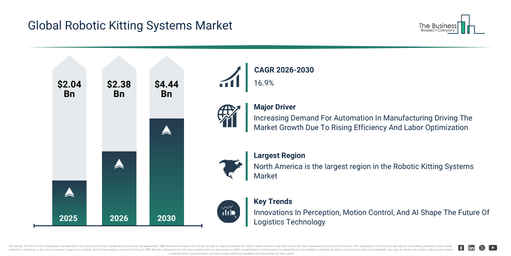
The robotic kitting systems market size has experienced rapid growth in recent years. It is anticipated to increase from $2.04 billion in 2025 to $2.38 billion in 2026, registering a compound annual growth rate (CAGR) of 16.6%. The expansion observed during the historic period stems from factors such as increasing automation in manufacturing, the adoption of robotic arms for assembly tasks, a rising demand for error reduction in kit assembly, escalating labor costs and efficiency imperatives, and the growth of warehousing and logistics operations.
The robotic kitting systems market size is anticipated to expand significantly in the coming years. It is projected to reach $4.44 billion by 2030, exhibiting a compound annual growth rate (CAGR) of 16.9%. This expansion over the forecast period is driven by factors such as the increasing implementation of AI-powered robotic systems, a rise in the uptake of vision and sensor-based picking solutions, growing demand for cloud-based fleet management software, the broadening of pre-assembly component grouping applications, and the escalating requirement for integrated maintenance and technical support services. Key developments expected during this period involve a greater embrace of robotic kitting in order fulfillment, an increasing call for vision-guided robotic arms, enhanced integration of simulation and optimization software, the extension of just-in-time (JIT) parts delivery solutions, and a heightened focus on tailored robotic kitting services.
Get A Free Sample Report With In-Depth Market Insights:
Robotic Kitting Systems Market Demand Drivers: What’s Powering Industry Growth?
The anticipated expansion of the robotic kitting systems market is largely driven by the rising need for automation within manufacturing industries. Automation in manufacturing refers to the deployment of machinery, robots, and computer-managed systems to execute production duties with minimal human involvement. A key factor contributing to this increasing demand is the scarcity of labor, compelling businesses to depend on automated setups to sustain operational efficiency and achieve production goals when skilled personnel are hard to find. By streamlining assembly and material handling, boosting precision and speed, and lessening the dependence on manual work, automation in manufacturing fuels the uptake of robotic kitting systems, allowing factories to function with greater efficiency and regularity. A notable example is provided by the International Federation of Robotics, a Germany-based non-profit organization, which reported that by September 2024, the worldwide operational stock of industrial robots in factories stood at 4,281,585 units, showing a 10% year-on-year growth. Furthermore, annual installations exceeded 500,000 units for the third year running, with Asia accounting for 70% of new robot deployments in 2023, followed by Europe at 17%, and the Americas at 10%. Consequently, the growing need for automation in manufacturing is a significant impetus behind the expansion of the robotic kitting systems market.
Robotic Kitting Systems Market Segment Analysis: What Are The Core Market Categories?
The robotic kitting systems market covered in this report is segmented –
1) By Component: Hardware, Software, Services
2) By Deployment: On-Premises, Cloud-Based
3) By Application: Assembly Line Kitting, Order Fulfillment Kitting, Just-In-Time (JIT) Parts Delivery, Pre-Assembly Component Grouping, Packaging Preparation
4) By End-User: Manufacturing, Logistics And Warehousing, Other End-Users
Subsegments:
1) By Hardware: Robotic Arms, End Effectors, Conveyor Systems, Vision And Sensor Systems, Control Panels And Interfaces
2) By Software: Robotic Programming Software, Fleet Management Software, Simulation And Optimization Tools, Vision Processing Software, Data Analytics And Reporting Tools
3) By Services: System Integration, Installation And Commissioning, Maintenance And Technical Support, Training And Consulting, Custom Application Development
Robotic Kitting Systems Market Innovation Trends: What Developments Are Reshaping The Industry?
Companies operating in the robotic kitting systems market are focusing on utilizing advanced technologies such as artificial intelligence (AI)-powered pick-and-place robots to automate and optimize the process of assembling kits. These AI-powered robots, employing AI, sensors, and robotic arms to precisely identify, pick, and place items, facilitate the automation of repetitive kitting tasks, reduce labor expenditures, and improve both efficiency and consistency. For example, in May 2023, OSARO Inc., a US-based robotics company, introduced the OSARO Robotic Kitting System, an AI-driven solution specifically designed to automate the assembly of subscription kits. This system incorporates modular hardware, including grippers, robot arms, and sensors, alongside adaptive learning algorithms, enabling it to manage frequent product changes and varying kit configurations. Its multidimensional perception and motion control allow for accurate pick-and-place of diverse items into boxes, resulting in lower labor costs and enhanced operational efficiency for e-commerce businesses and 3PL providers. The technology is also provided through a robotics-as-a-service (RaaS) model, which decreases upfront investment barriers and enables easy integration with autonomous mobile robots (AMRs) and other automation platforms.
Robotic Kitting Systems Market Competitive Landscape: Which Companies Lead The Industry?
Major companies operating in the robotic kitting systems market are Midea Group Co. Ltd., Schneider Electric SE, ABB Ltd., Omron Corporation, Stäubli International AG, GreyOrange Pte. Ltd., Abel Womack Inc., KC Robotics Inc., Tekpak Automation Ltd., Qubotix India Private Limited, Ready Systems Inc., Mecademic Inc., Covariant Inc., Kinemetrix Inc., Cybernetik Technologies Private Limited, Ambi Robotics Inc., Remtec Automation LLC, OSARO Inc., QComp Technologies Inc., THT Robotics Inc.
View The Full Robotic Kitting Systems Market Report:
Robotic Kitting Systems Market Regional Outlook: Where Is Opportunity Concentrated?
North America was the largest region in the robotic kitting systems market in 2025. Asia-Pacific is expected to be the fastest-growing region in the forecast period. The regions covered in the robotic kitting systems market report are Asia-Pacific, South East Asia, Western Europe, Eastern Europe, North America, South America, Middle East, Africa.
Reach Out To Our Team:
The Business Research Company: https://www.thebusinessresearchcompany.com/
Americas: +1 310-496-7795
Asia: +44 7882 955267 & +91 8897263534
Europe: +44 7882 955267
Email us at: marketing@tbrc.info
Follow us on:
LinkedIn: https://in.linkedin.com/company/the-business-research-company
YouTube: https://www.youtube.com/channel/UC24_fI0rV8cR5DxlCpgmyFQ
Global Market Model: https://www.thebusinessresearchcompany.com/global-market-model

Wasay has over a decade of experience in market research, data modelling, and analytics, with prior experience at GlobalData and Decision Tree Consulting Services. At The Business Research Company , he leads research operations across syndicated studies, customized consulting engagements, and the Global Market Model platform. His professional experience includes supporting organizations such as Boston Consulting Group, KPMG, and Ernst & Young. Wasay holds a degree in Electronics and Communications Engineering, postgraduate management qualifications from International Management Institute Belgium and Indian School of Business and Entrepreneurship, and completed the Integrated Program in Business Analytics from Indian Institute of Management Indore.