Built to provide research that’s more actionable and strategically valuable, The Business Research Company’s 2026 market reports include market attractiveness analysis, total addressable market sizing, company benchmarking matrices, interactive Excel dashboards, broader supply chain intelligence, emerging startup tracking, and in-depth product insights.
Automotive Market Growth Potential: How Will Market Size Shift Through 2030?
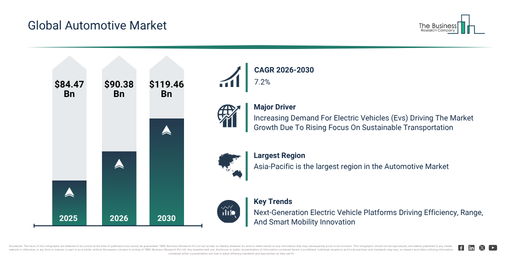
The automotive market has demonstrated strong growth in recent years. It is anticipated to increase from $84.47 billion in 2025 to $90.38 billion in 2026, at a compound annual growth rate (CAGR) of 7.0%. This historical expansion can be attributed to several factors including the rise of mass vehicle production systems, increasing global urbanization and the demand for mobility, more stringent fuel efficiency regulations, the expansion of automotive supply chains, and a growing consumer preference for personal transportation.
The automotive market is projected to experience substantial expansion over the coming years. This market is anticipated to reach $119.46 billion by the year 2030, demonstrating a compound annual growth rate (CAGR) of 7.2%. This projected growth can be attributed to several factors, including a rapid transition to electric and hybrid vehicles, increased integration of autonomous driving systems, a growing need for connected and software-defined vehicles, stricter emission and environmental standards, and the expansion of shared mobility and Mobility-as-a-Service models. Key trends anticipated during this period encompass the widespread adoption of software-defined vehicle architectures, the broadened integration of connected vehicle technologies and telematics, the proliferation of advanced driver assistance systems (ADAS), advancements in lightweight materials and sustainable manufacturing practices for vehicles, and ongoing innovation in EV battery technology and charging infrastructure.
Get A Free Sample Report With In-Depth Market Insights:
Automotive Market Demand Drivers Opening New Revenue Streams
The automotive market is anticipated to expand, driven by the escalating demand for electric vehicles (EVs). Electric vehicles are defined as those powered either entirely or partially by electricity, storing energy in rechargeable batteries rather than relying on traditional internal combustion engines. This heightened demand for EVs is a direct result of growing environmental concerns and the global push to decrease greenhouse gas emissions, encouraging individuals and governments alike to choose cleaner, more sustainable transportation methods. The increasing demand for electric vehicles also sparks innovation, elevates the production of advanced vehicle technologies, and accelerates the transition within the automotive industry from conventional combustion engine vehicles to more sustainable and energy-efficient mobility solutions. For instance, in January 2025, according to Cox Automotive, a US-based system software company, electric vehicle sales reached a total of 1.3 million units, representing a 7.3% increase over the revised figures for 2023. Consequently, the rising demand for electric vehicles is propelling the growth of the automotive market.
Automotive Market Segmentation: How Does The Market Break Down By Category?
The automotive market covered in this report is segmented –
1) By Vehicle Type: Passenger Vehicles, Commercial Vehicles, Electric Vehicles, Two-Wheelers, Three-Wheelers
2) By Fuel Type: Petrol, Diesel, Electric, Hybrid
3) By Component: Engine And Powertrain, Electrical And Electronics, Interior Components, Exterior Components
4) By Distribution Channel: Original Equipment Manufacturer (OEM), Aftermarket
5) By Application: Personal, Commercial, Industrial, Other Applications
Subsegments:
1) By Passenger Vehicles: Hatchback Vehicles, Sedan Vehicles, Sport Utility Vehicles, Multi Purpose Vehicles
2) By Commercial Vehicles: Light Commercial Vehicles, Medium Commercial Vehicles, Heavy Commercial Vehicles, Buses And Coaches, Pickup Trucks
3) By Electric Vehicles: Battery Electric Vehicles, Plug In Hybrid Electric Vehicles, Hybrid Electric Vehicles, Fuel Cell Electric Vehicles
4) By Three-Wheelers: Passenger Three Wheelers, Cargo Three Wheelers, Electric Three Wheelers, Hybrid Three Wheelers
5) By Two-Wheelers: Motorcycles, Scooters, Mopeds, Electric Two Wheelers, Sports Two Wheelers
Automotive Market Trends Powering Strategic Industry Growth
Major automotive companies are concentrating on developing innovative platforms, such as next-generation electric vehicle (EV) architectures, to enhance vehicle efficiency, extend driving range, reduce emissions, and support advanced connected and autonomous driving technologies. These next-generation EV architectures are sophisticated vehicle platforms that integrate battery systems, electric drivetrains, and software-controlled electronic systems into a cohesive structure. This integration helps improve energy efficiency, increase driving range, decrease emissions, facilitate faster charging, and enable advanced connectivity and autonomous driving features. For example, in January 2026, BMW Group, a Germany-based automotive manufacturing company, launched the BMW iX3 at CES 2026, introducing a next-generation electric SUV designed to showcase advanced mobility innovation. The BMW iX3 is built upon an advanced electric vehicle architecture that incorporates high-efficiency battery systems and optimized electric drivetrains to boost its driving range and performance. It features a software-defined cockpit with AI-enabled user interaction, allowing real-time personalization of driving and infotainment settings through over-the-air updates. The model also integrates advanced driver-assistance technologies aimed at improving safety, including enhanced sensor fusion and semi-autonomous driving capabilities. Furthermore, it emphasizes sustainability through improved energy efficiency, lightweight materials, and reduced lifecycle emissions when compared to conventional internal combustion engine vehicles.
Automotive Market Top Companies Driving Competitive Growth
Major companies operating in the automotive market are Volkswagen Aktiengesellschaft; Toyota Motor Corporation; Stellantis N.V.; Ford Motor Company; General Motors Company; Bayerische Motoren Werke Aktiengesellschaft; Mercedes-Benz Group AG; Honda Motor Co. Ltd.; Hyundai Motor Company; BYD Company Limited; SAIC Motor Corporation Limited; Tesla Inc.; Nissan Motor Co. Ltd.; China FAW Group Co. Ltd.; Renault S.A.; Tata Motors Limited; Suzuki Motor Corporation; Mazda Motor Corporation; Subaru Corporation; Geely Automobile Holdings Limited; Mitsubishi Motors Corporation; Ferrari N.V.
View The Full Automotive Market Report:
Automotive Market Global Footprint: Which Region Leads The Industry?
Asia-Pacific was the largest region in the automotive market in 2025. Asia-Pacific is expected to be the fastest-growing region in the forecast period. The regions covered in the automotive market report are Asia-Pacific, South East Asia, Western Europe, Eastern Europe, North America, South America, Middle East, Africa.
Reach Out To Our Team:
The Business Research Company: https://www.thebusinessresearchcompany.com/
Americas: +1 310-496-7795
Asia: +44 7882 955267 & +91 8897263534
Europe: +44 7882 955267
Email us at: marketing@tbrc.info
Follow us on:
LinkedIn: https://in.linkedin.com/company/the-business-research-company
YouTube: https://www.youtube.com/channel/UC24_fI0rV8cR5DxlCpgmyFQ
Global Market Model: https://www.thebusinessresearchcompany.com/global-market-model

Wasay has over a decade of experience in market research, data modelling, and analytics, with prior experience at GlobalData and Decision Tree Consulting Services. At The Business Research Company , he leads research operations across syndicated studies, customized consulting engagements, and the Global Market Model platform. His professional experience includes supporting organizations such as Boston Consulting Group, KPMG, and Ernst & Young. Wasay holds a degree in Electronics and Communications Engineering, postgraduate management qualifications from International Management Institute Belgium and Indian School of Business and Entrepreneurship, and completed the Integrated Program in Business Analytics from Indian Institute of Management Indore.