Featuring market attractiveness scoring, total addressable market sizing, company benchmarking matrices, interactive Excel dashboards, deeper supply chain intelligence, emerging startup tracking, and granular product-level insights, The Business Research Company’s 2026 market reports are built to deliver research that is both more actionable and more strategically valuable.
Automated Optical Inspection Market Growth From $2.06 Billion In 2026 To $4.46 Billion By 2030 At A CAGR Of 21.3%
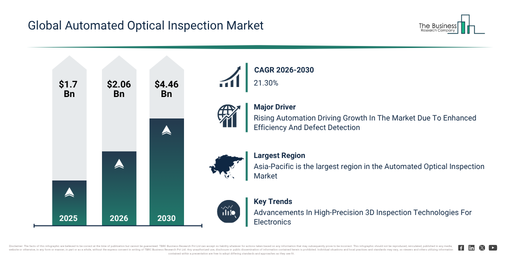
The automated optical inspection market has experienced rapid expansion over recent years. It is projected to grow from $1.7 billion in 2025 to $2.06 billion in 2026, achieving a compound annual growth rate (CAGR) of 21.0%. Historically, this expansion can be attributed to several factors including increasing PCB production volumes, the rising complexity of electronic assemblies, a strong demand for improved product quality and reliability, the significant shift from manual to automated inspection techniques, and the general growth observed in consumer electronics manufacturing.
The automated optical inspection market is projected to experience substantial growth in the upcoming years. Its valuation is anticipated to reach $4. 46 billion by 2030, progressing at a compound annual growth rate (CAGR) of 21. 3%. This expansion during the forecast timeframe is primarily driven by factors such as the increasing adoption of 3D and hybrid AOI technologies, escalating demand originating from electric vehicle electronics, the expansion of semiconductor packaging inspection processes, a growing necessity for real-time quality monitoring, and the integration of AOI into smart factory systems. Key trends expected within the forecast period encompass a rising demand for high-speed PCB inspection systems, the miniaturization of electronic components which necessitates greater inspection precision, the increasing uptake of 3D AOI systems for inspecting complex assemblies, a heightened focus on achieving zero-defect manufacturing standards, and the incorporation of multi-angle imaging to improve defect detection capabilities.
Get A Free Sample Report With In-Depth Market Insights:
Automated Optical Inspection Market Expansion Drivers: What’s Shaping Future Growth?
The expanding need for automation is projected to fuel the advancement of the automated optical inspection market in the future. Automation involves employing machines, computers, or various technologies to execute tasks with little to no human involvement. The adoption of automation is growing to minimize human mistakes by guaranteeing consistent and dependable task execution. Automated optical inspection supports automation by swiftly and precisely examining products for flaws, thereby cutting down on manual checks and maintaining uniform quality throughout manufacturing. For example, in April 2024, data from the International Federation of Robotics, an international organization headquartered in Germany, indicated a substantial surge in automation initiatives by manufacturing firms in the United States, evidenced by a 12% increase in total industrial robot installations, reaching 44,303 units in 2023. Consequently, the increasing requirement for automation is stimulating the expansion of the automated optical inspection market.
Automated Optical Inspection Market Segmentation And Category Overview
The automated optical inspection market covered in this report is segmented –
1) By Component: Hardware, Software, Services
2) By Technology: Inline Automated Optical Inspection, Offline Automated Optical Inspection
3) By Application: Printed Circuit Board Inspection, Flat Panel Display Inspection, Integrated Circuit Substrate Inspection, Other Applications
4) By Industry Vertical: Consumer Electronics, Automotive, Industrial, Medical Devices, Aerospace And Defense, Other Industry Verticals
Subsegments:
1) By Hardware: Area Scan Cameras, Line Scan Cameras, High Resolution Sensors
2) By Software: Anomaly Detection Modules, Image Acquisition Software, Image Processing Libraries
3) By Services: System Commissioning, Hardware Setup And Calibration, Software Configuration
Automated Optical Inspection Market Strategic Trends: What Defines The Next Growth Phase?
Major companies within the automated optical inspection market are channeling their efforts into developing advanced solutions, including high-resolution hybrid 3D automated optical inspection systems. These systems aim to enable the accurate, high-speed, and reliable detection of defects in complex electronic assemblies by utilizing sophisticated imaging and measurement technologies. High-resolution hybrid 3D automated optical inspection systems are defined as inspection solutions that integrate multi-directional projection, laser scanning, and advanced image processing to construct accurate three-dimensional models of electronic components, thereby enhancing defect detection and quality assurance. As an illustration, in January 2024, Yamaha Motor Co. Ltd., a Japan-based manufacturing firm, launched the YRi-V TypeHS 3D automated optical inspection system, tailored for electronic component mounting factories. This cutting-edge system offers high-speed and high-precision inspection capabilities, featuring a 25-megapixel high-resolution camera for superior image clarity, advanced CPU and GPU processing to accelerate data analysis, and a hybrid 3D inspection method combining an 8-direction projector with a line laser to accurately identify both reflective and ultra-small components, rendering it suitable for next-generation electronics manufacturing environments.
Automated Optical Inspection Market Competitive Landscape: Which Companies Lead The Industry?
Major companies operating in the automated optical inspection market are Yamaha Motor Co. Ltd., Nordson Corporation, Chroma ATE Inc., Mycronic Group, Camtek Ltd., NVIDIA Corp., Koh Young Technology Inc., Takano Co Ltd., ViTrox Corporation Berhad, Test Research Inc., Viscom AG, Saki Corporation, Parmi Co Ltd., GÖPEL Electronic GmbH, ZhenHuaXing Technology (Shenzhen) Co. Ltd., JUTZE Intelligence Technology Co Ltd., Machine Vision Products, Utechzone Co Ltd., Pemtron Corporation, Jet Technology Co. Ltd., Mirtec Co. Ltd., Marantz Electronics, Omron Corporation, AOI Systems Ltd., Smart Vision Co Ltd.
View The Full Automated Optical Inspection Market Report:
Automated Optical Inspection Market Regional Outlook: Where Is Opportunity Concentrated?
Asia-Pacific was the largest region in the automated optical inspection market in 2025. North America is expected to be the fastest-growing region in the forecast period. The regions covered in the automated optical inspection market report are Asia-Pacific, South East Asia, Western Europe, Eastern Europe, North America, South America, Middle East and Africa.
Reach Out To Our Team:
The Business Research Company: https://www.thebusinessresearchcompany.com/
Americas: +1 310-496-7795
Asia: +44 7882 955267 & +91 8897263534
Europe: +44 7882 955267
Email us at: marketing@tbrc.info
Follow us on:
LinkedIn: https://in.linkedin.com/company/the-business-research-company
YouTube: https://www.youtube.com/channel/UC24_fI0rV8cR5DxlCpgmyFQ
Global Market Model: https://www.thebusinessresearchcompany.com/global-market-model

Wasay has over a decade of experience in market research, data modelling, and analytics, with prior experience at GlobalData and Decision Tree Consulting Services. At The Business Research Company , he leads research operations across syndicated studies, customized consulting engagements, and the Global Market Model platform. His professional experience includes supporting organizations such as Boston Consulting Group, KPMG, and Ernst & Young. Wasay holds a degree in Electronics and Communications Engineering, postgraduate management qualifications from International Management Institute Belgium and Indian School of Business and Entrepreneurship, and completed the Integrated Program in Business Analytics from Indian Institute of Management Indore.