Backed by market attractiveness analysis, total addressable market sizing, company benchmarking matrices, interactive Excel dashboards, wider supply chain intelligence, emerging startup coverage, and detailed product-level insights, The Business Research Company’s 2026 market reports are designed to offer research that is more actionable and strategically valuable than ever.
Dynamic Flight Gate Allocation Market Revenue Outlook: What CAGR Lies Ahead Through 2030?
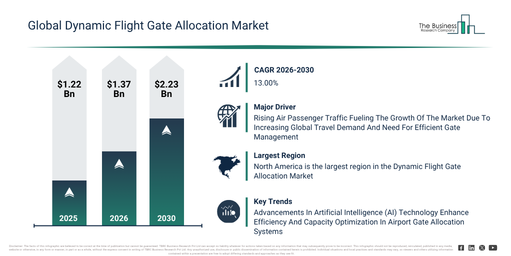
The dynamic flight gate allocation market size has experienced swift expansion in recent years. This market is projected to expand from $1.22 billion in 2025 to reach $1.37 billion in 2026, demonstrating a compound annual growth rate (CAGR) of 12.7%. Historically, this expansion stemmed from factors such as reliance on manual gate allocation, insufficient integration of airport operational systems, minimal use of real-time passenger flow analytics, a reactive approach to managing flight delays and disruptions, and unoptimized basic flight information display systems.
The dynamic flight gate allocation market is projected to witness significant expansion in the next few years, reaching $2.23 billion by 2030 with a compound annual growth rate (CAGR) of 13.0%. This growth during the forecast period is fueled by an increase in air passenger traffic, the rising implementation of AI-based airport optimization systems, a surge in smart airport infrastructure investments, the escalating demand for real-time operational decision support systems, and a greater necessity for solutions that reduce turnaround times efficiently. Key trends expected in this period include real-time predictive gate assignment utilizing AI-driven operational analytics, the expansion of collaborative gate pooling systems across major airports, a growing adoption of cloud-based airport operations management platforms, the integration of passenger flow analytics for improved gate optimization, and the deployment of disruption-aware dynamic reallocation systems to manage flight delays.
Get A Free Sample Report With In-Depth Market Insights:
Dynamic Flight Gate Allocation Market Demand Drivers: What’s Powering Industry Growth?
The increasing volume of air passengers is projected to drive the expansion of the dynamic flight gate allocation market in the future. This metric denotes the aggregate count of individuals utilizing scheduled air services across various routes within a specific timeframe, indicating the comprehensive demand for air travel. The growth in air passenger volume is largely attributable to more accessible air travel costs, with reduced ticket prices and the proliferation of budget airlines allowing a wider demographic to undertake flights more often for both professional and recreational reasons. Dynamic flight gate allocation facilitates the management of increasing air passenger traffic by effectively assigning gates instantaneously, thereby reducing bottlenecks and ensuring an uninterrupted movement of passengers across the airport. For example, data from January 2025, provided by the International Air Transport Association, a Canada-based trade group, revealed that in 2024, global international air passenger traffic saw a 13.6% year-on-year increase, while capacity expanded by 12.8%. Consequently, the escalating volume of air passengers is a key factor propelling the development of the dynamic flight gate allocation market.
Dynamic Flight Gate Allocation Market Breakdown By Product Type And Application
The dynamic flight gate allocation market covered in this report is segmented –
1) By Component: Software, Hardware, Services
2) By Functionality: Real Time Dynamic Gate Assignment, Collaborative Gate Pooling Models, Predictive And Scenario Based Gate Optimization
3) By Deployment Mode: On-Premises, Cloud-Based
4) By Application: Airports, Airlines, Ground Handling Companies, Other Applications
5) By End-User: International Airports, Domestic Airports, Regional Airports
Subsegments:
1) By Software: Gate Allocation Software, Optimization And Scheduling Software, Airport Operations Management Software, Decision Support Software, Analytics And Reporting Software
2) By Hardware: Servers And Data Storage Systems, Networking And Communication Equipment, Display And Monitoring Systems, Sensors And Tracking Devices, Control And Interface Devices
3) By Services: Consulting And Advisory Services, System Integration Services, Deployment And Implementation Services, Maintenance And Support Services, Training And Education Services
Dynamic Flight Gate Allocation Market Innovation Trends: What Developments Are Reshaping The Industry?
Major companies operating in the dynamic flight gate allocation market are concentrating on creating advanced solutions, such as systems for stand and gate optimization, to elevate airport capacity utilization, decrease turnaround durations, and boost operational effectiveness. Stand and gate optimization describes an intelligent system that employs real-time data and AI-driven analytics to allocate aircraft stands and gates fluidly, ensuring peak resource utilization and minimizing hold-ups. As an illustration, in March 2026, Assaia International AG, an aviation technology firm based in Switzerland, unveiled StandManager, a resource management system (RMS) designed to streamline stand and gate allocation. This platform continuously examines live operational information to automate stand planning, compute predictive buffers for individual flights, and dynamically modify allocations when flight timetables change. When integrated with Assaia’s ApronAI platform, the solution directly connects real-time aircraft turnaround performance, towing status, and delay forecasts to stand allocation, allowing airports to augment effective stand capacity by as much as 5% without needing additional infrastructure.
Dynamic Flight Gate Allocation Market Top Companies Driving Competitive Growth
Major companies operating in the dynamic flight gate allocation market are Amadeus IT Group S. A., PDC A/S, SITA International AG, ADB SAFEGATE B. V., ARC Cast, INFORM GmbH, Cirium Limited, OAG Aviation Worldwide Limited, Assaia International AG, Veovo Group Limited, Veoci Inc., AeroCloud Systems Limited, Airport Research Center GmbH, Damarel Systems International Limited, Zamar Aero Solutions Private Limited, Copenhagen Optimization A/S, RESA Airport Data Systems LLC, Beontra GmbH, ProDIGIQ Inc., TADERA Inc.
View The Full Dynamic Flight Gate Allocation Market Report:
Dynamic Flight Gate Allocation Market Global Footprint: Which Region Leads The Market?
North America was the largest region in the dynamic flight gate allocation market in 2025. Asia-Pacific is expected to be the fastest-growing region in the forecast period. The regions covered in the dynamic flight gate allocation market report are Asia-Pacific, South East Asia, Western Europe, Eastern Europe, North America, South America, Middle East and Africa.
Reach Out To Our Team:
The Business Research Company: https://www.thebusinessresearchcompany.com/
Americas: +1 310-496-7795
Asia: +44 7882 955267 & +91 8897263534
Europe: +44 7882 955267
Email us at: marketing@tbrc.info
Follow us on:
LinkedIn: https://in.linkedin.com/company/the-business-research-company
YouTube: https://www.youtube.com/channel/UC24_fI0rV8cR5DxlCpgmyFQ
Global Market Model: https://www.thebusinessresearchcompany.com/global-market-model

Wasay has over a decade of experience in market research, data modelling, and analytics, with prior experience at GlobalData and Decision Tree Consulting Services. At The Business Research Company , he leads research operations across syndicated studies, customized consulting engagements, and the Global Market Model platform. His professional experience includes supporting organizations such as Boston Consulting Group, KPMG, and Ernst & Young. Wasay holds a degree in Electronics and Communications Engineering, postgraduate management qualifications from International Management Institute Belgium and Indian School of Business and Entrepreneurship, and completed the Integrated Program in Business Analytics from Indian Institute of Management Indore.