Backed by market attractiveness analysis, total addressable market sizing, company benchmarking matrices, interactive Excel dashboards, wider supply chain intelligence, emerging startup coverage, and detailed product-level insights, The Business Research Company’s 2026 market reports are designed to offer research that is more actionable and strategically valuable than ever.
Home Computing And Networking Market Growth Analysis: How Will Revenue Trend Over The Forecast Period?
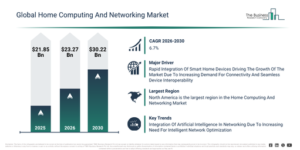
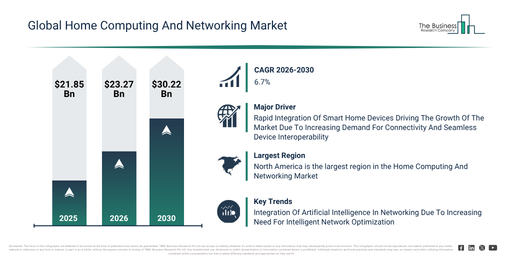
The home computing and networking market has experienced robust expansion in recent years. Its value is expected to rise from $21.85 billion in 2025 to $23.27 billion in 2026, demonstrating a compound annual growth rate (CAGR) of 6.5%. This historical increase can be ascribed to factors such as the heightened penetration of broadband internet, the growing acquisition of personal computers and laptops, the rise of home Wi-Fi routers and wireless access points, the broadened adoption of remote work, and the advent of smart home device usage.
The home computing and networking market is projected to experience substantial expansion in the coming years. This market is anticipated to reach a valuation of $30.22 billion by 2030, demonstrating a compound annual growth rate (CAGR) of 6.7%. Several factors are driving this growth during the forecast period, including the increasing need for high-speed, low-latency connectivity, the deeper integration of IoT-enabled home environments, heightened cybersecurity concerns within home networks, the widespread adoption of hybrid work and learning setups, and the evolution of AI-powered network optimization tools. Key trends expected during this period encompass the broader deployment of mesh Wi-Fi and comprehensive home connectivity, the increasing use of edge computing in domestic networks, improved interoperability and integration among smart home devices, the expansion of cloud-based personal storage and backup services, and advanced cybersecurity and home network protection offerings.
Get A Free Sample Report With In-Depth Market Insights:
Home Computing And Networking Market Industry Drivers: What’s Behind The Revenue Growth?
Increasing integration of smart home devices is anticipated to drive expansion in the home computing and networking market. These devices are electronic tools created to automate, oversee, or manage domestic activities by leveraging internet connectivity, sensors, and software, frequently enabling users to operate their residences remotely via smartphones or vocal commands. The heightened adoption of smart home devices stems from a greater need for convenience and automation in everyday household tasks, as people choose technologies that streamline chores and enhance efficiency. Home computing and networking facilitate this integration by supplying robust connectivity infrastructure, essential networking hardware, and effective data management systems, ensuring smooth communication between various linked devices. For example, a survey conducted in May 2025 by American Home Shield, a US-based home services organization, involving 1,006 homeowners and renters throughout the US, revealed that around 93% of Americans possessed at least one smart home device, and 42% stated that the majority of their household electronics were smart, highlighting significant adoption and growing integration of these connected technologies. Consequently, the expanding integration of smart home devices is propelling the growth within the home computing and networking market.
Home Computing And Networking Market Segmentation And Category Overview
The home computing and networking market covered in this report is segmented –
1) By Service Type: Broadband Connectivity Integration Services, Router And Modem Configuration Services, Smart Home Connectivity Services, Cloud Based Storage Services, Device Installation And Setup Services, Maintenance And Support Services
2) By Component: Desktop Computers, Laptops, Wi-Fi Routers, Modems And Gateways, Switches And Hubs, Network Adapters, Range Extenders, Smart Hubs, Network Storage Devices
3) By Connectivity Type: Wired Networking, Wireless Networking
4) By Application: Content Consumption, Remote Work, Online Communication, Smart Home Integration
5) By End-User: Residential Consumers, Home-based Businesses
Subsegments:
1) By Broadband Connectivity Integration Services: Fiber Optic Connectivity Integration, Digital Subscriber Line Integration, Cable Internet Integration, Satellite Internet Integration, Hybrid Network Integration
2) By Router And Modem Configuration Services: Router Installation And Setup, Modem Installation And Setup, Network Security Configuration, Bandwidth Optimization Configuration, Firmware Update And Management
3) By Smart Home Connectivity Services: Smart Device Integration, Home Automation Setup, Voice Assistant Integration, Security System Connectivity, Internet Of Things Device Management
4) By Cloud Based Storage Services: Personal Cloud Storage, Data Backup And Recovery Services, File Synchronization Services, Media Storage And Streaming Services, Secure Document Storage
5) By Device Installation And Setup Services: Computer And Laptop Installation, Peripheral Device Setup, Smart Device Installation, Network Device Installation, Software Installation And Configuration
6) By Maintenance And Support Services: Remote Technical Support, On Site Maintenance Services, Network Monitoring Services, Troubleshooting And Repair Services, System Upgrade And Update Services
#Home Computing And Networking Market Growth Trends: What’s Shaping The Future Outlook?
Leading companies in the home computing and networking market are increasingly integrating artificial intelligence-powered mesh networking systems to enhance network performance and elevate the overall user experience. These advanced networking solutions leverage machine learning algorithms and real-time data analytics to automatically optimize network operations, efficiently allocate bandwidth, detect potential security threats, and ensure seamless connectivity across multiple devices within a home environment. For instance, in September 2023, NETGEAR, a US-based networking hardware company, introduced the Orbi 970 series, a next-generation mesh networking system designed to deliver high-performance connectivity for modern smart homes. This system incorporates quad-band technology with a dedicated high-capacity backhaul to optimize data transmission, supports speeds of up to 27 gigabits per second, and enables connectivity for up to 200 devices, facilitating efficient and intelligent network management. Its design provides comprehensive 360-degree coverage across residential spaces, including multi-level homes, and is expandable through additional satellite units to accommodate growing network demands.
Home Computing And Networking Market Company Landscape And Competitive Strategy
Major companies operating in the home computing and networking market are Apple Inc.; Microsoft Corporation; Dell Technologies Inc.; Panasonic Corporation; Cisco Systems Inc.; Lenovo Group Limited; Intel Corporation; HP Inc.; Fujitsu Limited; Advanced Micro Devices Inc.; Western Digital Corporation; Acer Inc.; Seagate Technology Holdings plc; Juniper Networks Inc.; Ubiquiti Inc.; Razer Inc.; TP-Link Technologies Co. Ltd.; Teltonika Networks; Netgear Inc.; Linksys Holdings Inc.; MikroTik Ltd; Synology Inc.; D-Link Corporation; EnGenius Technologies Inc.; Tenda Technology; Buffalo Technology Inc.; AirLive; QNAP Systems Inc.
View The Full Home Computing And Networking Market Report:
Home Computing And Networking Market Largest Region: Which Geography Holds The Biggest Share?
North America was the largest region in the home computing and networking market in 2025. Asia-Pacific is expected to be the fastest-growing region in the forecast period. The regions covered in the home computing and networking market report are Asia-Pacific, South East Asia, Western Europe, Eastern Europe, North America, South America, Middle East, Africa.
Reach Out To Our Team:
The Business Research Company: https://www.thebusinessresearchcompany.com/
Americas: +1 310-496-7795
Asia: +44 7882 955267 & +91 8897263534
Europe: +44 7882 955267
Email us at: marketing@tbrc.info
Follow us on:
LinkedIn: https://in.linkedin.com/company/the-business-research-company
YouTube: https://www.youtube.com/channel/UC24_fI0rV8cR5DxlCpgmyFQ
Global Market Model: https://www.thebusinessresearchcompany.com/global-market-model

Wasay has over a decade of experience in market research, data modelling, and analytics, with prior experience at GlobalData and Decision Tree Consulting Services. At The Business Research Company , he leads research operations across syndicated studies, customized consulting engagements, and the Global Market Model platform. His professional experience includes supporting organizations such as Boston Consulting Group, KPMG, and Ernst & Young. Wasay holds a degree in Electronics and Communications Engineering, postgraduate management qualifications from International Management Institute Belgium and Indian School of Business and Entrepreneurship, and completed the Integrated Program in Business Analytics from Indian Institute of Management Indore.