Backed by market attractiveness analysis, total addressable market sizing, company benchmarking matrices, interactive Excel dashboards, wider supply chain intelligence, emerging startup coverage, and detailed product-level insights, The Business Research Company’s 2026 market reports are designed to offer research that is more actionable and strategically valuable than ever.
Integrated Photonics Market Size Outlook: How Quickly Will Revenue Expand Through 2030?
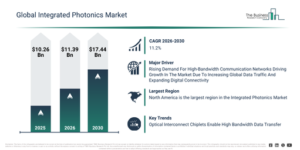
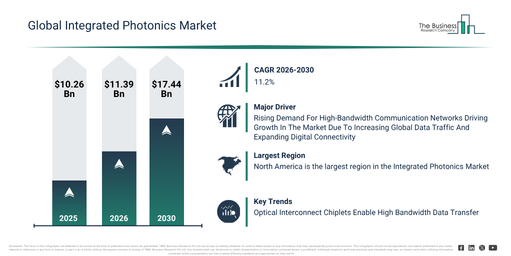
The integrated photonics market has experienced substantial expansion in recent years. It is projected to increase from $10.26 billion in 2025 to $11.39 billion in 2026 at a compound annual growth rate (CAGR) of 11.0%. Historically, this expansion has been driven by factors such as the need for increased bandwidth in communication systems, the proliferation of fiber optic networks, constraints in the scaling of electronic chip performance, rising data center traffic volumes, and initial interest in silicon photonics research.
The integrated photonics market is projected to experience substantial expansion in the coming years. This market is anticipated to reach a valuation of $17.44 billion by 2030, exhibiting a compound annual growth rate (CAGR) of 11.2%. Factors contributing to this anticipated growth include the dramatic rise in data traffic driven by AI workloads, the global proliferation of hyperscale data centers, a growing need for energy-efficient computing designs, the wider adoption of quantum communication setups, and progress in integrated photonic fabrication methods. Key developments expected during this timeframe involve the accelerated integration of silicon photonics, the use of co-packaged optics for scaling data centers, heterogeneous integration in photonic chip development, significant strides in quantum photonic computing, and the deployment of high-speed optical interconnects.
Get A Free Sample Report With In-Depth Market Insights:
Integrated Photonics Market Growth Momentum: What Factors Are Shaping Demand?
The increasing need for high bandwidth communication networks is projected to drive the expansion of the integrated photonics market in the future. These networks are advanced digital communication infrastructures designed to facilitate the rapid transmission of substantial data volumes across both optical and telecommunication networks. The rising demand for high bandwidth communication stems from data-intensive applications, such as cloud computing and video streaming, which necessitate quick and extensive data transfer. High bandwidth communication networks bolster integrated photonics by allowing for ultra-fast data transmission, enhanced signal processing, and effective optical connectivity within high-capacity communication systems. For example, the International Telecommunication Union, a Switzerland-based telecommunications agency, reported that mobile broadband data traffic was approximately 1 zettabyte in 2023 and grew to 1.3 zettabytes in 2024. Consequently, the expanding need for high bandwidth communication networks is a significant factor propelling the growth of the integrated photonics market.
Integrated Photonics Market Breakdown By Product Type And Application
The integrated photonics market covered in this report is segmented –
1) By Component: Lasers, Modulators, Photodetectors, Multiplexers And Demultiplexers, Optical Amplifiers, Waveguides, Optical Transceivers
2) By Material Platform: Silicon Photonics, Indium Phosphide, Silicon Nitride, Gallium Arsenide, Lithium Niobate
3) By Integration Type: Monolithic Integration, Hybrid Integration, Heterogeneous Integration
4) By Application: Optical Communications, Data Centers And High Performance Computing, Sensing And Imaging, Biomedical Applications, Quantum Computing, Optical Signal Processing
5) By End User Industry: Telecommunications, Information Technology And Data Centers, Healthcare And Life Sciences, Aerospace And Defense, Automotive, Consumer Electronics
Subsegments:
1) By Lasers: Semiconductor Lasers, Fiber Lasers, Solid State Lasers, Quantum Cascade Lasers, Distributed Feedback Lasers, Vertical Cavity Surface Emitting Lasers
2) By Modulators: Electro Optic Modulators, Electro Absorption Modulators, Mach Zehnder Modulators, Thermo Optic Modulators, Acousto Optic Modulators
3) By Photodetectors: P Type Intrinsic N-Type Photodetectors, Avalanche Photodetectors, Metal Semiconductor Metal Photodetectors, Schottky Photodetectors, Quantum Well Photodetectors
4) By Multiplexers And Demultiplexers: Arrayed Waveguide Grating Multiplexers, Thin Film Multiplexers, Fiber Bragg Grating Multiplexers, Planar Lightwave Circuit Multiplexers, Optical Interleaver Multiplexers
5) By Optical Amplifiers: Erbium Doped Fiber Amplifiers, Semiconductor Optical Amplifiers, Raman Optical Amplifiers, Parametric Optical Amplifiers
6) By Waveguides: Planar Waveguides, Channel Waveguides, Rib Waveguides, Strip Waveguides, Slot Waveguides
7) By Optical Transceivers: Single Mode Optical Transceivers, Multi Mode Optical Transceivers, Coherent Optical Transceivers, Pluggable Optical Transceivers, On Board Optical Transceivers
Integrated Photonics Market Trends Redefining Industry Growth
Leading companies in the integrated photonics market are concentrating on developing advanced products, such as optical interconnect chiplets featuring standardized electrical interfaces. The goal is to enhance bandwidth, improve energy efficiency, and minimize latency and data bottlenecks in AI workloads. These optical interconnect chiplets with standardized electrical interfaces are modular chips designed to utilize optical signals for rapid data transfer while connecting through standard electrical interfaces. For instance, in March 2025, Ayar Labs, a US-based optical interconnect technology company, introduced its TeraPHY optical I/O chiplet with UCIe interface. This chiplet provides up to 8 Tbps bandwidth, integrates silicon photonics with CMOS manufacturing processes, and employs a 16-wavelength SuperNova light source to facilitate high-speed optical data transmission, simultaneously reducing latency and power consumption. These innovations propel scalable photonic connectivity for forthcoming computing and communication systems.
Integrated Photonics Market Leading Players And Competitive Positioning
Major companies operating in the integrated photonics market are International Business Machines Corporation; NVIDIA Corporation; Cisco Systems Inc.; Intel Corporation; Broadcom Inc.; Hewlett Packard Enterprise Company; Nokia Corporation; nLIGHT Inc.; Coherent Corp.; Rockley Photonics; Ciena Corporation; Fabrinet; Lumentum Holdings Inc.; Jenoptik AG; IPG Photonics Corporation; Applied Optoelectronics Inc.; EMCORE Corporation; Photonics Industries International Inc.; Effect Photonics B.V.; Ayar Labs Inc.; OpenLight Photonics Inc.; Gooch & Housego plc; Ligentec SA
View The Full Integrated Photonics Market Report:
Integrated Photonics Market Regional Split: Which Areas Are Fueling Growth?
North America was the largest region in the integrated photonics market in 2025. Asia-Pacific is expected to be the fastest-growing region in the forecast period. The regions covered in the integrated photonics market report are Asia-Pacific, South East Asia, Western Europe, Eastern Europe, North America, South America, Middle East, Africa.
Reach Out To Our Team:
The Business Research Company: https://www.thebusinessresearchcompany.com/
Americas: +1 310-496-7795
Asia: +44 7882 955267 & +91 8897263534
Europe: +44 7882 955267
Email us at: marketing@tbrc.info
Follow us on:
LinkedIn: https://in.linkedin.com/company/the-business-research-company
YouTube: https://www.youtube.com/channel/UC24_fI0rV8cR5DxlCpgmyFQ
Global Market Model: https://www.thebusinessresearchcompany.com/global-market-model

Wasay has over a decade of experience in market research, data modelling, and analytics, with prior experience at GlobalData and Decision Tree Consulting Services. At The Business Research Company , he leads research operations across syndicated studies, customized consulting engagements, and the Global Market Model platform. His professional experience includes supporting organizations such as Boston Consulting Group, KPMG, and Ernst & Young. Wasay holds a degree in Electronics and Communications Engineering, postgraduate management qualifications from International Management Institute Belgium and Indian School of Business and Entrepreneurship, and completed the Integrated Program in Business Analytics from Indian Institute of Management Indore.