Featuring market attractiveness scoring, total addressable market sizing, company benchmarking matrices, interactive Excel dashboards, deeper supply chain intelligence, emerging startup tracking, and granular product-level insights, The Business Research Company’s 2026 market reports are built to deliver research that is both more actionable and more strategically valuable.
Infra-Red Communications Market Forecast: Value Set To Climb From $2.19 Billion To $3.73 Billion
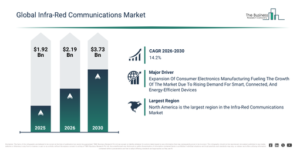
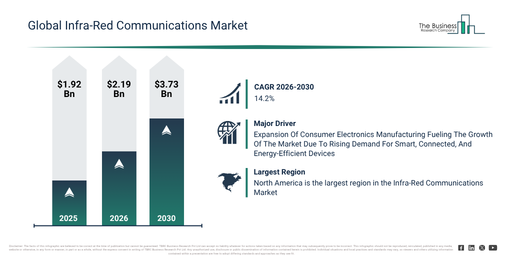
The infra-red communications market size has witnessed rapid expansion in recent years. It is anticipated to grow from $1.92 billion in 2025 to $2.19 billion in 2026, at a compound annual growth rate (CAGR) of 14.0%. The historical growth of this market can be attributed to the early adoption of remote control systems, the demand for low-cost short-range communication, the proliferation of consumer electronics devices, the development of line-of-sight optical communication, and the expansion of industrial automation control systems.
The infra-red communications market is anticipated to experience substantial expansion over the next few years. It is projected to achieve a valuation of $3.73 billion by 2030, propelled by a compound annual growth rate (CAGR) of 14.2%. This expansion during the forecast period stems from various factors, including the increasing integration of IoT-enabled devices, a heightened demand for secure short-range communication, the development of smart home ecosystems, the miniaturization of infrared components, and the broadening of automotive sensing and control applications. Prominent trends foreseen for the forecast period comprise low-power infrared communication modules, intelligent remote control and gesture-based IR systems, IR-based IoT device pairing and connectivity, short-range secure device authentication using IR, and miniaturized infrared sensors designed for consumer electronics.
Get A Free Sample Report With In-Depth Market Insights:
Infra-Red Communications Market Growth Factors: What’s Supporting Expansion?
The infra-red communications market is projected to expand due to the increasing scale of consumer electronics manufacturing. This manufacturing involves the mass production of electronic goods for daily use, like televisions, smartphones, gaming systems, and smart home equipment. The increase in consumer electronics production is fueled by a global rise in demand for intelligent, interconnected, and energy-saving devices, spurred by rapid digitalization and widespread adoption of IoT-enabled household and personal gadgets. Infra-red communications facilitates this manufacturing by providing short-range, low-power wireless links for components such as remotes and sensors, thereby boosting the efficiency, functionality, and compatibility of electronic systems. For example, in January 2024, the United States consumer technology industry’s retail revenues hit $512 billion in 2024, an increase from $505 billion in 2023, according to the Consumer Technology Association, a United States technology trade association. Consequently, the growth in consumer electronics manufacturing is propelling the infra-red communications market. The infra-red communications market is anticipated to grow as industrial automation continues to expand. Industrial automation is defined as the application of control systems, including computers, robots, and information technologies, to manage and supervise industrial operations with minimal human involvement. This increase in automation stems from rising labor expenses, prompting businesses to adopt automated systems to cut reliance on costly human workers, boost operational efficiency, and ensure consistent production standards. Infra-red communications bolsters industrial automation by facilitating rapid, interference-free wireless data exchange among machines, thereby minimizing the need for extensive cabling and enhancing efficiency, adaptability, and real-time oversight. For instance, in September 2024, the World Robotics 2024 report from the International Federation of Robotics, a Germany-based non-profit organization, indicated that the global operational stock of industrial robots reached 4,281,585 units, marking a 10% year-on-year rise, with annual installations surpassing 500,000 units for the third consecutive year. Hence, the rising trend in industrial automation is a key driver for the infra-red communications market.
Infra-Red Communications Market Segment Landscape: Which Areas Lead Development?
The infra-red communications market covered in this report is segmented –
1) By Component: Infrared Light Emitting Diodes, Infrared Photodiodes, Infrared Transceivers, Infrared Sensors, Infrared Receivers, Other Components
2) By Technology: Near Infrared Communication, Mid Infrared Communication, Far Infrared Communication
3) By Wavelength Range: Short Wavelength Infrared, Medium Wavelength Infrared, Long Wavelength Infrared
4) By End User: Consumer Electronics Manufacturers, Automotive Industry, Industrial Manufacturing, Healthcare Industry, Defense And Military, Commercial Sector
Subsegments:
1) By Infrared Light Emitting Diodes: Near Infrared Light Emitting Diodes, High Power Infrared Light Emitting Diodes, Surface Mount Infrared Light Emitting Diodes, Through Hole Infrared Light Emitting Diodes, Multi Chip Infrared Light Emitting Diodes
2) By Infrared Photodiodes: Silicon Infrared Photodiodes, Indium Gallium Arsenide Infrared Photodiodes, Avalanche Infrared Photodiodes, Planar Infrared Photodiodes, High Sensitivity Infrared Photodiodes
3) By Infrared Transceivers: Short Range Infrared Transceivers, High Speed Infrared Transceivers, Integrated Infrared Transceiver Modules, Low Power Infrared Transceivers, Long Distance Infrared Transceivers
4) By Infrared Sensors: Passive Infrared Sensors, Active Infrared Sensors, Thermal Infrared Sensors, Motion Detection Infrared Sensors, Temperature Sensing Infrared Sensors
5) By Infrared Receivers: Integrated Infrared Receivers, High Sensitivity Infrared Receivers, Remote Control Infrared Receivers, Surface Mount Infrared Receivers, Low Noise Infrared Receivers
6) By Other Components: Infrared Communication Modules, Infrared Signal Processors, Infrared Control Units, Infrared Interface Modules, Infrared Detection Modules
Infra-Red Communications Market Company Landscape And Competitive Strategy
Major companies operating in the infra-red communications market are Raytheon Technologies Corporation; Broadcom Inc.; Texas Instruments Incorporated; STMicroelectronics N.V.; NXP Semiconductors N.V.; Murata Manufacturing Co Ltd.; Renesas Electronics Corporation; ON Semiconductor Corporation (onsemi); Omron Corporation; Teledyne Technologies Incorporated; Melexis N.V.; Vishay Intertechnology Inc.; Nippon Ceramic Co Ltd.; Lynred SA; Sensirion AG; Hamamatsu Photonics K.K.; InfraTec GmbH; Laser Components GmbH; Semiconductor Devices Inc.; Senba Sensing Technology Co Ltd.
View The Full Infra-Red Communications Market Report:
Infra-Red Communications Market Largest Region: Which Geography Holds The Highest Market Share?
North America was the largest region in the infra-red communications market in 2025. Asia-Pacific is expected to be the fastest-growing region in the forecast period. The regions covered in the infra-red communications market report are Asia-Pacific, South East Asia, Western Europe, Eastern Europe, North America, South America, Middle East, Africa.
Reach Out To Our Team:
The Business Research Company: https://www.thebusinessresearchcompany.com/
Americas: +1 310-496-7795
Asia: +44 7882 955267 & +91 8897263534
Europe: +44 7882 955267
Email us at: marketing@tbrc.info
Follow us on:
LinkedIn: https://in.linkedin.com/company/the-business-research-company
YouTube: https://www.youtube.com/channel/UC24_fI0rV8cR5DxlCpgmyFQ
Global Market Model: https://www.thebusinessresearchcompany.com/global-market-model

Wasay has over a decade of experience in market research, data modelling, and analytics, with prior experience at GlobalData and Decision Tree Consulting Services. At The Business Research Company , he leads research operations across syndicated studies, customized consulting engagements, and the Global Market Model platform. His professional experience includes supporting organizations such as Boston Consulting Group, KPMG, and Ernst & Young. Wasay holds a degree in Electronics and Communications Engineering, postgraduate management qualifications from International Management Institute Belgium and Indian School of Business and Entrepreneurship, and completed the Integrated Program in Business Analytics from Indian Institute of Management Indore.