Backed by market attractiveness analysis, total addressable market sizing, company benchmarking matrices, interactive Excel dashboards, wider supply chain intelligence, emerging startup coverage, and detailed product-level insights, The Business Research Company’s 2026 market reports are designed to offer research that is more actionable and strategically valuable than ever.
Osmotic Power Market Size, Value And Growth Trajectory Through 2030
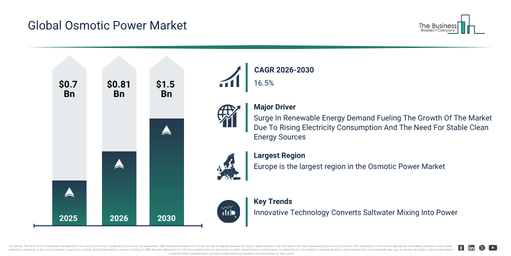
The osmotic power market size has experienced rapid growth in recent years. It is anticipated to expand from $0.7 billion in 2025 to $0.81 billion in 2026, achieving a compound annual growth rate (CAGR) of 16.3%. The historic period’s growth can be ascribed to early research in osmosis based energy conversion, the development of membrane filtration technologies from the desalination industry, limited commercialization of salinity gradient power systems, the high cost of membrane materials and low efficiency systems, and a dependence on conventional fossil fuel based coastal power generation.
The osmotic power market size is poised for substantial expansion in the coming years. It is projected to reach $1.5 billion in 2030, exhibiting a compound annual growth rate (CAGR) of 16.5%. This anticipated growth during the forecast period is fueled by several factors, including breakthroughs in high-efficiency semipermeable membrane technology, greater investment in marine renewable energy infrastructure, an escalating need for decentralized and eco-friendly coastal power generation, the incorporation of osmotic power into desalination facilities, and favorable governmental policies supporting blue energy development initiatives. Key developments expected throughout the forecast period encompass the wider implementation of pressure retarded osmosis systems for large-scale coastal renewable energy production, growing use of reverse electrodialysis technology for effective salinity gradient power conversion, increased deployment of advanced semipermeable membrane materials to enhance energy conversion efficiency, the emergence of hybrid osmotic power generators that integrate renewable hybrid systems for improved grid stability, and expanding exploitation of hypersaline water sources, such as brine and salt lakes, for osmotic energy extraction.
Get A Free Sample Report With In-Depth Market Insights:
Osmotic Power Market Growth Drivers: What’s Behind The Acceleration?
The worldwide surge in renewable energy demand is anticipated to stimulate the expansion of the osmotic power market. Renewable energy originates from naturally regenerating sources such as solar, wind, hydropower, and biomass. This heightened global demand for renewable energy is a result of growing electricity consumption, spurred by industrialization, urbanization, and the ongoing shift towards electric transport and infrastructure, thereby accelerating the global adoption of clean energy systems. Osmotic power contributes to meeting renewable energy needs by offering a stable and uninterrupted electricity supply derived from salinity differences, helping to stabilize variable sources like wind and solar power. For example, in March 2025, the International Renewable Energy Agency, an intergovernmental organization based in the UAE, stated that global renewable power capacity additions reached 585 gigawatts in 2024, comprising more than 90% of all power expansion, an increase from previous years. Consequently, the rising global demand for renewable energy is propelling the growth of the osmotic power market. The escalating demand for electricity is projected to boost the growth of the osmotic power market moving forward. Electricity is defined as the movement of electric charge, typically through a conductor, utilized to supply energy for operating various devices and systems. This increase in electricity demand is predominantly fueled by rapid industrialization, as expanding manufacturing and production operations necessitate greater volumes of electrical energy to power machinery, automation systems, and extensive industrial processes. Elevated electricity demand benefits osmotic power by fostering the requirement for consistent, uninterrupted renewable energy, thus encouraging the deployment of salinity gradient systems capable of delivering dependable baseload power in conjunction with intermittent sources. For instance, in March 2025, the Energy Information Administration (EIA), a US federal statistical agency, indicated that the United States generated 4.43 thousand terawatt-hours (TWh) of electricity, representing a 2.8% rise compared to 2024, which had previously recorded the highest annual output. Therefore, the growing electricity demand is stimulating the expansion of the osmotic power market.
Osmotic Power Market Segments: Where Is Growth Concentrated?
The osmotic power market covered in this report is segmented –
1) By Product Type: Pressure Retarded Osmosis Systems, Reverse Electrodialysis Systems, Semi Permeable Membrane Modules, Osmotic Power Generators, Salinity Gradient Energy Converters
2) By Source: Sea Water, Seawater Reverse Osmosis Brine, Salt Dome, Hypersaline Lakes, Inland Saline Water Bodies
3) By Application: Shipping And Harbor Industries, Military Ships And Aircraft Carriers, Oil And Natural Gas Industries
4) By End User: Utility Companies, Desalination Plant Operators, Industrial Manufacturing Facilities, Government And Research Institutions, Remote Coastal Communities
Subsegments:
1) By Pressure Retarded Osmosis Systems: Freshwater And Seawater Systems, Brackish Water Systems, Hybrid Osmosis Systems, High Pressure Systems, Low Pressure Systems
2) By Reverse Electrodialysis Systems: Cation Exchange Membrane Systems, Anion Exchange Membrane Systems, Stack Configuration Systems, Modular Electrodialysis Units, Continuous Flow Systems
3) By Semi Permeable Membrane Modules: Hollow Fiber Membrane Modules, Flat Sheet Membrane Modules, Spiral Wound Membrane Modules, Tubular Membrane Modules, Composite Membrane Modules
4) By Osmotic Power Generators: Turbine Based Generators, Pressure Driven Generators, Electrochemical Generators, Hybrid Energy Generators, Modular Power Units
5) By Salinity Gradient Energy Converters: Membrane Based Converters, Electrochemical Converters, Capacitive Mixing Systems, Hydrogel Based Converters, Hybrid Salinity Converters
Osmotic Power Market Trends: What’s Defining The Industry’s Next Phase?
Leading companies in the osmotic power market are prioritizing the development of advanced solutions, such as pressure-retarded osmosis (PRO) plants, to efficiently generate renewable electricity by leveraging the salinity difference between freshwater and seawater, thereby improving the technology’s energy output, scalability, and commercial viability. Pressure-retarded osmosis (PRO) plants are systems designed to produce electricity by enabling the mixing of freshwater and seawater through a semipermeable membrane under pressure, harnessing the resulting osmotic flow to power a turbine. As an illustration, in August 2025, the Fukuoka District Waterworks Agency, a municipal water utility based in Japan, launched the Fukuoka Osmotic Power Plant, an innovative energy production facility. This plant utilizes concentrated brine from desalination processes and treated wastewater streams as feedwater sources to maximize salinity gradients and enhance power output. Through sophisticated membrane modules, osmotic pressure is converted into mechanical energy, which then rotates turbines to generate electricity. The facility is engineered to produce around 880,000 kilowatt-hours annually, an amount adequate to support both desalination operations and nearby households. It offers continuous 24-hour clean energy generation with no direct carbon emissions, thus helping to lessen reliance on intermittent renewable sources.
Osmotic Power Market Leading Companies And Competitive Benchmarking
Major companies operating in the osmotic power market are Acciona S.A., SUEZ S.A., Hitachi Zosen Corporation, Statkraft AS, Toyobo Co. Ltd., Gradiant Corporation, Hydranautics Inc., Aquaporin A/S, Sweetch Energy, Blue Energy Canada Inc., REDstack B.V., SaltPower ApS, AquaBattery B.V.
View The Full Osmotic Power Market Report:
Osmotic Power Market Top Region By Revenue And Market Share
Europe was the largest region in the osmotic power market in 2025. Asia-Pacific is expected to be the fastest-growing region in the forecast period. The regions covered in the osmotic power market report are Asia-Pacific, South East Asia, Western Europe, Eastern Europe, North America, South America, Middle East, Africa.
Reach Out To Our Team:
The Business Research Company: https://www.thebusinessresearchcompany.com/
Americas: +1 310-496-7795
Asia: +44 7882 955267 & +91 8897263534
Europe: +44 7882 955267
Email us at: marketing@tbrc.info
Follow us on:
LinkedIn: https://in.linkedin.com/company/the-business-research-company
YouTube: https://www.youtube.com/channel/UC24_fI0rV8cR5DxlCpgmyFQ
Global Market Model: https://www.thebusinessresearchcompany.com/global-market-model

Wasay has over a decade of experience in market research, data modelling, and analytics, with prior experience at GlobalData and Decision Tree Consulting Services. At The Business Research Company , he leads research operations across syndicated studies, customized consulting engagements, and the Global Market Model platform. His professional experience includes supporting organizations such as Boston Consulting Group, KPMG, and Ernst & Young. Wasay holds a degree in Electronics and Communications Engineering, postgraduate management qualifications from International Management Institute Belgium and Indian School of Business and Entrepreneurship, and completed the Integrated Program in Business Analytics from Indian Institute of Management Indore.