
Featuring market attractiveness scoring, total addressable market sizing, company benchmarking matrices, interactive Excel dashboards, deeper supply chain intelligence, emerging startup tracking, and granular product-level insights, The Business Research Company’s 2026 market reports are built to deliver research that is both more actionable and more strategically valuable.
Digital Twin In Energy Market Expansion Outlook: What Revenue Opportunities Are Ahead?
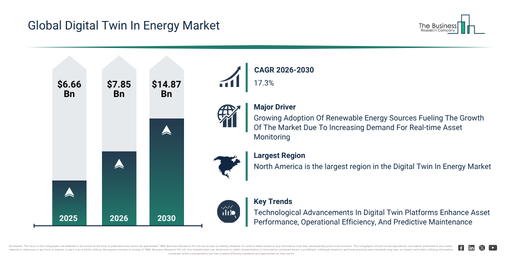
The digital twin in energy market has experienced rapid expansion in recent years. It is forecast to grow from $6.66 billion in 2025 to $7.85 billion in 2026, achieving a compound annual growth rate (CAGR) of 17.8%. This historical growth can be attributed to several factors, including the increasing necessity for enhanced energy asset reliability, the rising demand for remote asset monitoring, the expanding deployment of sensor-based energy data collection, a greater focus on reducing unplanned equipment downtime, and the broader use of simulation models for energy system analysis.
The digital twin market in the energy sector is set for considerable expansion in the coming years, with projections indicating a rise to $14.87 billion by 2030, driven by a compound annual growth rate (CAGR) of 17.3%. This anticipated growth over the forecast period is primarily attributed to a heightened demand for predictive asset performance management, the escalating need for real-time energy system optimization, the wider adoption of digital twin solutions across renewable energy assets, an increasing push for operational cost reduction, and the expanding deployment of digital twins for grid modernization. Key trends defining this period include the growing embrace of real-time energy asset monitoring, an increasing demand for predictive energy asset maintenance, the broader utilization of virtual energy asset replicas, a greater emphasis on energy performance optimization, and the expanding integration of digital twins throughout power generation and transmission systems.
Get A Free Sample Report With In-Depth Market Insights:
Digital Twin In Energy Market Growth Backed By Core Demand Fundamentals
The increasing embrace of renewable energy sources is anticipated to fuel the expansion of the digital twin in energy market going forward. These sources, referring to naturally replenishing energy resources like solar, wind, hydropower, geothermal, and biomass, are utilized to generate electricity with a lower environmental impact. The rising adoption of renewable energy is primarily driven by an intensified global focus on reducing carbon emissions and transitioning to sustainable energy systems. Digital twin technology supports renewable energy by enabling real-time monitoring, predictive maintenance, performance optimization, and simulation of renewable energy assets, thus improving operational efficiency and grid integration. For instance, in October 2024, the International Energy Agency (IEA), a France-based intergovernmental organization, projected that the share of renewables in final energy consumption will increase from 13% in 2023 to nearly 20% by 2030. Therefore, the growing adoption of renewable energy sources is driving the growth of the digital twin in energy market.
Digital Twin In Energy Market Segment Outlook: Which Categories Are Growing Fastest?
The digital twin in energy market covered in this report is segmented –
1) By Component: Software, Hardware, Services
2) By Technology: Artificial Intelligence And Machine Learning Systems, Internet Of Things Enabled Systems, Big Data Analytics Platforms, Predictive Analytics Solutions, Simulation And Modeling Software, Cloud Computing Platforms
3) By Deployment Mode: On-Premises, Cloud
4) By Application: Asset Performance Management, Predictive Maintenance, Process Optimization, Energy Management, Other Applications
5) By End User: Power Generation, Oil And Gas, Renewable Energy, Utilities, Other End Users
Subsegments:
1) By Software: Asset Performance Management Software, Data Integration Software, Visualization Software
2) By Hardware: Sensors, Edge Devices, Data Acquisition Systems, Communication Devices, Industrial Controllers
3) By Services: Consulting Services, Integration Services, Deployment Services, Maintenance And Support Services, Training Services
Digital Twin In Energy Market Growth Trends Reshaping The Competitive Landscape
Leading companies in the digital twin in energy market are implementing advanced industrial intelligence platforms, specifically digital twin platforms, to bolster real-time asset visibility, enhance operational efficiency, and facilitate predictive maintenance across their energy operations. These digital twin platforms are integrated software environments designed to create virtual representations of physical energy assets by merging real-time operational data, simulation functionalities, artificial intelligence, and analytical tools. This integrated approach allows for the continuous monitoring, optimization, and management of asset performance throughout their entire lifecycle. For example, in April 2024, AVEVA, a UK-based industrial software company, unveiled CONNECT, an industrial intelligence platform that unifies industrial data, digital twin capabilities, AI-powered analytics, and cloud-based services into a single ecosystem. This platform empowers energy companies to oversee, evaluate, and refine asset performance in real time, thereby supporting predictive maintenance, improving operational efficiency, and enabling smarter decision-making using sophisticated digital twin technology.
Digital Twin In Energy Market Competitive Landscape: Which Companies Lead The Industry?
Major companies operating in the digital twin in energy market are Microsoft Corporation, Siemens AG, GE Vernova Inc., International Business Machines Corporation, Oracle Corporation, Schneider Electric SE, Honeywell International Inc., SAP SE, ABB Ltd, Baker Hughes Company, Emerson Electric Co., Johnson Controls International plc, Rockwell Automation Inc., Dassault Systèmes SE, Hexagon AB, Bentley Systems Incorporated, Yokogawa Electric Corporation, Kongsberg Digital AS, Palantir Technologies Inc., PTC Inc., DNV AS, Cognite AS, Seeq Corporation, Akselos SA, Neara Pty Ltd, Twaice Technologies GmbH, Arundo Analytics Inc., IOTA Software Inc.
View The Full Digital Twin In Energy Market Report:
Digital Twin In Energy Market Regional Outlook: Where Is Opportunity Concentrated?
North America was the largest region in the digital twin in energy market in 2025. Asia-Pacific is expected to be the fastest-growing region in the forecast period. The regions covered in the digital twin in energy market report are Asia-Pacific, South East Asia, Western Europe, Eastern Europe, North America, South America, Middle East, Africa.
Reach Out To Our Team:
The Business Research Company: https://www.thebusinessresearchcompany.com/
Americas: +1 310-496-7795
Asia: +44 7882 955267 & +91 8897263534
Europe: +44 7882 955267
Email us at: marketing@tbrc.info
Follow us on:
LinkedIn: https://in.linkedin.com/company/the-business-research-company
YouTube: https://www.youtube.com/channel/UC24_fI0rV8cR5DxlCpgmyFQ
Global Market Model: https://www.thebusinessresearchcompany.com/global-market-model

Wasay has over a decade of experience in market research, data modelling, and analytics, with prior experience at GlobalData and Decision Tree Consulting Services. At The Business Research Company , he leads research operations across syndicated studies, customized consulting engagements, and the Global Market Model platform. His professional experience includes supporting organizations such as Boston Consulting Group, KPMG, and Ernst & Young. Wasay holds a degree in Electronics and Communications Engineering, postgraduate management qualifications from International Management Institute Belgium and Indian School of Business and Entrepreneurship, and completed the Integrated Program in Business Analytics from Indian Institute of Management Indore.