
Built to provide research that’s more actionable and strategically valuable, The Business Research Company’s 2026 market reports include market attractiveness analysis, total addressable market sizing, company benchmarking matrices, interactive Excel dashboards, broader supply chain intelligence, emerging startup tracking, and in-depth product insights.
Commercial Aircraft Aerostructures Market Forecast: Value Set To Climb From $55.02 Billion To $75.39 Billion
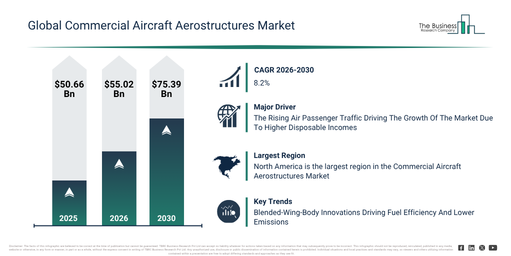
The commercial aircraft aerostructures market size has shown strong growth in recent years. It is forecast to increase from $50.66 billion in 2025 to $55.02 billion in 2026, achieving a compound annual growth rate (CAGR) of 8.6%. This historical expansion can be attributed to several factors, including a rise in commercial aircraft deliveries, an increase in global passenger air traffic, the ongoing expansion of aircraft fleets, a growing demand for lightweight aircraft structures, and the increasing need for aircraft replacement and modernization.
The commercial aircraft aerostructures market size is anticipated to experience substantial growth in the forthcoming years. It is projected to expand to $75.39 billion by 2030, demonstrating a compound annual growth rate (CAGR) of 8.2%. This growth over the forecast period is largely attributable to factors such as the increasing demand for fuel-efficient aircraft, the rising adoption of composite-intensive aircraft designs, an increase in narrow-body and wide-body aircraft production, a growing need for next-generation aircraft structures, and expanding commercial aviation fleet renewal programs. Prominent trends for the same period include the increasing demand for lightweight commercial aircraft aerostructures, the rising integration of advanced composite aerostructure materials, a growing need for aerodynamic structural optimization, an increasing focus on structural durability and fatigue resistance, and the expanding demand for modular and customizable aerostructure designs.
Get A Free Sample Report With In-Depth Market Insights:
Commercial Aircraft Aerostructures Market Opportunity Drivers: What’s Unlocking New Revenue Potential?
The expanding volume of air passenger movement is projected to fuel the advancement of the commercial aircraft aerostructures market in the future. Air passenger traffic defines the aggregate count of travelers conveyed by carriers via both domestic and international flight operations within a given timeframe, serving as a primary metric for air travel demand. This increase in air passenger traffic stems from elevated disposable incomes, enabling a greater number of individuals to afford air travel for both professional and recreational purposes. The growth in air passenger traffic underpins the demand for commercial aircraft aerostructures by motivating airlines to enlarge and update their fleets, thereby boosting aircraft manufacturing and the requirement for structural parts. Illustratively, in October 2024, data from the Department of Transportation, a US-based government department, revealed that 647,205 flights were conducted in August 2024, marking a 2.61% rise compared to the 630,761 flights in August 2023. Consequently, the growing air passenger traffic is a significant catalyst for the expansion of the commercial aircraft aerostructures market.
Commercial Aircraft Aerostructures Market Breakdown By Product Type And Application
The commercial aircraft aerostructures market covered in this report is segmented –
1) By Component: Fuselage, Wings, Empennage, Nacelles And Pylons, Flight Control Surfaces, Doors And Skids, Noses
2) By Material: Composites, Metal Alloys, Alloys And Superalloys, Hybrid Materials
3) By Aircraft Type: Narrow Body Aircraft, Wide Body Aircraft, Regional Aircraft, Business Jets, Very Large Aircraft, Helicopters
4) By End User: Original Equipment Manufacturer, Aftermarket, Maintenance, Repair, And Overhaul
Subsegments:
1) By Fuselage: Forward Fuselage, Center Fuselage, Aft Fuselage, Monocoque Fuselage Structures, Semi Monocoque Fuselage Structures
2) By Wings: Movable Wings (Flaps, Slats Integration), Wing Box Structures, Winglets, High Lift Wing Systems
3) By Empennage: Vertical Stabilizers, Horizontal Stabilizers, Rudder Assemblies, Elevator Assemblies, Tailcone Structures
4) By Nacelles And Pylons: Engine Nacelles, Inlet Cowlings, Exhaust Systems, Engine Mounting Pylons, Thrust Reverser Structures
5) By Flight Control Surfaces: Ailerons, Elevators, Rudders, Spoilers, Flaps
6) By Doors And Skids: Passenger Doors, Cargo Doors, Emergency Exits, Landing Skids (Helicopters), Service Access Doors
7) By Noses: Radomes, Nose Landing Gear Bay Structures, Nose Cone Assemblies, Avionics Bay Structures, Weather Radar Housings
Commercial Aircraft Aerostructures Market Innovation Trends Shaping Future Development
Major companies operating in the commercial aircraft aerostructures market are increasingly focused on developing innovative solutions, such as blended-wing-body (BWB) aircraft designs, to enhance aerodynamic efficiency, reduce fuel consumption, and decrease carbon emissions. A blended-wing-body aircraft design refers to an aerodynamic configuration where the aircraft’s fuselage and wings are smoothly integrated into a unified load-bearing structure. For example, in October 2024, Natilus Inc., a US-based aerospace company, unveiled HORIZON, a blended-wing-body passenger aircraft engineered to transport 200 passengers on intercontinental routes. It offers benefits like 50% lower emissions, 30% lower fuel consumption, and heightened aerodynamic efficiency. This launch aims to help airlines reduce operating costs and their environmental footprint while contributing to the decarbonization of commercial aviation.
Commercial Aircraft Aerostructures Market Key Participants And Competitive Landscape
Major companies operating in the commercial aircraft aerostructures market are Airbus SE, GKN Aerospace Services Limited, Safran, RTX Corporation, Mitsubishi Heavy Industries Ltd, Kawasaki Heavy Industries Ltd, Leonardo S.p.A., Hexcel Corporation, Bombardier Inc., Triumph Group Inc., Korea Aerospace Industries Ltd., Subaru Corporation, Aernnova Aerospace S.A.U., FACC AG, Hindustan Aeronautics Limited, Magellan Aerospace Corporation, Latecoere, Sonaca Group S.A., Tata Advanced Systems Limited, Embraer S.A., Daher, Dynamatic Technologies Limited, Mahindra Aerospace Private Limited
View The Full Commercial Aircraft Aerostructures Market Report:
Commercial Aircraft Aerostructures Market Geographic Analysis: Where Is Demand Accelerating Fastest?
North America was the largest region in the commercial aircraft aerostructures market in 2025. Asia-Pacific is expected to be the fastest-growing region in the forecast period. The regions covered in the commercial aircraft aerostructures market report are Asia-Pacific, South East Asia, Western Europe, Eastern Europe, North America, South America, Middle East, Africa.
Reach Out To Our Team:
The Business Research Company: https://www.thebusinessresearchcompany.com/
Americas: +1 310-496-7795
Asia: +44 7882 955267 & +91 8897263534
Europe: +44 7882 955267
Email us at: marketing@tbrc.info
Follow us on:
LinkedIn: https://in.linkedin.com/company/the-business-research-company
YouTube: https://www.youtube.com/channel/UC24_fI0rV8cR5DxlCpgmyFQ
Global Market Model: https://www.thebusinessresearchcompany.com/global-market-model

Wasay has over a decade of experience in market research, data modelling, and analytics, with prior experience at GlobalData and Decision Tree Consulting Services. At The Business Research Company , he leads research operations across syndicated studies, customized consulting engagements, and the Global Market Model platform. His professional experience includes supporting organizations such as Boston Consulting Group, KPMG, and Ernst & Young. Wasay holds a degree in Electronics and Communications Engineering, postgraduate management qualifications from International Management Institute Belgium and Indian School of Business and Entrepreneurship, and completed the Integrated Program in Business Analytics from Indian Institute of Management Indore.