
Featuring market attractiveness scoring, total addressable market sizing, company benchmarking matrices, interactive Excel dashboards, deeper supply chain intelligence, emerging startup tracking, and granular product-level insights, The Business Research Company’s 2026 market reports are built to deliver research that is both more actionable and more strategically valuable.
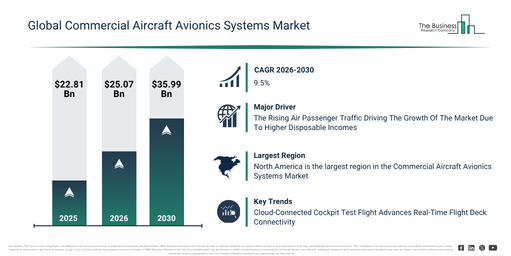
Commercial Aircraft Avionics Systems Market Set To Climb From $25.07 Billion In 2026 To $35.99 Billion By 2030
The commercial aircraft avionics systems market has demonstrated significant growth recently. This market is projected to expand from $22.81 billion in 2025 to $25.07 billion in 2026, exhibiting a compound annual growth rate (CAGR) of 9.9%. Historically, this growth has been driven by several factors, including the escalating need for enhanced flight safety and operational reliability, the expansion of commercial aircraft fleets, the increasing integration of sophisticated navigation and communication systems, stricter regulatory mandates for aircraft safety compliance, and the ongoing modernization of existing aircraft avionics systems.
The commercial aircraft avionics systems market is projected to experience substantial expansion over the coming years, anticipated to reach $35.99 billion in 2030, exhibiting a compound annual growth rate (CAGR) of 9.5%. This expansion during the projection period stems from factors such as heightened demand for connected aircraft avionics, greater integration of sophisticated flight data analytics, an escalating need for fuel-efficient aircraft operations, wider uptake of next-generation cockpit technologies, and an increasing need for advanced air traffic management systems. Key trends expected during the forecast timeframe encompass the rising uptake of integrated avionics systems to improve flight operations, a growing need for advanced cockpit display and human-machine interface solutions, an increased emphasis on lightweight and energy-efficient avionics components, the ongoing development of modular and scalable avionics architectures, and the broadening implementation of next-generation flight safety and monitoring systems.
Get A Free Sample Report With In-Depth Market Insights:
Commercial Aircraft Avionics Systems Market Growth Catalysts And Demand Drivers
The anticipated surge in air passenger traffic is set to drive the expansion of the commercial aircraft avionics systems market in the coming years. Air passenger traffic denotes the total count of individuals transported by airlines through both domestic and international services over a defined period, serving as a critical measure of air travel demand. This traffic is experiencing an upswing primarily due to elevated disposable incomes, enabling a greater number of people to afford air travel for both business and leisure. An increase in air passenger traffic spurs a rise in aircraft deliveries, fleet modernization efforts, and retrofit initiatives, which, in turn, intensifies the need for advanced commercial aircraft avionics systems to improve safety, operational efficiency, connectivity, and adherence to air traffic management regulations. For instance, in October 2024, data from the Department of Transportation, a US-based government department, revealed that 647,205 flights were operated in August 2024, marking a 2.61% increase from the 630,761 flights recorded in August 2023. Consequently, the escalating air passenger traffic is a primary catalyst for the growth of the commercial aircraft avionics market.
Commercial Aircraft Avionics Systems Market Segment Landscape And Growth Outlook
The commercial aircraft avionics systems market covered in this report is segmented –
1) By System: Flight Management Systems, Communication Systems, Navigation Systems, Surveillance Systems, Weather Systems, Electrical And Emergency Systems
2) By Platform: Narrow Body Aircraft, Wide Body Aircraft, Regional Aircraft, Business Jets
3) By Fit: Line Fit, Retrofit
4) By Technology: Digital Avionics, Analog Avionics
5) By End User: Commercial Airlines, Cargo Operators
Subsegments:
1) By Flight Management Systems: Flight Management Computer, Control Display Unit, Flight Control Unit, Performance Management System, Fuel Management System
2) By Communication Systems: Very High Frequency Communication, High Frequency Communication, Satellite Communication, Aircraft Communications Addressing And Reporting System, Controller Pilot Data Link Communications
3) By Navigation Systems: Global Navigation Satellite System, Inertial Navigation System, Inertial Reference System, Distance Measuring Equipment, Very High Frequency Omnidirectional Range
4) By Surveillance Systems: Traffic Collision Avoidance System, Automatic Dependent Surveillance Broadcast, Secondary Surveillance Radar Transponder, Terrain Awareness And Warning System, Enhanced Ground Proximity Warning System
5) By Weather Systems: Weather Radar System, Lightning Detection System, Turbulence Detection System, Wind Shear Detection System, Ice Detection System
6) By Electrical And Emergency Systems: Electrical Power Management System, Standby Power System, Emergency Locator Transmitter, Cockpit Voice Recorder, Flight Data Recorder
Commercial Aircraft Avionics Systems Market Trends Shaping Long-Term Demand
Companies active in the commercial aircraft avionics systems market are concentrating on developing innovative solutions, such as cloud-connected cockpit systems, to enhance real-time aircraft data integration, operational efficiency, predictive maintenance, and flight safety, driven by the escalating demand for digitalized and autonomous aviation operations. A cloud-connected cockpit system represents an advanced avionics architecture that directly connects an aircraft’s flight deck, its sensors, and mission systems to secure cloud platforms, facilitating continuous data exchange between the aircraft and ground-based operations. For instance, in May 2023, Honeywell International Inc., a US-based automation company, successfully conducted a test flight of its new integrated Anthem flight deck, marking the company’s first cloud-connected cockpit. This test flight demonstrated live connectivity between onboard avionics and cloud-based systems, enabling continuous data exchange for navigation, flight management, and overall system monitoring. This constituted a significant step towards more digitalized and connected cockpit environments, improving operational efficiency and pilot situational awareness. With this advancement, Honeywell aimed to support the aviation industry’s transition towards smarter, more integrated, and software-driven flight deck technologies.
Commercial Aircraft Avionics Systems Market Industry Leaders And Competitive Landscape
Major companies operating in the commercial aircraft avionics systems market are Astronautics Corporation of America, BAE Systems plc, Curtiss-Wright Corporation, Elbit Systems Ltd., Garmin Ltd., General Electric Company, Honeywell International Inc., L3Harris Technologies Inc., Leonardo S.p.A., Moog Inc., Panasonic Avionics Corporation, RTX Corporation, Safran S.A., Teledyne Technologies Incorporated, Thales S.A., uAvionix Corporation
View The Full Commercial Aircraft Avionics Systems Market Report:
Commercial Aircraft Avionics Systems Market Regional Analysis And Leading Geography
North America was the largest region in the commercial aircraft avionics systems market in 2025. Asia-Pacific is expected to be the fastest-growing region in the forecast period. The regions covered in the commercial aircraft avionics systems market report are Asia-Pacific, South East Asia, Western Europe, Eastern Europe, North America, South America, Middle East, Africa.
Reach Out To Our Team:
The Business Research Company: https://www.thebusinessresearchcompany.com/
Americas: +1 310-496-7795
Asia: +44 7882 955267 & +91 8897263534
Europe: +44 7882 955267
Email us at: marketing@tbrc.info
Follow us on:
LinkedIn: https://in.linkedin.com/company/the-business-research-company
YouTube: https://www.youtube.com/channel/UC24_fI0rV8cR5DxlCpgmyFQ
Global Market Model: https://www.thebusinessresearchcompany.com/global-market-model

Wasay has over a decade of experience in market research, data modelling, and analytics, with prior experience at GlobalData and Decision Tree Consulting Services. At The Business Research Company , he leads research operations across syndicated studies, customized consulting engagements, and the Global Market Model platform. His professional experience includes supporting organizations such as Boston Consulting Group, KPMG, and Ernst & Young. Wasay holds a degree in Electronics and Communications Engineering, postgraduate management qualifications from International Management Institute Belgium and Indian School of Business and Entrepreneurship, and completed the Integrated Program in Business Analytics from Indian Institute of Management Indore.