
Backed by market attractiveness analysis, total addressable market sizing, company benchmarking matrices, interactive Excel dashboards, wider supply chain intelligence, emerging startup coverage, and detailed product-level insights, The Business Research Company’s 2026 market reports are designed to offer research that is more actionable and strategically valuable than ever.
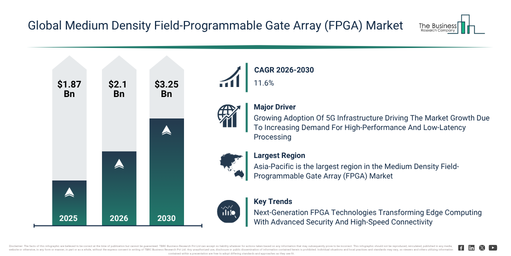
Medium Density Field-Programmable Gate Array (FPGA) Market Growth From $2.1 Billion In 2026 To $3.25 Billion By 2030 At A CAGR Of 11.6%
The market size for medium density field-programmable gate arrays (FPGAs) has seen substantial growth in recent years. It is anticipated to expand from $1.87 billion in 2025 to $2.1 billion in 2026, achieving a compound annual growth rate (CAGR) of 12.0%. This past growth can be ascribed to several factors, including an escalating demand for adaptable digital circuit implementation, the rising acceptance of programmable logic in industrial control systems, a growing need for rapid hardware prototyping, the increasing utilization of configurable semiconductor devices, and an expanding requirement for hardware design flexibility.
The medium density field-programmable gate array (FPGA) market is projected to experience swift expansion over the coming years. Its valuation is set to reach $3.25 billion in 2030, with a compound annual growth rate (CAGR) of 11.6%. This anticipated growth during the forecast timeframe stems from several factors, including the escalating need for edge computing and real-time processing, the wider integration of FPGA-driven artificial intelligence acceleration, the expanding application of programmable logic within automotive electronics, the surging requirement for low-power configurable computing, and the broadening utilization of FPGAs in communication and networking infrastructure. Key trends anticipated during this period encompass the increased acceptance of FPGAs with higher logic density, a heightened demand for energy-efficient programmable logic devices, the progressing integration of embedded processing capabilities, the wider implementation of reconfigurable hardware designs, and an escalating need for swift FPGA-based prototyping solutions.
Get A Free Sample Report With In-Depth Market Insights:
Medium Density Field-Programmable Gate Array (FPGA) Market Opportunity Drivers: What’s Unlocking New Revenue Potential?
The increasing integration of 5G infrastructure is anticipated to spur the expansion of the medium density field-programmable gate array (FPGA) market moving ahead. 5G infrastructure encompasses the complete network setup, including base stations, antennas, core networks, and associated technologies, which facilitates high-speed, low-latency, and dependable fifth-generation wireless communication. The uptake of 5G infrastructure is on the rise, driven by an escalating need for quicker mobile broadband, as both individual users and enterprises demand superior data speeds, reduced latency, and more consistent connectivity for demanding applications. Medium-density FPGAs are crucial for 5G infrastructure, enabling the flexible, low-latency, and energy-efficient execution of vital signal processing and networking tasks. This allows for quick adjustments to evolving wireless standards, effective hardware acceleration at the network’s periphery, and economical implementation of scalable baseband, fronthaul, and control-plane applications. Illustratively, in November 2024, the Global mobile Suppliers Association (GSA), a UK-based non-governmental organization, reported that 5G standalone (SA) ecosystem devices reached 2,112 announced devices with claimed support by the end of September 2024, marking a 39.7% increase from 1,511 devices at the end of September 2023. Consequently, the expanding deployment of 5G infrastructure is fueling the growth of the medium density field-programmable gate array (FPGA) market.
Medium Density Field-Programmable Gate Array (FPGA) Market Segments: Where Is Growth Concentrated?
The medium density field-programmable gate array (FPGA) market covered in this report is segmented –
1) By Type: Static Random Access Memory (SRAM), Antifuse, Flash, Other Types
2) By Logic Density: Up To 50K Logic Cells, 50K–150K Logic Cells, Above 150K Logic Cells
3) By Configuration: Low-End, Mid-Range, High-End
4) By Application: Communication Network, Industrial Control, Data Center, Automobile Electronics, Consumer Electronics, Other Applications
5) By End User: Original Equipment Manufacturers (OEMs), Original Design Manufacturers (ODMs), Other End Users
Subsegments:
1) By Static Random Access Memory (SRAM): Low Power Static Random Access Memory (SRAM)-Based Field-Programmable Gate Arrays (FPGAs), High Performance Static Random Access Memory (SRAM)-Based Field-Programmable Gate Arrays (FPGAs), Embedded Static Random Access Memory (SRAM)-Based Field-Programmable Gate Arrays (FPGAs), Reconfigurable Static Random Access Memory (SRAM)-Based Field-Programmable Gate Arrays (FPGAs)
2) By Antifuse: One-Time Programmable (OTP) Antifuse Field-Programmable Gate Arrays (FPGAs), Radiation-Hardened Antifuse Field-Programmable Gate Arrays (FPGAs), High Security Antifuse Field-Programmable Gate Arrays (FPGAs), Industrial Grade Antifuse Field-Programmable Gate Arrays (FPGAs)
3) By Flash: Low Power Flash-Based Field-Programmable Gate Arrays (FPGAs), High Density Flash-Based Field-Programmable Gate Arrays (FPGAs), Instant-On Flash-Based Field-Programmable Gate Arrays (FPGAs), Secure Flash-Based Field-Programmable Gate Arrays (FPGAs)
4) By Other Types: Electrically Erasable Programmable Read-Only Memory (EEPROM)-Based Field-Programmable Gate Arrays (FPGAs), Hybrid Configuration Field-Programmable Gate Arrays (FPGAs), Radiation-Tolerant Field-Programmable Gate Arrays (FPGAs), Application-Specific Field-Programmable Gate Arrays (FPGAs)
Medium Density Field-Programmable Gate Array (FPGA) Market Innovation Trends Shaping Future Development
Leading companies within the medium density field-programmable gate array (FPGA) market are prioritizing the development of inventive solutions, such as cost-optimized dual-range FPGA platforms, to bolster edge computing performance, security, power efficiency, and high-speed connectivity. These cost-optimized FPGA platforms are programmable semiconductor devices that integrate configurable logic, high input/output (I/O) density, low power consumption, and embedded security functionalities. This allows developers to tailor hardware functions for diverse applications, offering enhanced flexibility and reduced development costs compared to application-specific integrated circuits (ASICs). For example, in July 2025, Advanced Micro Devices Inc., a US-based semiconductor company, declared the full production launch of its Spartan UltraScale+ FPGA family, designed for cost-sensitive edge applications. The initial product offering includes the SU10P, SU25P, and SU35P devices, which feature high I/O density, low power consumption, integrated LPDDR4X/5 memory controller support, PCIe Gen4 hard IP, and advanced security capabilities such as post-quantum cryptography, a true random number generator (TRNG), a physical unclonable function (PUF), and secure hashing. The devices also provide support for high-speed interfaces like LVDS and MIPI D-PHY and are compatible with the AMD Vivado Design Suite 2025.1, accelerating development and deployment for industrial, medical, machine vision, and edge computing applications. These innovations underscore the rising demand for secure, power-efficient, and highly configurable FPGA solutions in medium-density applications.
Medium Density Field-Programmable Gate Array (FPGA) Market Competitive Landscape: Which Companies Lead The Industry?
Major companies operating in the medium density field-programmable gate array (FPGA) market are Advanced Micro Devices Inc., Intel Corporation, Lattice Semiconductor Corporation, Microchip Technology Incorporated, Achronix Semiconductor Corporation, Efinix Inc., NanoXplore Inc., GOWIN Semiconductor Corporation, QuickLogic Corporation, Shanghai Anlogic Infotech, 3D PLUS S.A.S., Shenzhen Pango Microsystems, AGM Micro Inc.
View The Full Medium Density Field-Programmable Gate Array (FPGA) Market Report:
Medium Density Field-Programmable Gate Array (FPGA) Market Regional Outlook: Where Is Opportunity Concentrated?
Asia-Pacific was the largest region in the medium density field-programmable gate array (FPGA) market in 2025. Asia-Pacific is expected to be the fastest-growing region in the forecast period. The regions covered in the medium density field-programmable gate array (FPGA) market report are Asia-Pacific, South East Asia, Western Europe, Eastern Europe, North America, South America, Middle East, Africa.
Reach Out To Our Team:
The Business Research Company: https://www.thebusinessresearchcompany.com/
Americas: +1 310-496-7795
Asia: +44 7882 955267 & +91 8897263534
Europe: +44 7882 955267
Email us at: marketing@tbrc.info
Follow us on:
LinkedIn: https://in.linkedin.com/company/the-business-research-company
YouTube: https://www.youtube.com/channel/UC24_fI0rV8cR5DxlCpgmyFQ
Global Market Model: https://www.thebusinessresearchcompany.com/global-market-model

Wasay has over a decade of experience in market research, data modelling, and analytics, with prior experience at GlobalData and Decision Tree Consulting Services. At The Business Research Company , he leads research operations across syndicated studies, customized consulting engagements, and the Global Market Model platform. His professional experience includes supporting organizations such as Boston Consulting Group, KPMG, and Ernst & Young. Wasay holds a degree in Electronics and Communications Engineering, postgraduate management qualifications from International Management Institute Belgium and Indian School of Business and Entrepreneurship, and completed the Integrated Program in Business Analytics from Indian Institute of Management Indore.