
Featuring market attractiveness scoring, total addressable market sizing, company benchmarking matrices, interactive Excel dashboards, deeper supply chain intelligence, emerging startup tracking, and granular product-level insights, The Business Research Company’s 2026 market reports are built to deliver research that is both more actionable and more strategically valuable.
Remote Home Monitoring Systems Market Set To Climb From $28.94 Billion In 2026 To $52.21 Billion By 2030
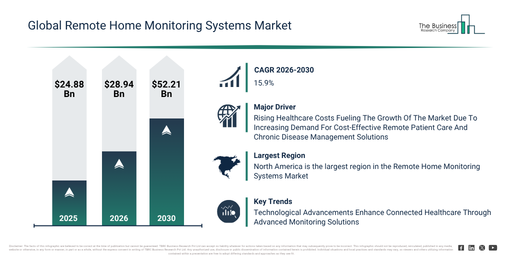
The market for remote home monitoring systems has shown substantial growth in recent years. Its value is anticipated to rise from $24.88 billion in 2025 to $28.94 billion in 2026, demonstrating a compound annual growth rate (CAGR) of 16.3%. The historical expansion of this market can be attributed to several factors, including the increasing prevalence of chronic diseases, a growing demand for remote patient monitoring, an expanding aging population requiring continuous oversight, the wider adoption of wearable health monitoring devices, and an escalating need for post-acute care monitoring.
The market for remote home monitoring systems is projected to experience significant expansion in the coming years. It is anticipated to grow to $52.21 billion in 2030, achieving a compound annual growth rate (CAGR) of 15.9%. This expected growth during the forecast period is propelled by factors such as the increasing demand for continuous health monitoring, greater adoption of home-based healthcare services, a rising need for elderly care and fall detection solutions, the expanding use of AI-enabled remote monitoring systems, and the increasing integration of remote monitoring with digital healthcare platforms. Prominent trends for the forecast period include the growing integration of multi-parameter remote monitoring devices, increased adoption of continuous remote monitoring solutions, the ongoing development of compact wearable monitoring technologies, a greater use of automated alerts and emergency response capabilities, and the expanding integration of remote monitoring with mobile and connected platforms.
Get A Free Sample Report With In-Depth Market Insights:
Remote Home Monitoring Systems Market Growth Drivers: What’s Behind The Acceleration?
The increasing expenditure on healthcare is anticipated to drive the expansion of the remote home monitoring systems market in the future. These costs encompass all expenses incurred for medical services, treatments, hospital care, medications, and healthcare infrastructure by individuals, service providers, insurance companies, and governmental bodies. The surge in healthcare spending stems from the rising occurrence of chronic illnesses, which necessitate prolonged treatments, repeated hospital admissions, and continuous disease management, thereby substantially elevating total healthcare outlays. With healthcare expenses persistently climbing, remote home monitoring systems offer an economical alternative. They achieve this by decreasing superfluous hospital visits, facilitating prompt identification of health problems, enhancing the management of chronic conditions, and enabling more streamlined care delivery from patients’ residences. A notable example is the projection from WTW’s 2026 Global Medical Trends report, issued by the UK-based advisory and risk management firm WTW, which indicates a global medical cost increase of 10.3% in 2026 relative to 2025. This underscores the persistent global upward trend in healthcare expenditures. Consequently, the escalating healthcare costs are a primary force behind the expansion of the remote home monitoring systems market.
Remote Home Monitoring Systems Market Segmentation And Category Overview
The remote home monitoring systems market covered in this report is segmented –
1) By Product: Vital Sign Monitoring Devices, Wearable Monitoring Devices, Implantable Monitoring Devices, Mobility Monitoring Devices, Other Products
2) By Technology: Internet Of Things Based Systems, Artificial Intelligence Enabled Systems, Cloud Based Systems, Mobile Health Systems
3) By Platform: Desktop, Mobile
4) By Operating System: iPhone Operating System, Android, Windows
5) By Application: Chronic Disease Management, Elderly Care, Post Acute Care Monitoring, Wellness And Fitness Monitoring, Other Applications
Subsegments:
1) By Vital Sign Monitoring Devices: Blood Pressure Monitoring Devices, Heart Rate Monitoring Devices, Temperature Monitoring Devices, Respiratory Monitoring Devices, Blood Oxygen Monitoring Devices
2) By Wearable Monitoring Devices: Smart Watches, Fitness Trackers, Wearable Sensors, Smart Clothing Devices, Activity Monitoring Devices
3) By Implantable Monitoring Devices: Cardiac Monitoring Devices, Neurological Monitoring Devices, Implantable Sensor Devices, Chronic Disease Monitoring Devices
4) By Mobility Monitoring Devices: Fall Detection Devices, Motion Tracking Devices, Gait Monitoring Devices, Location Tracking Devices, Activity Recognition Devices
5) By Other Products: Smart Home Sensors, Emergency Response Devices, Remote Care Platforms, Medication Management Devices
Remote Home Monitoring Systems Market Trends: What’s Defining The Industry’s Next Phase?
Leading companies in the remote home monitoring systems market are concentrating on creating advanced products, such as wearable cardiopulmonary monitoring systems, to enhance remote patient care, facilitate early disease detection, manage chronic conditions, and lower healthcare costs. These wearable cardiopulmonary monitoring systems are non-invasive medical devices that record physiological data, including heart and lung function metrics, enabling healthcare professionals to monitor patients’ health remotely and make prompt clinical decisions more effectively than with traditional in-person monitoring methods. For example, in March 2024, Analog Devices Inc., a US-based semiconductor and digital healthcare technology firm, secured U.S. Food and Drug Administration (FDA) 510(k) clearance and introduced the Sensinel Cardiopulmonary Management (CPM) System to the market, an innovative wearable healthcare solution designed for managing chronic conditions like heart failure. This compact wearable device allows patients to apply it themselves at home for three to five minutes to collect cardiopulmonary health data, which is then securely sent via a cellular connection to the Sensinel CPM Cloud Platform for analysis. The system employs intelligent algorithms to assess physiological indicators, assisting care teams in detecting early health changes, enhancing predictive care, decreasing hospital admissions, and optimizing clinical workflows.
Remote Home Monitoring Systems Market Top Companies Driving Competitive Growth
Major companies operating in the remote home monitoring systems market are Abbott Laboratories, Medtronic plc, GE HealthCare Technologies Inc, Koninklijke Philips N.V., Boston Scientific Corporation, OMRON Corporation, DexCom Inc, iRhythm Technologies Inc, Withings S.A., Huma Therapeutics Limited, Kaigo Health Inc, AliveCor Inc, Empatica Inc, Health Recovery Solutions Inc, CoachCare Inc, BioIntelliSense Inc, CarePredict Inc, HealthArc LLC, KangarooHealth Inc
View The Full Remote Home Monitoring Systems Market Report:
Remote Home Monitoring Systems Market Global Footprint: Which Region Leads The Industry?
North America was the largest region in the remote home monitoring systems market in 2025. Asia-Pacific is expected to be the fastest-growing region in the forecast period. The regions covered in the remote home monitoring systems market report are Asia-Pacific, South East Asia, Western Europe, Eastern Europe, North America, South America, Middle East, Africa.
Reach Out To Our Team:
The Business Research Company: https://www.thebusinessresearchcompany.com/
Americas: +1 310-496-7795
Asia: +44 7882 955267 & +91 8897263534
Europe: +44 7882 955267
Email us at: marketing@tbrc.info
Follow us on:
LinkedIn: https://in.linkedin.com/company/the-business-research-company
YouTube: https://www.youtube.com/channel/UC24_fI0rV8cR5DxlCpgmyFQ
Global Market Model: https://www.thebusinessresearchcompany.com/global-market-model

Wasay has over a decade of experience in market research, data modelling, and analytics, with prior experience at GlobalData and Decision Tree Consulting Services. At The Business Research Company , he leads research operations across syndicated studies, customized consulting engagements, and the Global Market Model platform. His professional experience includes supporting organizations such as Boston Consulting Group, KPMG, and Ernst & Young. Wasay holds a degree in Electronics and Communications Engineering, postgraduate management qualifications from International Management Institute Belgium and Indian School of Business and Entrepreneurship, and completed the Integrated Program in Business Analytics from Indian Institute of Management Indore.