
Built to provide research that’s more actionable and strategically valuable, The Business Research Company’s 2026 market reports include market attractiveness analysis, total addressable market sizing, company benchmarking matrices, interactive Excel dashboards, broader supply chain intelligence, emerging startup tracking, and in-depth product insights.
Microwave Cross-Polarization Interference Cancellation (XPIC) System Market Size Forecast: How Big Could The Market Get By 2030?
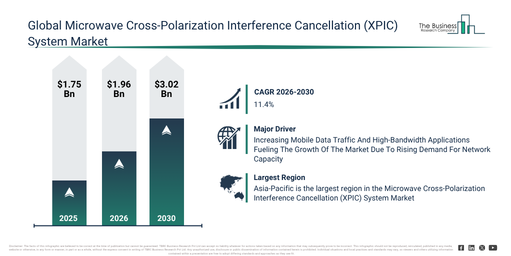
The market size for microwave cross-polarization interference cancellation (XPIC) systems has experienced substantial growth in recent years. Its expansion is projected to continue, escalating from $1.75 billion in 2025 to $1.96 billion in 2026, demonstrating a compound annual growth rate (CAGR) of 11.8%. Historically, this growth has stemmed from factors such as heightened demand for high-capacity wireless backhaul, the increasing rollout of microwave communication networks, a greater need for spectral efficiency, the enlargement of mobile telecommunications infrastructure, and the wider integration of digital signal processing technologies.
The market for microwave cross-polarization interference cancellation (XPIC) systems is anticipated to experience substantial expansion over the coming years. This market is projected to reach $3.02 billion by 2030, exhibiting a compound annual growth rate (CAGR) of 11.4%. Factors contributing to this growth during the forecast period include the expedited deployment of 5G networks, a surging need for high-bandwidth wireless connectivity, the expansion of network densification across both remote and urban locales, a growing imperative for efficient spectrum use, and the increasing implementation of sophisticated microwave backhaul infrastructure. Key trends identified for this period encompass the enhanced adoption of high-capacity microwave communication links, wider deployment of dual-polarization microwave transmission systems, advances in the development of sophisticated digital signal processing for interference cancellation, greater utilization of spectrally efficient microwave backhaul solutions, and the increasing incorporation of high-performance XPIC technology within microwave radio systems.
Get A Free Sample Report With In-Depth Market Insights:
Microwave Cross-Polarization Interference Cancellation (XPIC) System Market Growth Catalysts And Demand Drivers
The microwave cross-polarization interference cancellation (XPIC) system market is anticipated to expand in the future due to the escalating volume of mobile data traffic. This traffic encompasses all digital data transmitted and received across mobile networks by devices such as smartphones, tablets, and IoT devices, utilizing cellular technologies like 3G, 4G, 5G, and subsequent generations. The surge in mobile data traffic stems from the swift embrace of 4G and 5G networks, which, with their rapid connectivity and enhanced capacity, encourage increased consumption of data-intensive digital services. This escalation in mobile data traffic benefits microwave cross-polarization interference cancellation (XPIC) systems by necessitating greater wireless backhaul capacity through more effective use of available spectrum. For instance, in June 2024, an Ericsson report, a Sweden-based telecommunications company, indicated that global mobile network data traffic experienced an approximate 6% quarter-over-quarter rise from the fourth quarter (Q4) of 2023 to the first quarter (Q1) of 2024, reaching a total of 145 exabytes (EB) per month. Consequently, the rising mobile data traffic is a key driver for the growth of the microwave cross-polarization interference cancellation (XPIC) system market. The microwave cross-polarization interference cancellation (XPIC) system market is expected to see growth propelled by increasing investments in smart city and infrastructure development. These investments involve allocating funds towards constructing and enhancing urban infrastructure through advanced digital technologies, intelligent transportation, energy-efficient systems, and connected public services, aiming to boost sustainability, operational efficiency, and residents’ quality of life. The surge in smart city and infrastructure investments is a direct result of rapid urbanization, as expanding urban populations heighten the need for efficient transportation, dependable utilities, digital connectivity, and sustainable public infrastructure to foster economic growth and improve living standards. Such rising investments necessitate the deployment of high-capacity wireless backhaul networks, thereby boosting the demand for microwave cross-polarization interference cancellation (XPIC) systems to optimize spectrum efficiency, enhance link capacity, and guarantee dependable connectivity in densely populated urban settings. For instance, in April 2026, Patent Professional Corporation, a US-based technology-forward law firm, reported that global IoT infrastructure spending for smart cities grew from $130 billion in 2023 to $200 billion by 2025, indicating an annual growth rate of approximately 25%. Hence, the escalating investments in smart city and infrastructure development are a significant driver for the growth of the microwave cross-polarization interference cancellation (XPIC) system market.
Microwave Cross-Polarization Interference Cancellation (XPIC) System Market Segments: Where Is Growth Concentrated?
The microwave cross-polarization interference cancellation (XPIC) system market covered in this report is segmented –
1) By Component: Hardware, Software, Services
2) By Frequency Band: L Band, S Band, C Band, X Band, Ku Band, Ka Band, Other Frequency Bands
3) By Deployment Mode: On-Premises, Cloud-Based
4) By End User: Telecom Operators, Internet Service Providers, Enterprises, Government, Other End Users
Subsegments:
1) By Hardware: Radio Units, Antenna Systems, Modems, Signal Processors, Power Supply Units
2) By Software: Network Management Tools, Performance Monitoring Solutions, Configuration Management Systems, Security And Encryption Programs, Optimization Algorithms
3) By Services: Installation Services, Maintenance Services, Training Services, Consulting Services, Technical Support Services
Microwave Cross-Polarization Interference Cancellation (XPIC) System Market Leading Players And Competitive Positioning
Major companies operating in the microwave cross-polarization interference cancellation (XPIC) system market are Telefonaktiebolaget LM Ericsson, Huawei Technologies Co. Ltd., Nokia Corporation, NEC Corporation, ZTE Corporation, Samsung Electronics Co. Ltd., Fujitsu Limited, CommScope Holding Company Inc., Ceragon Networks Ltd., Aviat Networks Inc., Rosenberger Hochfrequenztechnik GmbH & Co. KG, Comba Telecom Systems Holdings Limited, SIAE MICROELETTRONICA S.p.A., Cambium Networks Corporation, Intracom Telecom S.A., SAF Tehnika JSC, Filtronic plc, MTI Wireless Edge Ltd., Microwave Networks Inc., InfiNet Wireless LLC, Nera Telecommunications Ltd., Winncom Technologies Corp.
View The Full Microwave Cross-Polarization Interference Cancellation (XPIC) System Market Report:
Microwave Cross-Polarization Interference Cancellation (XPIC) System Market Regional Split: Which Areas Are Fueling Growth?
Asia-Pacific was the largest region in the microwave cross-polarization interference cancellation (XPIC) system market in 2025. Asia-Pacific is expected to be the fastest-growing region in the forecast period. The regions covered in the microwave cross-polarization interference cancellation (XPIC) system market report are Asia-Pacific, South East Asia, Western Europe, Eastern Europe, North America, South America, Middle East, Africa.
Reach Out To Our Team:
The Business Research Company: https://www.thebusinessresearchcompany.com/
Americas: +1 310-496-7795
Asia: +44 7882 955267 & +91 8897263534
Europe: +44 7882 955267
Email us at: marketing@tbrc.info
Follow us on:
LinkedIn: https://in.linkedin.com/company/the-business-research-company
YouTube: https://www.youtube.com/channel/UC24_fI0rV8cR5DxlCpgmyFQ
Global Market Model: https://www.thebusinessresearchcompany.com/global-market-model

Wasay has over a decade of experience in market research, data modelling, and analytics, with prior experience at GlobalData and Decision Tree Consulting Services. At The Business Research Company , he leads research operations across syndicated studies, customized consulting engagements, and the Global Market Model platform. His professional experience includes supporting organizations such as Boston Consulting Group, KPMG, and Ernst & Young. Wasay holds a degree in Electronics and Communications Engineering, postgraduate management qualifications from International Management Institute Belgium and Indian School of Business and Entrepreneurship, and completed the Integrated Program in Business Analytics from Indian Institute of Management Indore.