
Backed by market attractiveness analysis, total addressable market sizing, company benchmarking matrices, interactive Excel dashboards, wider supply chain intelligence, emerging startup coverage, and detailed product-level insights, The Business Research Company’s 2026 market reports are designed to offer research that is more actionable and strategically valuable than ever.
Microservices Catalog Market Revenue Outlook: What CAGR Lies Ahead Through 2030?
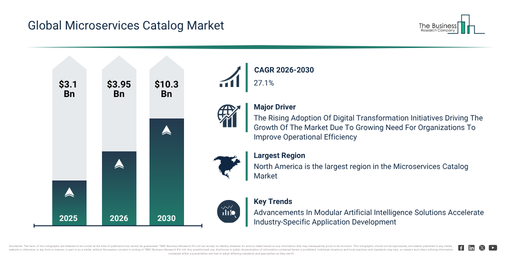
The microservices catalog market has experienced substantial expansion in recent years. Projections indicate it will expand from $3.1 billion in 2025 to $3.95 billion in 2026, demonstrating a compound annual growth rate (CAGR) of 27.5%. This historical growth can be linked to the increasing uptake of microservices architecture, the rising intricacy of distributed applications, the increasing requirement for centralized service visibility, the broadening of API-based application development, and the escalating need for effective microservices management.
The microservices catalog market is projected to experience substantial expansion over the coming years. This market is set to reach a valuation of $10.3 billion by 2030, exhibiting a compound annual growth rate (CAGR) of 27.1%. Key factors driving this expansion during the forecast period include the increasing adoption of cloud-native application development, a rising need for automated service discovery, the growing requirement for microservices governance, the expanding deployment of distributed applications, and the increasing demand for service dependency management. Significant trends anticipated in this period encompass the growing embrace of centralized microservices discovery and cataloging, the escalating integration of API metadata and dependency mapping, the increasing utilization of automated microservices inventory management, a heightened focus on microservices ownership and version tracking, and the expanding implementation of service catalog governance and lifecycle management.
Get A Free Sample Report With In-Depth Market Insights:
Microservices Catalog Market Opportunity Drivers: What’s Unlocking New Revenue Potential?
The microservices catalog market is anticipated to grow as digital transformation initiatives see increased adoption. These initiatives are strategic efforts by organizations to integrate digital technologies, such as cloud computing, artificial intelligence, automation, and data analytics, into their operations to improve efficiency, enhance customer experiences, and create new business models. This rise in digital transformation is driven by the growing need for organizations to improve operational efficiency by automating processes, optimizing resource utilization, reducing operational costs, and enabling faster data-driven decision-making. The adoption of these initiatives benefits microservices catalogs by increasing the demand for centralized service discovery, management, and governance across distributed application environments. For instance, in November 2023, the Central Digital and Data Office (CDDO), a UK-based government agency, noted that from April 2022 to April 2023, the Government Digital and Data profession expanded its workforce by 19%, thereby enhancing essential digital skills across the civil service. During the same period, 32 organizations implemented the common Government Digital and Data pay framework, which reduced reliance on contractors and generated savings for taxpayers. Therefore, the increasing adoption of digital transformation initiatives is a key driver for the growth of the microservices catalog market.
Microservices Catalog Market Segment Analysis: What Are The Core Market Categories?
The microservices catalog market covered in this report is segmented –
1) By Component: Platform, Services
2) By Deployment Mode: On-Premises, Cloud
3) By Organization Size: Small And Medium Enterprises, Large Enterprises
4) By Application: Banking, Financial Services, And Insurance, Healthcare, Retail And E-commerce, Information Technology And Telecommunications, Manufacturing, Other Applications
Subsegments:
1) By Platform: Service Registry, Application Programming Interface Gateway, Configuration Management, Service Discovery, Catalog Management, Access Control, Monitoring And Analytics, Workflow Automation
2) By Services: Consulting Services, Integration Services, Deployment Services, Migration Services, Customization Services, Training Services, Support And Maintenance Services, Managed Services
Microservices Catalog Market Innovation Trends Shaping Future Development
Leading entities within the microservices catalog market are prioritizing the creation of advanced solutions, specifically generative artificial intelligence microservices, with the aim of accelerating AI application development, optimizing deployment processes, and offering adaptable artificial intelligence functionalities via APIs across various sectors. Generative Artificial intelligence microservices represent modular, reusable AI elements that deliver particular generative artificial intelligence functions, including text generation, image creation, speech processing, or data analysis, accessible through standardized APIs for straightforward application integration. As an illustration, during March 2024, NVIDIA Corporation, a technology firm based in the US, introduced a novel collection or suite of generative AI microservices tailored for healthcare, encompassing NVIDIA NIM AI models and GPU-accelerated microservices relevant to biology, chemistry, medical imaging, genomics, and healthcare data processes. This introduction empowers healthcare organizations and developers to more rapidly construct and implement AI-driven applications by utilizing pre-existing, optimized microservices available through standardized APIs. These microservices contribute to expediting drug discovery, advancing medical research, refining clinical workflows, and facilitating the development of digital health solutions.
Microservices Catalog Market Competitive Overview And Top Companies
Major companies operating in the microservices catalog market are Microsoft Corporation, Google LLC, International Business Machines Corporation, Oracle Corporation, Broadcom Inc., ServiceNow Inc., Atlassian Corporation, Postman Inc., Kong Inc., Spotify Technology S.A., Solo.io Inc., Axway Software SA, Humanitec GmbH, Port.io Ltd., Cortex Applications Inc., OpsLevel Inc., Gravitee.io SAS, Tyk Technologies Ltd., Mia-Platform S.r.l., Tetrate.io Inc.
View The Full Microservices Catalog Market Report:
Microservices Catalog Market Top Region: Where Does Most Revenue Come From?
North America was the largest region in the microservices catalog market in 2025. Asia-Pacific is expected to be the fastest-growing region in the forecast period. The regions covered in the microservices catalog market report are Asia-Pacific, South East Asia, Western Europe, Eastern Europe, North America, South America, Middle East, Africa.
Reach Out To Our Team:
The Business Research Company: https://www.thebusinessresearchcompany.com/
Americas: +1 310-496-7795
Asia: +44 7882 955267 & +91 8897263534
Europe: +44 7882 955267
Email us at: marketing@tbrc.info
Follow us on:
LinkedIn: https://in.linkedin.com/company/the-business-research-company
YouTube: https://www.youtube.com/channel/UC24_fI0rV8cR5DxlCpgmyFQ
Global Market Model: https://www.thebusinessresearchcompany.com/global-market-model

Wasay has over a decade of experience in market research, data modelling, and analytics, with prior experience at GlobalData and Decision Tree Consulting Services. At The Business Research Company , he leads research operations across syndicated studies, customized consulting engagements, and the Global Market Model platform. His professional experience includes supporting organizations such as Boston Consulting Group, KPMG, and Ernst & Young. Wasay holds a degree in Electronics and Communications Engineering, postgraduate management qualifications from International Management Institute Belgium and Indian School of Business and Entrepreneurship, and completed the Integrated Program in Business Analytics from Indian Institute of Management Indore.