
Backed by market attractiveness analysis, total addressable market sizing, company benchmarking matrices, interactive Excel dashboards, wider supply chain intelligence, emerging startup coverage, and detailed product-level insights, The Business Research Company’s 2026 market reports are designed to offer research that is more actionable and strategically valuable than ever.
Military Airborne Radar Market Growth Potential: How Will Market Size Shift Through 2030?
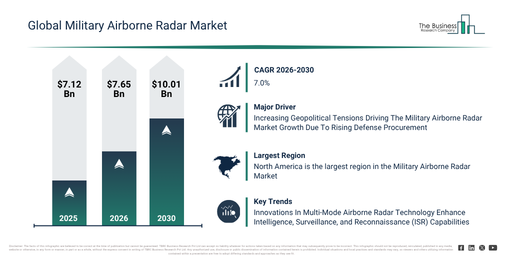
The military airborne radar market size has experienced strong growth in recent years. It is anticipated to expand from $7.12 billion in 2025 to $7.65 billion in 2026, demonstrating a compound annual growth rate (CAGR) of 7.4%. The expansion observed historically is attributable to increased defense spending, ongoing military aircraft modernization, a rising demand for airborne surveillance, the broadening of electronic warfare capabilities, and escalating geopolitical tensions.
The military airborne radar market is projected to experience substantial expansion in the upcoming years. It is forecast to grow to $10.01 billion by 2030, demonstrating a compound annual growth rate (CAGR) of 7.0%. This growth during the forecast period is fueled by the increasing adoption of unmanned aerial systems, a rising demand for advanced threat detection, growing investment in next-generation fighter aircraft, the increasing integration of AI-enabled radar processing, and the expanding demand for multifunction airborne radar systems. Key trends for this period include the wider adoption of active electronically scanned array radar, greater integration of multifunction radar systems, advancements in gallium nitride radar components, an increasing need for long-range detection capabilities, and the development of lightweight and compact airborne radar systems.
Get A Free Sample Report With In-Depth Market Insights:
Military Airborne Radar Market Demand Drivers Opening New Revenue Streams
Heightened geopolitical tensions are anticipated to drive the expansion of the military airborne radar market in the future. These tensions signify conflicts, rivalries, or instability among countries or regions, stemming from conflicting political, territorial, or strategic agendas. The rising occurrence of geopolitical tensions is primarily fueled by intensified interstate conflicts and power struggles, with ongoing wars and regional rivalries prompting governments to re-evaluate their security approaches and swiftly enhance defense capabilities. Consequently, an increase in geopolitical tensions stimulates the need for military airborne radar systems, as countries prioritize sophisticated aerial surveillance and threat identification technologies for monitoring adversary airspace and achieving crucial battlefield insight. For example, data from The Armed Conflict Location & Event Data Project (ACLED), a US-based non-profit, indicated that in July 2024, more than 165,273 political violence events were documented globally, representing a 15% surge between July 2023 and June 2024. Thus, the escalation of geopolitical tensions is a key factor propelling the growth of the military airborne radar market.
Military Airborne Radar Market Segment Outlook: Which Categories Are Growing Fastest?
The military airborne radar market covered in this report is segmented –
1) By Component: Antenna, Transmitter, Receiver, Duplexer, Power Amplifier, Other Components
2) By Range: Short Range, Medium Range, Long Range
3) By Technology: Phased Array Radar, Synthetic Aperture Radar, Pulse Doppler Radar, Frequency Modulated Continuous Wave Radar, Multifunction Radar
4) By Application: Surveillance, Targeting, Navigation, Weather Monitoring, Search And Rescue
5) By End User: Military Aviation, Defense Forces, Intelligence Agencies, Research Institutions, Commercial Aviation
Subsegments:
1) By Antenna: Active Electronically Scanned Array Antenna, Passive Electronically Scanned Array Antenna, Slotted Array Antenna, Planar Array Antenna
2) By Transmitter: Solid State Transmitter, Traveling Wave Tube Transmitter, Gallium Nitride Power Module, Gallium Arsenide Power Module
3) By Receiver: Superheterodyne Receiver, Digital Receiver, Multi Channel Receiver, Wideband Receiver
4) By Duplexer: Ferrite Duplexer, Circulator Duplexer, Coaxial Duplexer, Waveguide Duplexer
5) By Power Amplifier: Solid State Power Amplifier, Traveling Wave Tube Amplifier, Gallium Nitride Power Amplifier, Gallium Arsenide Power Amplifier
6) By Other Components: Signal Processor, Radar Processor, Frequency Synthesizer, Exciter Module
Military Airborne Radar Market Trends Powering Strategic Industry Growth
Leading companies in the military airborne radar sector are concentrating on developing advanced multi-mode airborne radar systems to enhance intelligence, surveillance, and reconnaissance (ISR) capabilities, improve situational understanding, and bolster defense operations across complex environments. A multi-mode airborne radar is an sophisticated radar system capable of operating in various radar modes, including Synthetic Aperture Radar (SAR), Ground Moving Target Indication (GMTI), and Inverse Synthetic Aperture Radar (ISAR), enabling it to detect, track, and image ground and maritime targets under diverse operational circumstances. For example, in June 2026, Robin Radar Systems, a Netherlands-based radar technology company, partnered with the Netherlands Organisation for Applied Scientific Research (TNO), a Netherlands-based research organization, to develop and commercialize a new multi-mode airborne radar platform for ground and sea surveillance, search and rescue, and intelligence, surveillance, and reconnaissance (ISR) missions. This radar is engineered for deployment on large unmanned aircraft systems (UAS) and integrates onboard processing with SAR, GMTI, and ISAR capabilities, providing long-range situational awareness and reliable imaging even in darkness, adverse weather, smoke, and dust.
Military Airborne Radar Market Key Participants And Competitive Landscape
Major companies operating in the military airborne radar market are RTX Corporation, Lockheed Martin Corporation, Northrop Grumman Corporation, The Boeing Company, General Dynamics Corporation, BAE Systems plc, Thales Group, L3Harris Technologies Inc., Leonardo S.p.A., Honeywell International Inc., Rheinmetall AG, Saab AB, Israel Aerospace Industries Ltd., Elbit Systems Ltd., Aselsan A.S., Hindustan Aeronautics Limited, Bharat Electronics Limited, Hanwha Systems Co. Ltd., Indra Sistemas S.A., HENSOLDT AG, Kratos Defense & Security Solutions Inc., Qorvo Inc., Mercury Systems Inc., Terma A/S, NEC Corporation
View The Full Military Airborne Radar Market Report:
Military Airborne Radar Market Geographic Analysis: Where Is Demand Rising Fastest?
North America was the largest region in the military airborne radar market in 2025. Asia-Pacific is expected to be the fastest-growing region in the forecast period. The regions covered in the military airborne radar market report are Asia-Pacific, South East Asia, Western Europe, Eastern Europe, North America, South America, Middle East, Africa.
Reach Out To Our Team:
The Business Research Company: https://www.thebusinessresearchcompany.com/
Americas: +1 310-496-7795
Asia: +44 7882 955267 & +91 8897263534
Europe: +44 7882 955267
Email us at: marketing@tbrc.info
Follow us on:
LinkedIn: https://in.linkedin.com/company/the-business-research-company
YouTube: https://www.youtube.com/channel/UC24_fI0rV8cR5DxlCpgmyFQ
Global Market Model: https://www.thebusinessresearchcompany.com/global-market-model

Wasay has over a decade of experience in market research, data modelling, and analytics, with prior experience at GlobalData and Decision Tree Consulting Services. At The Business Research Company , he leads research operations across syndicated studies, customized consulting engagements, and the Global Market Model platform. His professional experience includes supporting organizations such as Boston Consulting Group, KPMG, and Ernst & Young. Wasay holds a degree in Electronics and Communications Engineering, postgraduate management qualifications from International Management Institute Belgium and Indian School of Business and Entrepreneurship, and completed the Integrated Program in Business Analytics from Indian Institute of Management Indore.