Designed to make market research more actionable and strategically valuable, The Business Research Company’s 2026 market reports feature market attractiveness scoring, total addressable market sizing, company benchmarking matrices, interactive Excel dashboards, deeper supply chain intelligence, emerging startup tracking, and granular product-level insights.
Aerospace Market To Expand At A 5.7% CAGR: Size And Growth Projections Through 2030
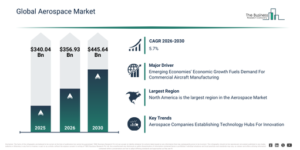
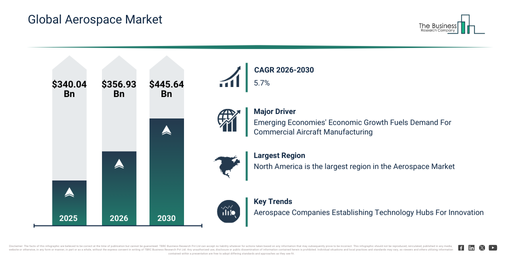
The aerospace market has demonstrated consistent expansion in recent years. It is projected to expand from $340.04 billion in 2025 to $356.93 billion in 2026, registering a compound annual growth rate (CAGR) of 5.0%. Historically, this expansion can be linked to several key factors, including a surge in global air travel boosting demand for commercial aircraft manufacturing, the enlargement of Maintenance, Repair, and Overhaul (MRO) services to maintain older commercial fleets, innovations in advanced aircraft components that enhance both efficiency and safety, the increasing integration of drones and ultralight aircraft into commercial sectors, and an uptick in aircraft modification and overhaul initiatives propelled by fleet modernization efforts.
The aerospace market is projected to experience substantial expansion over the upcoming years. Its valuation is set to reach $445.64 billion by 2030, achieving a compound annual growth rate (CAGR) of 5.7%. This anticipated growth during the forecast period is primarily driven by an escalating global demand for advanced, fuel-efficient aircraft from airlines, increased capital allocation towards sophisticated manufacturing techniques for aircraft parts, the broadening scope of commercial drone applications necessitating specific aerospace production expertise, a heightened requirement for thorough MRO solutions as global air fleets expand, and the evolution of sustainable aviation innovations impacting future aircraft designs and support provisions. Key trends identified for this period encompass a heightened pursuit of fuel-efficient aircraft, the extension of MRO capabilities into developing regions, a greater incorporation of composite materials in aircraft production, an increase in commercial aircraft shipments propelled by air travel demand, and augmented spending on advanced aerospace support equipment.
Get Your Free Aerospace Market Report Sample Today:
Which Factor Is Expected To Drive The Aerospace Market Over The Forecast Period?
The overall economic expansion in emerging economies is projected to positively affect the commercial aircraft manufacturing market. The increase in disposable income stemming from economic growth in these emerging markets has favorably influenced the demand for air travel. For example, in April 2024, the International Monetary Fund, a US-based financial agency, indicated that the global economy is expected to sustain a 3.2% growth rate in 2024 and 2025, mirroring the pace observed in 2023. Developed economies are also anticipated to show stable growth throughout the forecast period. Additionally, emerging markets are forecast to continue growing slightly faster than developed markets during the forecast period. This stable economic growth is expected to lead to increased investments in national security, thereby propelling the aerospace market over the forecast period.
Aerospace Market Segmentation Insights: How Is The Industry Categorized?
The aerospace market covered in this report is segmented –
1) By Type: Commercial Aircraft, Aircraft Maintenance, Repair and Overhauling Services, Aerospace Support and Auxiliary Equipment
2) By Size: Wide-Body, Narrow-Body, Regional, Other Sizes
3) By Operation: Autonomous Aircraft, Manual
4) By End-User: Government, Private Sector
Subsegments:
1) By Commercial Aircraft: Narrow-Body Aircraft, Wide-Body Aircraft, Regional Aircraft, Business Jets
2) By Aircraft Maintenance: Line Maintenance, Base Maintenance, Heavy Maintenance, Predictive Maintenance
3) By Repair and Overhauling Services: Component Repair, Engine Overhaul, Airframe Overhaul, Avionics Repair
4) By Aerospace Support and Auxiliary Equipment: Ground Support Equipment (GSE), Test Equipment, Tooling Equipment, Cargo Handling Equipment
Aerospace Market Trends Explained: What Is Changing And Why It Matters
Major entities within the aerospace market are concentrating on establishing technology hubs, such as Izon, to secure a competitive advantage. Aerospace technology hubs are defined as geographical areas that gather technology-driven companies, nascent businesses, and other organizations participating in the aerospace industry. For example, in September 2024, Honeywell, a US-based multinational conglomerate known for its technology and manufacturing contributions across sectors like aerospace, building technologies, and performance materials, initiated an innovation hub at Arizona State University’s Tempe campus. This venture was a partnership with the Ira A. Fulton Schools of Engineering. Both organizations are devoted to equipping students with vital engineering competencies to confront the critical issues facing the aerospace industry. The introduction of the Honeywell Innovation Hub highlights the company’s resolve to align its offerings with three important megatrends, which include developments in aviation.
Aerospace Market Competitor Landscape: Who Are The Major Companies?
Major companies operating in the aerospace market are Airbus Group, The Boeing Company, United Technologies Corporation, General Electric Company, Safran S.A., Honeywell International, Rolls-Royce Holdings Plc., Embraer S.A., Bombardier, Cessna (Textron Aviation), Dirgantara Indonesia, BAE Systems, Raj Hamsa Ultralights, Leonardo, Meggitt PLC, Honda Aircraft Company, GKN, Mitsubishi Aircraft Corporation, Mahindra Aerospace, IHI Corporation, Hindustan Aeronautics Limited (HAL), Kawasaki Aerospace Company, PD AeroSpace, Thales Japan, L3Harris Technologies Inc., TransDigm Group Incorporated, Arconic Inc., Britten-Norman, Pilatus Aircraft Ltd., Commercial Aircraft Corporation of China (COMAC), Superior Aviation Beijing Co., Indian Rotorcraft, Foxcon Aviation, ShinMaywa Aircraft Industries, Aviation Industry Corporation of China (AVIC), Drone Aerospace Systems Pvt Ltd., Dassault Aviation SA, Cobham plc, JAMCO Corporation, QinetiQ, Textron Inc., Hybrid Air Vehicles (HAV)
See The Full Aerospace Market Report For Complete Market Sizing And Trends:
Aerospace Market Regional Demand Analysis And Leading Geography
North America was the largest region in the aerospace market in 2025. North America is expected to be the fastest growing region in the forecast period. The regions covered in the aerospace market report are Asia-Pacific, South East Asia, Western Europe, Eastern Europe, North America, South America, Middle East, Africa.
Reach Out To Our Team:
The Business Research Company: https://www.thebusinessresearchcompany.com/
Americas: +1 310-496-7795
Asia: +44 7882 955267 & +91 8897263534
Europe: +44 7882 955267
Email us at: marketing@tbrc.info
Follow us on:
LinkedIn: https://in.linkedin.com/company/the-business-research-company
YouTube: https://www.youtube.com/channel/UC24_fI0rV8cR5DxlCpgmyFQ
Global Market Model: https://www.thebusinessresearchcompany.com/global-market-model

Wasay has over a decade of experience in market research, data modelling, and analytics, with prior experience at GlobalData and Decision Tree Consulting Services. At The Business Research Company , he leads research operations across syndicated studies, customized consulting engagements, and the Global Market Model platform. His professional experience includes supporting organizations such as Boston Consulting Group, KPMG, and Ernst & Young. Wasay holds a degree in Electronics and Communications Engineering, postgraduate management qualifications from International Management Institute Belgium and Indian School of Business and Entrepreneurship, and completed the Integrated Program in Business Analytics from Indian Institute of Management Indore.