
Delivering more actionable and strategically valuable research, The Business Research Company’s 2026 market reports feature market attractiveness analysis, total addressable market evaluation, company benchmarking matrices, interactive Excel dashboards, expanded supply chain intelligence, emerging startup coverage, and detailed product insights.
Carbon Neutral Cement Market Growth Analysis: How Will Revenue Expand During The Forecast Period?
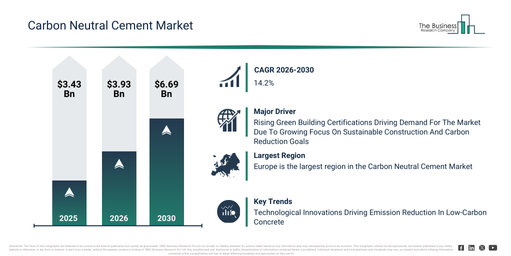
The carbon neutral cement market has experienced rapid expansion in recent years. Its valuation is projected to climb from $3.43 billion in 2025 to $3.93 billion in 2026, at a compound annual growth rate (CAGR) of 14.5%. This past growth can be ascribed to a heightened regulatory focus on CO2 emissions, the increasing acceptance of sustainable cement solutions, a surge in infrastructure projects, growing consciousness regarding construction’s environmental impact, and the advancement of alternative cement technologies.
The carbon neutral cement market size is projected for rapid expansion in the coming years. It is anticipated to grow to $6.69 billion by 2030, exhibiting a compound annual growth rate (CAGR) of 14.2%. This growth during the forecast period can be attributed to the broadening of carbon-neutral cement applications, increasing integration of digital carbon monitoring, rising utilization of high-performance blended concrete, advancements in low-carbon binder technologies, and a surge in sustainable infrastructure investments. Furthermore, key trends anticipated in this period encompass the deployment of carbon-neutral cement production systems, the adoption of alternative binder technologies, the integration of smart emission monitoring solutions, the expansion of AI-assisted carbon optimization tools, and the use of connected supply chains for carbon accounting.
Download A Free Sample Report For Comprehensive Market Insights:
#Carbon Neutral Cement Market Demand Drivers Creating New Revenue Opportunities
The rising number of green building certifications is projected to boost the expansion of the carbon neutral cement market moving forward. Carbon neutral cement refers to a variety of cement manufactured using technologies and substances that reduce or counterbalance carbon dioxide (CO2) emissions across its entire lifespan, from sourcing raw materials to production and application. Its objective is to attain net-zero carbon emissions via approaches like alternative binders, carbon capture, and the utilization of renewable energy or carbon offsets. Green building certifications are formal frameworks that assess and acknowledge buildings for meeting particular benchmarks in sustainability, energy efficiency, and environmental performance. These certifications are becoming more common due to heightened environmental consciousness, as an increasing number of developers and organizations strive to lower carbon emissions and foster sustainable construction methods to fulfill global climate targets. Low-carbon concrete assists in achieving green building certifications by decreasing the carbon footprint of building materials, improving energy efficiency, and contributing to sustainability points linked to emissions reduction, resource efficiency, and environmental performance. For instance, in July 2024, as per the Green Building Council, a US-based non-profit organization, more than 46,000 residential projects obtained LEED green building certification, indicating nearly a 5% rise in new registrations compared to 2023. Consequently, the increasing green building certifications are fueling the growth of the carbon neutral cement market.
Carbon Neutral Cement Market Segment Outlook: Which Categories Are Expanding The Fastest?
The carbon neutral cement market covered in this report is segmented –
1) By Type: Geopolymer Cement, Limestone Calcined Clay Cement (LC3), Magnesium-Based Cement, CarbonCured Cement, Bio-Cement, Alkali-Activated Cement, Other Types
2) By Technology: Alternative Calcium Sources, Clinker Substitution Techniques, Digital Emission Monitoring, Carbon Capture And Storage (CCS) Materials, Agriculture Waste-Based Materials
3) By Distribution Channel: Direct Sales (B2B), Distributors And Dealers, Online Sales Platforms, Government Procurement, Other Distribution Channels
4) By Application: Residential, Industrial Infrastructure, Transportation And Roadways, Marine And Offshore Structures, Other Applications
5) By End User: Construction Companies, Cement And Concrete Manufacturers, Government And Public Infrastructure Projects, Real Estate Developers, Other End Users
Subsegments:
1) By Geopolymer Cement: Fly Ash-Based, Slag-Based, Metakaolin-Based
2) By Limestone Calcined Clay Cement (LC3): Portland-Limestone Calcined Clay, Blended Limestone Calcined Clay Cement
3) By Magnesium-Based Cement: Magnesium Oxide Cement, Magnesium Hydroxide Cement
4) By Carbon Cured Cement: CO2-Cured Concrete, CO2-Cured Mortar
5) By Bio-Cement: Microbially Induced Calcium Carbonate, Enzyme-Induced Carbonate
6) By Alkali-Activated Cement: Slag-Based, Fly Ash-Based, Hybrid Blends
7) By Other Types: Sulfoaluminate Cement, Calcium Aluminate Cement
Carbon Neutral Cement Market Trends Driving Strategic Industry Expansion
Major companies in the carbon neutral cement market are concentrating on developing technological advancements, such as clinker carbon capture, to lower CO2 emissions during cement production and boost the sustainability of concrete manufacturing. Clinker carbon capture is a technology that captures carbon dioxide (CO2) emissions released during the clinker production process in cement manufacturing, stopping them from entering the atmosphere and thereby cutting the carbon footprint of concrete. For instance, in November 2023, Heidelberg Materials AG, a Germany-based building materials company, introduced a carbon-neutral cement brand named evoZero, which holds the distinction of being the world’s first carbon-captured net-zero cement. It provides a near-zero carbon footprint without compromising cement performance, offering builders a flexible, reliable product that supports environmentally friendly construction. This innovation is critical in reducing the cement industry’s carbon emissions and furthering global sustainability goals through transparent, verified carbon reductions.
Carbon Neutral Cement Market Key Companies And Competitive Benchmarking
Major companies operating in the carbon neutral cement market are Holcim Ltd., Cemex S.A.B. de C.V., Siam Cement Public Company Limited, Taiheiyo Cement Corporation, Vicat S.A., Votorantim Cimentos S.A., Fortera Corporation, JSW Cement Ltd., HeidelbergCement AG, Sublime Systems Inc., Kiran Global Chem Limited, Ecocem Global Ltd., Cemvision AB, Navrattan Group, SeraTech Technologies Inc., Brimstone Materials Inc., EcoBinder Solutions Ltd., Ecomaterials India Pvt. Ltd., Material Evolution, Concrete4Change Ltd.
Access The Complete Carbon Neutral Cement Market Report:
Carbon Neutral Cement Market Leading Geography: Which Region Generates The Most Revenue?
Europe was the largest region in the carbon neutral cement market in 2025. Asia-Pacific is expected to be the fastest-growing region in the forecast period. The regions covered in the carbon neutral cement market report are Asia-Pacific, South East Asia, Western Europe, Eastern Europe, North America, South America, Middle East, Africa.
Get in touch with us:
The Business Research Company: https://www.thebusinessresearchcompany.com/
Americas: +1 310-496-7795
Asia: +44 7882 955267 & +91 8897263534
Europe: +44 7882 955267
Email us at: marketing@tbrc.info
Follow us on:
LinkedIn: https://in.linkedin.com/company/the-business-research-company
YouTube: https://www.youtube.com/channel/UC24_fI0rV8cR5DxlCpgmyFQ
Global Market Model: https://www.thebusinessresearchcompany.com/global-market-model

Wasay has over a decade of experience in market research, data modelling, and analytics, with prior experience at GlobalData and Decision Tree Consulting Services. At The Business Research Company , he leads research operations across syndicated studies, customized consulting engagements, and the Global Market Model platform. His professional experience includes supporting organizations such as Boston Consulting Group, KPMG, and Ernst & Young. Wasay holds a degree in Electronics and Communications Engineering, postgraduate management qualifications from International Management Institute Belgium and Indian School of Business and Entrepreneurship, and completed the Integrated Program in Business Analytics from Indian Institute of Management Indore.