
Enhanced with market attractiveness analysis, total addressable market evaluation, company benchmarking matrices, interactive Excel dashboards, expanded supply chain intelligence, emerging startup coverage, and detailed product insights, The Business Research Company’s 2026 market reports deliver more actionable and strategically valuable research.
Carbon Dioxide (CO2) Mineralization Market Forecast: What Market Value Is Expected By 2030?
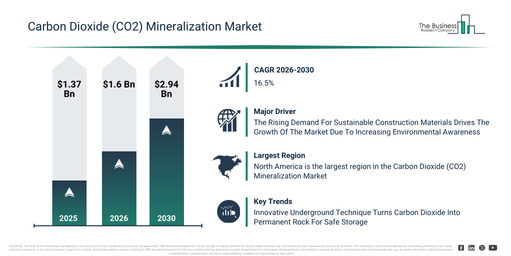
The carbon dioxide (CO2) mineralization market size has observed rapid expansion in recent years. This market is forecast to increase from $1.37 billion in 2025 to $1.6 billion in 2026, achieving a compound annual growth rate (CAGR) of 16.7%. The historical growth of this market can be linked to factors such as the rising demand for carbon capture solutions, the expanding application of mineralization in building materials, the embrace of magnesium-based cements, increasing initiatives to reduce industrial emissions, and supportive regulations for CO2 management.
The carbon dioxide (CO2) mineralization market is projected to experience substantial expansion in the coming years. It is forecast to reach $2.94 billion by 2030, growing at a compound annual growth rate (CAGR) of 16.5%. This growth throughout the forecast period can be attributed to the increasing incorporation of advanced mineralization technologies, the broadening of ex-situ and in-situ mineralization initiatives, the creation of scalable industrial uses, the growing uptake of enhanced weathering techniques, and the rise in carbon credit and certification offerings. Key trends anticipated during this period include the adoption of direct and indirect CO2 mineralization methods, the expansion of enhanced weathering processes, the utilization of carbonate-based building materials, the incorporation of magnesium-based cements, and the establishment of monitoring and verification systems.
Download A Free Sample Report For Comprehensive Market Insights:
Carbon Dioxide (CO2) Mineralization Market Expansion Supported By Key Demand Factors
The carbon dioxide (CO2) mineralization market is expected to grow as the demand for sustainable construction materials increases. Sustainable construction materials are defined as building materials that are environmentally responsible, resource-efficient, and engineered to minimize adverse impacts on the environment throughout their life cycle, from production and use to disposal or recycling. The heightened demand for these materials is attributed to greater environmental awareness among consumers, governments, and industries regarding the need to reduce carbon footprints and promote eco-friendly building practices. Carbon dioxide (CO2) mineralization supports sustainable construction materials by transforming captured CO2 into stable carbonates, which can be utilized as eco-friendly building materials, thereby decreasing carbon emissions and advancing a circular construction economy. For example, in July 2024, the U.S. Green Building Council, a U.S.-based non-profit organization, was involved in over 46,000 residential projects certified under the LEED green building rating system in 2024, following nearly a 5% increase in new LEED residential project registrations in 2023. Consequently, the rising demand for sustainable construction materials is a key driver for the growth of the carbon dioxide (CO2) mineralization market.
Carbon Dioxide (CO2) Mineralization Market Segment Landscape: Which Areas Lead Market Development?
The carbon dioxide (co2) mineralization market covered in this report is segmented –
1) By Technology: Direct Aqueous Mineralization, Indirect Mineralization, Enhanced Weathering, Other Technologies
2) By Feedstock: Natural Minerals, Industrial Waste, Other Feedstocks
3) By Application: Carbon Capture And Storage, Building Materials, Industrial Processes, Environmental Remediation, Other Applications
4) By End-User: Construction, Oil And Gas, Chemical, Power Generation, Other End-Users
Subsegments:
1) By Direct Aqueous Mineralization: In-Situ Mineralization, Ex-Situ Mineralization, Accelerated Carbonation, Brine-Based Mineralization
2) By Indirect Mineralization: Two-Step Carbonation, Acid Dissolution Process, Thermal Activation Process, Carbonation Of Industrial Residues
3) By Enhanced Weathering: Terrestrial Weathering, Marine Weathering, Olivine Weathering, Basalt Weathering
4) By Other Technologies: Electrochemical Mineralization, Biological Mineralization, Supercritical Carbon Dioxide Mineralization, Hybrid Mineralization Processes
Carbon Dioxide (CO2) Mineralization Market Growth Trends Influencing Competitive Dynamics
Leading companies in the carbon dioxide mineralization (CO2) market are concentrating on developing innovative approaches, such as in-situ mineralization, to transform CO2 into stable minerals for secure and permanent storage. In-situ mineralization is a process where carbon dioxide (CO2) is directly injected into underground rock formations, where it chemically reacts with naturally present minerals to form stable, solid carbonates, effectively achieving permanent CO2 storage within the Earth. For example, in April 2024, Deep Sky Corp., a Canada-based carbon removal technology and project development company, collaborated with Carbfix hf, an Iceland-based carbon capture and storage (CCS) company, to launch the first CO2 mineralization storage project in Quebec, aiming to permanently store carbon by converting it into rock. These projects utilize a technology that injects CO2 into underground basaltic rock formations, facilitating its rapid mineralization into stable stone. This method ensures permanent and safe carbon sequestration within just a few years, unlike traditional storage techniques. The project merges Deep Sky’s expertise in carbon removal with Carbfix’s proven mineralization technology to develop scalable and commercially viable carbon storage solutions, thereby supporting global net-zero objectives.
Carbon Dioxide (CO2) Mineralization Market Industry Leaders And Market Competition
Major companies operating in the carbon dioxide (CO2) mineralization market are Heidelberg Materials AG, CEMEX S.A.B. de C.V., Lhoist Group S.A., Solidia Technologies Inc., Neustark AG, Calix Limited, Carbon Upcycling Technologies Inc., CarbiCrete Inc., Deep Sky Corp., Mineral Carbonation International Pty Ltd., CarbonBuilt LLC, Baie Minerals Inc., Green Minerals AS, Paebbl Inc., Blue Skies Minerals Inc., CO2 Lock Corporation, CarbonFree Chemicals Holdings LLC, Travertine Technologies Inc., Karbonetiq Inc, Carbfix hf.
Access The Complete Carbon Dioxide (CO2) Mineralization Market Report:
Carbon Dioxide (CO2) Mineralization Market Regional Outlook: Where Are The Largest Opportunities Located?
North America was the largest region in the carbon dioxide (CO2) mineralization market in 2025. Asia-Pacific is expected to be the fastest-growing region in the forecast period. The regions covered in the carbon dioxide (CO2) mineralization market report are Asia-Pacific, South East Asia, Western Europe, Eastern Europe, North America, South America, Middle East, Africa.
Get in touch with us:
The Business Research Company: https://www.thebusinessresearchcompany.com/
Americas: +1 310-496-7795
Asia: +44 7882 955267 & +91 8897263534
Europe: +44 7882 955267
Email us at: marketing@tbrc.info
Follow us on:
LinkedIn: https://in.linkedin.com/company/the-business-research-company
YouTube: https://www.youtube.com/channel/UC24_fI0rV8cR5DxlCpgmyFQ
Global Market Model: https://www.thebusinessresearchcompany.com/global-market-model

Wasay has over a decade of experience in market research, data modelling, and analytics, with prior experience at GlobalData and Decision Tree Consulting Services. At The Business Research Company , he leads research operations across syndicated studies, customized consulting engagements, and the Global Market Model platform. His professional experience includes supporting organizations such as Boston Consulting Group, KPMG, and Ernst & Young. Wasay holds a degree in Electronics and Communications Engineering, postgraduate management qualifications from International Management Institute Belgium and Indian School of Business and Entrepreneurship, and completed the Integrated Program in Business Analytics from Indian Institute of Management Indore.