With a focus on actionable insights and strategic value, The Business Research Company’s 2026 market reports include market attractiveness scoring, total addressable market sizing, company benchmarking matrices, interactive Excel dashboards, deeper supply chain intelligence, emerging startup tracking, and granular product-level insights.
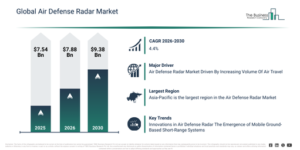
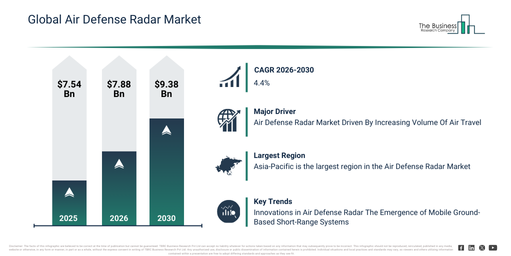
Air Defense Radar Market Size Outlook: A $9.38 Billion Market By 2030, Growing At 4.4% Annually
The air defense radar market has experienced consistent expansion over recent years. This market is projected to expand from $7.54 billion in 2025 to $7.88 billion in 2026, demonstrating a compound annual growth rate (CAGR) of 4.5%. This historical growth is attributable to several factors, including an increase in defense modernization initiatives that are prompting the acquisition of tracking and fire control radars, an escalation of geopolitical tensions which fuels the need for sophisticated airspace surveillance, innovations in radar signal processing and phased-array technologies that improve detection precision, the past proliferation of integrated air defense systems within military forces, and an increase in maintenance and system support services provided by manufacturers during warranty periods.
The air defense radar market is expected to demonstrate steady expansion in the coming years, with its size projected to reach $9.38 billion in 2030, exhibiting a compound annual growth rate (CAGR) of 4.4%. This growth during the forecast period can be attributed to the increasing adoption of multi-mission radars capable of tracking diverse aerial threats, including UAVs and hypersonic weapons; growing investment in long-range early warning radar systems to enhance national air defense; a rising demand for mobile and rapidly deployable radar platforms for tactical operations; expanding procurement of networked air defense systems that integrate sensors and command-and-control solutions; and an anticipated increase in lifecycle service packages, encompassing training, upgrades, and predictive maintenance for new radar deployments. Major trends for this period include the development of integrated multi-function radar systems for improved threat detection, the miniaturization and increased mobility of radar systems for tactical deployments, the application of advanced signal processing algorithms for higher tracking accuracy, the expansion of network-centric air defense systems for real-time coordination, and the incorporation of stealth detection and countermeasure capabilities into radar systems.
Make Data-Driven Decisions With A Free Air Defense Radar Market Sample Report:
Key Demand Driver Expected To Lift Air Defense Radar Market Revenue
The expanding volume of air travel is anticipated to propel the air defense radar market’s expansion in the future. Air travel is defined as the transportation of individuals, goods, or correspondence via aircraft between multiple destinations. This surge in air travel volume is attributed to elements like the rise of low-cost carriers (LCCs), bilateral open skies agreements, enhanced airport infrastructure investments, and a boost in tourism. Air defense radar indirectly facilitates air travel volume by guaranteeing airspace safety and security, crucial for upholding confidence among passengers, airlines, and regulatory bodies regarding air travel safety. As an illustration, in December 2024, Eurostat, a Luxembourg-based government agency, reported that 973 million passengers flew within the EU in 2023, representing a 19.3% increase from 816 million in 2022. This data further indicated that every EU country observed a rise in air passenger figures year-over-year. Consequently, the escalating volume of air travel serves as a key driver for the air defense radar market.
Exploring The Air Defense Radar Market Through Its Key Segments
The air defense radar market covered in this report is segmented –
1) By Product Type: Synthetic Aperture And Moving Target Indicator Radar, Surveillance Radar, Airborne Early Warning Radar, Multi-Functional Radar, Weather Radar, Other Product Types
2) By System Type: Fixed, Portable
3) By Platform: Ground-Based, Aircraft-Mounted, Naval-Based
4) By Range: Long Range, Medium Range, Short Range
5) By Application: Ballistic Missile Defense, Identification Friend Or Foe, Weather Forecasting, Other Applications
Subsegments:
1) By Synthetic Aperture And Moving Target Indicator Radar: Ground Surveillance Radar, Airborne Moving Target Indicator (AMTI) Radar
2) By Surveillance Radar: 2D Surveillance Radar, 3D Surveillance Radar
3) By Airborne Early Warning Radar: AWACS (Airborne Warning And Control System), AEW (Airborne Early Warning) Systems
4) By Multi-Functional Radar: Fire Control Radar, Target Tracking Radar
5) By Weather Radar: Doppler Weather Radar, Terminal Doppler Weather Radar
6) By Other Product Types: Electronic Warfare Radar, Ground Control Approach Radar
New Trends Redefining Competition In The Air Defense Radar Market
Leading companies operating in the air defense radar market are developing innovative products, such as highly mobile ground-based short-range air defense systems, to improve target detection and response against evolving aerial threats. Advances in artificial intelligence, signal processing, and network integration are essential for enhancing operational effectiveness and adaptability. A highly mobile ground-based short-range air defense system (SHORAD) protects forces and critical assets from aerial threats through rapid deployment and repositioning. For instance, in June 2024, Kongsberg Defense and Aerospace, a Norway-based aerospace company, launched a national manoeuvre air defense system. This national manoeuvre air defense system (NOMADS) provides significant mobility and versatile threat engagement to protect frontline forces from aerial threats. Its integration into NATO frameworks enhances collective defense capabilities, ensuring rapid response in dynamic combat environments.
Air Defense Radar Market Competition: Key Players And Industry Participants
Major companies operating in the air defense radar market are RTX Corporation, Lockheed Martin Corporation, General Dynamics Corporation, Northrop Grumman Corporation, BAE Systems plc, L3Harris Technologies Inc., Thales Group, Leonardo S.p.A., Rheinmetall Defence Electronics GmbH, CACI International Inc., Babcock International Group, MBDA Missile Systems, Israel Aerospace Industries Ltd., Indra Sistemas SA, Kongsberg Gruppen ASA, Rafael Advanced Defense Systems Ltd., Rohde & Schwarz GmbH & Co KG, Aselsan AS, Hensoldt AG, QinetiQ Group plc, Saab AB, Ultra Electronics Holdings plc, Terma AS, RADA Electronic Industries Ltd., Elta Group
Get The Detailed Air Defense Radar Market Research Report Here:
Air Defense Radar Market Regional Overview: Largest Market And Global Coverage
Asia-Pacific was the largest region in the air defense radar market in 2025. The regions covered in the air defense radar market report are Asia-Pacific, South East Asia, Western Europe, Eastern Europe, North America, South America, Middle East, Africa.
Reach Out To Our Team:
The Business Research Company: https://www.thebusinessresearchcompany.com/
Americas: +1 310-496-7795
Asia: +44 7882 955267 & +91 8897263534
Europe: +44 7882 955267
Email us at: marketing@tbrc.info
Follow us on:
LinkedIn: https://in.linkedin.com/company/the-business-research-company
YouTube: https://www.youtube.com/channel/UC24_fI0rV8cR5DxlCpgmyFQ
Global Market Model: https://www.thebusinessresearchcompany.com/global-market-model

Wasay has over a decade of experience in market research, data modelling, and analytics, with prior experience at GlobalData and Decision Tree Consulting Services. At The Business Research Company , he leads research operations across syndicated studies, customized consulting engagements, and the Global Market Model platform. His professional experience includes supporting organizations such as Boston Consulting Group, KPMG, and Ernst & Young. Wasay holds a degree in Electronics and Communications Engineering, postgraduate management qualifications from International Management Institute Belgium and Indian School of Business and Entrepreneurship, and completed the Integrated Program in Business Analytics from Indian Institute of Management Indore.