The Business Research Company’s 2026 market reports are designed to deliver research that is more actionable and strategically valuable. Key offerings include market attractiveness scoring, total addressable market sizing, company benchmarking matrices, interactive Excel dashboards, deeper supply chain intelligence, emerging startup tracking, and granular product-level insights.
Air Defense System Market Size 2026: Valuation, Growth Rate And Forecast To 2030
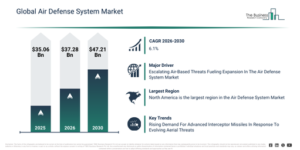
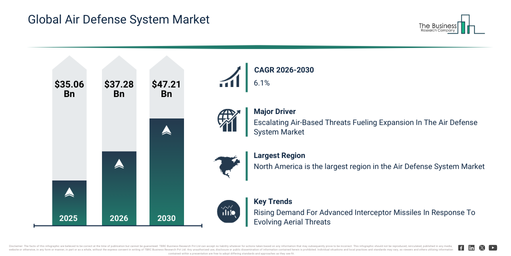
The air defense system market size has experienced strong growth in recent years. It is anticipated to expand from $35.06 billion in 2025 to $37.28 billion in 2026, at a compound annual growth rate (CAGR) of 6.3%. The historical expansion can be attributed to factors such as increasing procurement of ground-based air defense systems for border protection, a rise in the deployment of man-portable air defense systems in asymmetric warfare, the progression of modernization programs aimed at replacing legacy air defense platforms, an escalated threat from hostile UAVs and cruise missiles driving system upgrades, and advancements in radar and command-and-control integration enhancing system effectiveness.
The air defense system market is projected to experience substantial expansion over the upcoming years. Its size is anticipated to reach $47.21 billion by 2030, demonstrating a compound annual growth rate (CAGR) of 6.1%. This projected growth can be linked to several factors, including the broader adoption of mobile air defense systems for quick-response missions, increased spending on multi-layered air and missile defense frameworks, a heightened need for counter-UAV technologies within comprehensive defense setups, the creation of advanced interceptors with better precision and reach, and a greater focus on ensuring interoperable defense networks among allied countries. Key trends anticipated during this period involve the increasing embrace of multi-layer integrated air defense networks, a heightened requirement for mobile and quickly deployable air defense units, an expanding emphasis on capabilities for counter-UAV and swarm defense, enhancements to existing air defense systems through precision engagement technologies, and the broadening of long-range hypersonic missile interception capacities.
Get A Free Sample Of The Air Defense System Market Report 2026:
What Is Driving The Growth Of The Air Defense System Market?
An increasing volume of air-based threats is anticipated to fuel the expansion of the air defense system market in the future. An air threat encompasses the total danger presented by adversaries, particularly their capability to exploit weaknesses through aerial threat vehicles and bombs. These systems are employed against air threats to locate, recognize, and monitor potential dangers, subsequently engaging and eliminating them prior to any potential harm. With the evolution of air power, the scope of air threats has broadened to incorporate attack helicopters, unmanned aerial vehicles (UAVs), cruise missiles, and ballistic missiles. For example, data from January 2024, based on a report from the UK-based non-governmental organization Action on Armed Violence (AOAV), indicates a significant rise in air-launched attacks in 2023, showing a 226% escalation from 519 incidents recorded in 2022. Consequently, the increasing prevalence of air-based threats is a key factor stimulating the growth of the air defense system market.
How Is The Air Defense System Market Segmented?
The air defense system market covered in this report is segmented –
1) By Type: Missile Defense System, Anti-Aircraft System, Counter Rocket, Artillery And Mortar (C-RAM) System
2) By Component: Weapon System, Fire Control System, Command And Control System, Other Components
3) By Range: Short Range Air Defense System, Medium Range Air Defense System, Long Range Air Defense System
4) By Application: Land, Naval, Airborne
Subsegments:
1) By Missile Defense System: Ballistic Missile Defense, Cruise Missile Defense, Terminal High Altitude Area Defense (THAAD), Aegis Ballistic Missile Defense
2) By Anti-Aircraft System: Short-Range Air Defense (SHORAD), Medium-Range Air Defense (MRAD), Long-Range Air Defense (LRAD), Surface-To-Air Missile (SAM) Systems
3) By Counter Rocket, Ground-Based Interception Systems, Airborne Interception Systems, Early Warning And Detection Systems, Integrated Command And Control Systems
4) By Artillery And Mortar (C-RAM) System: Ground-Based C-RAM Solutions, Integrated C-RAM Systems, Mobile C-RAM Platforms, Sensor And Detection Systems, Command And Control Systems
What Are The Latest Trends In The Air Defense System Market?
Leading companies operating in the air defense system market are concentrating on creating advanced solutions, including interceptor missiles, to satisfy the growing need for improved defense against evolving aerial dangers. These interceptor missiles are engineered to identify, monitor, and eliminate approaching threats such as ballistic and cruise missiles, along with sophisticated aircraft. In contrast to conventional systems that utilize proximity fuses or blast fragmentation, contemporary interceptors use hit-to-kill technology, guaranteeing greater precision and reducing incidental harm. For example, in October 2025, Boeing, an aerospace firm based in the U.S., secured multi-year agreements worth approximately $2.7 billion to provide more than 3,000 guidance seekers for the Patriot Advanced Capability-3 (PAC-3) interceptor missiles. These seekers are essential components that allow the missiles to detect, track, and engage targets. Annual production is projected to reach as many as 750 units through 2030. This increase in demand is fueled by heightened geopolitical tensions and persistent conflicts across Ukraine, the Middle East, and the Indo-Pacific region. Furthermore, these advancements are consistent with wider U.S. defense strategies, such as the Golden Dome missile defense system proposed by former President Donald Trump.
Who Are The Key Players In The Air Defense System Market?
Major companies operating in the air defense system market are Lockheed Martin Corporation, BAE Systems plc, Rheinmetall AG, Thales Group, Northrop Grumman Corporation, Hanwha Corporation, Leonardo SPA, L3Harris Technologies Inc., Saab AB, Israel Aerospace Industries Ltd., The Boeing Company, Aselsan AS, Airbus Defence and Space, Elbit Systems Ltd., Kongsberg Gruppen ASA, Cobham Ltd., MBDA Missile Systems, Raytheon Technologies Corporation, Defense Research and Development Organization, Turkish Aerospace Industries Inc., Rafael Advanced Defense Systems Ltd., General Dynamics Corporation, Almaz-Antey Corporation, Mitsubishi Electric Corporation, Rostec State Corporation
Read The Complete Air Defense System Market Report 2026:
Which Region Is The Largest In The Air Defense System Market?
North America was the largest region in the air defense system market in 2025. Asia-Pacific is expected to be the fastest-growing region in the air defense system market report during the forecast period. The regions covered in the air defense system market report are Asia-Pacific, South East Asia, Western Europe, Eastern Europe, North America, South America, Middle East, Africa.
Reach Out To Our Team:
The Business Research Company: https://www.thebusinessresearchcompany.com/
Americas: +1 310-496-7795
Asia: +44 7882 955267 & +91 8897263534
Europe: +44 7882 955267
Email us at: marketing@tbrc.info
Follow us on:
LinkedIn: https://in.linkedin.com/company/the-business-research-company
YouTube: https://www.youtube.com/channel/UC24_fI0rV8cR5DxlCpgmyFQ
Global Market Model: https://www.thebusinessresearchcompany.com/global-market-model

Wasay has over a decade of experience in market research, data modelling, and analytics, with prior experience at GlobalData and Decision Tree Consulting Services. At The Business Research Company , he leads research operations across syndicated studies, customized consulting engagements, and the Global Market Model platform. His professional experience includes supporting organizations such as Boston Consulting Group, KPMG, and Ernst & Young. Wasay holds a degree in Electronics and Communications Engineering, postgraduate management qualifications from International Management Institute Belgium and Indian School of Business and Entrepreneurship, and completed the Integrated Program in Business Analytics from Indian Institute of Management Indore.