
The Business Research Company’s 2026 market reports are designed to deliver research that is more actionable and strategically valuable. Key offerings include market attractiveness scoring, total addressable market sizing, company benchmarking matrices, interactive Excel dashboards, deeper supply chain intelligence, emerging startup tracking, and granular product-level insights.
Airborne Satellite Communication (SATCOM) System Market Size, Growth Rate And Key Forecast Highlights For 2026–2030
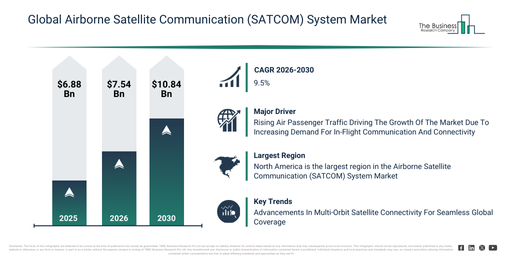
The airborne satellite communication (SATCOM) system market has experienced robust growth recently. It will grow from $6.88 billion in 2025 to $7.54 billion in 2026 at a compound annual growth rate (CAGR) of 9.7%. This historic growth is attributable to an increased reliance on airborne communication for remote operations, expanded connectivity in military and commercial aviation, improvements in antenna stabilization and multiplexing technologies, the adoption of SATCOM systems for extended military missions, and growing investments in highly reliable airborne communication networks.
The airborne satellite communication (SATCOM) system market is projected to experience substantial expansion in the coming years. This market is forecast to reach $10.84 billion by 2030, exhibiting a compound annual growth rate (CAGR) of 9.5%. Key factors driving this growth during the forecast period include the evolution of next-generation high-throughput SATCOM systems, the incorporation of AI-based network optimization, increased use in drone and UAV communication, wider acceptance of multi-band and multi-orbit SATCOM, and a growing need for uninterrupted global airborne connectivity for defense operations. Significant trends anticipated in this period encompass the broadening of satellite-based connectivity for remote aviation, increased adoption of multi-band SATCOM, an escalating demand for secure airborne communications, greater integration of SATCOM into unmanned aerial platforms, and innovations in high-altitude long-endurance (HALE) connectivity.
See What’s Inside The Airborne Satellite Communication (SATCOM) System Market Report With A Free Sample:
Airborne Satellite Communication (SATCOM) System Market Expansion: The Major Factor Driving Growth
Rising air passenger numbers are anticipated to fuel the expansion of the airborne satellite communication (SATCOM) system market in the future. This traffic refers to the aggregate count of individuals flying on commercial planes within a specific timeframe, encompassing both internal and international journeys. The surge in air passenger volume stems from higher middle-class incomes, allowing more individuals to finance air travel for business and recreational pursuits, thereby expanding the worldwide traveler base. Consequently, increasing air passenger traffic stimulates the need for airborne SATCOM systems, as airlines demand dependable in-flight communication and internet solutions to efficiently handle greater passenger loads, concurrently guaranteeing safety, operational synchronization, and connectivity for travelers. For example, the International Air Transport Association, a Canadian trade body, reported in January 2025 that domestic full-year air traffic rose by 5.7% in 2024 compared to the prior year, alongside a 2.5% increase in available capacity. Thus, the escalation in air passenger traffic is indeed fostering the expansion of the airborne satellite communication (SATCOM) system market.
Understanding Airborne Satellite Communication (SATCOM) System Market Segmentation For Strategic Planning
The airborne satellite communication (satcom) system market covered in this report is segmented –
1) By Component: Transceivers, Airborne Radio, Modems And Routers, SATCOM Terminals
2) By Frequency: C-Band, L-Band, Ka-Band, Ku-Band, UHF-Band
3) By Platform: Fixed-Wing Aircraft, Rotary-Wing Aircraft, Unmanned Aerial Vehicles
4) By Application: Military Communication, Commercial Aviation, Search And Rescue, Remote Sensing, Disaster Management
5) By End Use: Government, Defense, Private Aviation, Commercial Airlines
Subsegments::
1) By Transceivers: Ku Band Transceivers, Ka Band Transceivers, L Band Transceivers, S Band Transceivers
2) By Airborne Radio: Vhf Radios, Uhf Radios, Satcom Radios, High Frequency Radios
3) By Modems And Routers: Satellite Modems, Ip Routers, Network Routers, Data Modems
4) By Satcom Terminals: Airborne Satcom Terminals, Mobile Satcom Terminals, Fixed Satcom Terminals, Portable Satcom Terminals
Key Airborne Satellite Communication (SATCOM) System Market Trends To Watch In 2026
Major companies in the airborne satellite communication (SATCOM) system market are focusing on integrating multi-orbit capabilities to expand global satellite reach, bolster network reliability, and provide continuous high-speed connectivity across various regions. Multi-orbit capability refers to a satellite system’s capacity to operate across different orbital paths, which enhances coverage, offers redundancy, and increases flexibility for communication, navigation, and data services. As an example, in May 2024, SES S.A., a Luxembourg-based satellite communications company, introduced SES Open Orbits, a multi-orbit Ka-band inflight connectivity network specifically for airlines. This network combines SES’s GEO (geostationary) and MEO (medium-earth orbit) satellites with contributions from regional partners Neo Space Group, AeroSat Link, and Hughes Communications India, achieving seamless global coverage. Its open-architecture design enables traffic to be dynamically managed across various satellite systems, ensuring airlines can deliver consistent connectivity throughout the entire flight. This initiative is set to transform in-flight connectivity by providing airlines with uninterrupted, high-speed internet access globally, thereby improving the passenger experience and operational efficiency.
Key Companies Active In The Airborne Satellite Communication (SATCOM) System Market
Major companies operating in the airborne satellite communication (SATCOM) system market are RTX Corporation, Northrop Grumman Corporation, Honeywell International Inc., BAE Systems plc, Collins Aerospace, Thales S.A., L3Harris Technologies Inc., Ball Corporation, Singapore Technologies Engineering Ltd., Israel Aerospace Industries Ltd., Viasat Inc., General Dynamics Mission Systems Inc., ASELSAN Electronics Industry and Trade Inc., Intelsat S.A., Telesat Corporation, Smiths Interconnect Inc., Hughes Network Systems LLC, Gilat Satellite Networks Ltd., Orbit Communications Systems Ltd., Cobham Aerospace Communications Dourdan SACA.
Explore Detailed Airborne Satellite Communication (SATCOM) System Market Research And Forecasts:
Which Geography Dominates The Airborne Satellite Communication (SATCOM) System Market?
North America was the largest region in the airborne satellite communication (SATCOM) system market in 2025. Asia-Pacific is expected to be the fastest-growing region in the forecast period. The regions covered in the airborne satellite communication (SATCOM) system market report are Asia-Pacific, South East Asia, Western Europe, Eastern Europe, North America, South America, Middle East, Africa.
Reach Out To Our Team:
The Business Research Company: https://www.thebusinessresearchcompany.com/
Americas: +1 310-496-7795
Asia: +44 7882 955267 & +91 8897263534
Europe: +44 7882 955267
Email us at: marketing@tbrc.info
Follow us on:
LinkedIn: https://in.linkedin.com/company/the-business-research-company
YouTube: https://www.youtube.com/channel/UC24_fI0rV8cR5DxlCpgmyFQ
Global Market Model: https://www.thebusinessresearchcompany.com/global-market-model

Wasay has over a decade of experience in market research, data modelling, and analytics, with prior experience at GlobalData and Decision Tree Consulting Services. At The Business Research Company , he leads research operations across syndicated studies, customized consulting engagements, and the Global Market Model platform. His professional experience includes supporting organizations such as Boston Consulting Group, KPMG, and Ernst & Young. Wasay holds a degree in Electronics and Communications Engineering, postgraduate management qualifications from International Management Institute Belgium and Indian School of Business and Entrepreneurship, and completed the Integrated Program in Business Analytics from Indian Institute of Management Indore.

