Designed to make market research more actionable and strategically valuable, The Business Research Company’s 2026 market reports feature market attractiveness scoring, total addressable market sizing, company benchmarking matrices, interactive Excel dashboards, deeper supply chain intelligence, emerging startup tracking, and granular product-level insights.
Airborne Sensors Market To Expand At A 6.5% CAGR: Size And Growth Projections Through 2030
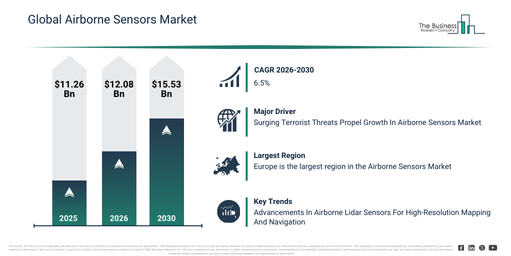
The airborne sensors market has experienced robust growth in recent years. It is anticipated to increase from $11.26 billion in 2025 to $12.08 billion in 2026, reflecting a compound annual growth rate (CAGR) of 7.3%. This historical expansion can be attributed to several factors, such as the rising uptake of airborne imaging and sensing technologies for geospatial surveying, the increasing use of sensors on drones for efficient data collection, the expansion of defense and intelligence applications requiring advanced airborne sensing capabilities, enhancements in pressure and temperature sensor technologies leading to improved measurement accuracy, and the broader application of airborne sensors in environmental monitoring and climate research.
The airborne sensors market is anticipated to experience substantial expansion over the next few years, with its size projected to reach $15.53 billion by 2030, demonstrating a compound annual growth rate (CAGR) of 6.5%. This growth during the forecast period is fueled by an increasing demand for multi-sensor payloads integrating speed and thermal sensing, coupled with rising investments in high-resolution and real-time airborne data acquisition systems. Further contributing factors include the growing adoption of autonomous airborne platforms that require advanced sensor suites, the development of lightweight and energy-efficient sensors for extended flight endurance, and the expansion of commercial applications. Key trends expected in this period encompass AI-powered data analysis for real-time airborne sensor interpretation, the deployment of autonomous drones and UAVs for remote data collection, the utilization of cloud-based storage and processing for high-volume sensor data, the integration of IoT-enabled sensors for connected airborne platforms, and the advancement of multi-modal sensors combining optical, infrared, and radar capabilities.
Get Your Free Airborne Sensors Market Report Sample Today:
Which Factor Is Expected To Drive The Airborne Sensors Market Over The Forecast Period?
The airborne sensors market is anticipated to expand due to a rise in terrorist activities. These activities, defined as criminal or violent acts by individuals or groups linked to terrorist organizations, fuel the need for airborne sensors in defense to safeguard borders. For example, the Institute for Economics & Peace (IEP), an Australia-based non-profit think tank, reported in February 2024 that terrorism remains a major global threat, with 8,352 deaths in 2023, an increase from 6,823 in 2022, and the lethality rate seeing its first increase in five years. Consequently, a surge in terrorist activities will stimulate growth in the airborne sensors market.
Airborne Sensors Market Segmentation Insights: How Is The Industry Categorized?
The airborne sensors market covered in this report is segmented –
1) By Type: Non-Scanning, Scanning
2) By Component: Hardware, Software
3) By Application: Defense Aircraft, Commercial Aircraft, Other Application
Subsegments:
1) By Non-Scanning Sensors: Electro-Optical Sensors, Infrared Sensors, Multi-Spectral Sensors
2) By Scanning Sensors: Synthetic Aperture Radar (SAR), Imaging Radar, Lidar Sensors
Airborne Sensors Market Trends Explained: What Is Changing And Why It Matters
Leading firms within the airborne sensors market are prioritizing the creation of sophisticated airborne LiDAR sensors to improve capabilities in high-resolution terrain mapping, obstacle detection, and precision navigation. An airborne LiDAR sensor functions as a laser-based remote sensing system, installed on aircraft, designed to gather precise distance measurements from the ground or other targets, thereby producing comprehensive 3D maps useful for applications like topography, forestry, and infrastructure monitoring. As an example, in March 2024, JOUAV, a drone manufacturer situated in China, introduced its JoLiDAR-1000 airborne LiDAR sensor. This novel sensor, engineered for drones, marks a substantial progression in LiDAR technology for UAV applications, including GIS, surveying, and precision power line inspection. It incorporates a 1000 m medium-range laser scanner, full-frequency RTK+IMU fusion technology, a 5 mm measurement accuracy, and a 100° field of view, all within a compact, lightweight design that ensures straightforward deployment. The JoLiDAR-1000 removes the requirement for base stations or ground control points, thereby allowing for swift and accurate data collection across various applications.
Airborne Sensors Market Competitor Landscape: Who Are The Major Companies?
Major companies operating in the airborne sensors market are Hexagon AB, Thales Group, Raytheon Technologies Corp., Lockheed Martin Corporation, information systems laboratories, Teledyne Geospatial, General Dynamics Corporation, Honeywell International Inc., ITT Inc., AVT Airborne Sensing GmbH, Northrop Grumman Corporation, L3Harris Technologies Inc., Conax Technologies, Meggitt PLC, Curtiss-Wright Corporation, Ametek Inc., Safran SA, General Electric Co., Airbus SE, BAE Systems PLC, Optasense, Rolta India Ltd.
See The Full Airborne Sensors Market Report For Complete Market Sizing And Trends:
Airborne Sensors Market Regional Demand Analysis And Leading Geography
Europe was the largest region in the airborne sensors market in 2025. Asia-Pacific is expected to be the fastest-growing region in the forecast period. The regions covered in the airborne sensors market report are Asia-Pacific, South East Asia, Western Europe, Eastern Europe, North America, South America, Middle East, Africa.
Reach Out To Our Team:
The Business Research Company: https://www.thebusinessresearchcompany.com/
Americas: +1 310-496-7795
Asia: +44 7882 955267 & +91 8897263534
Europe: +44 7882 955267
Email us at: marketing@tbrc.info
Follow us on:
LinkedIn: https://in.linkedin.com/company/the-business-research-company
YouTube: https://www.youtube.com/channel/UC24_fI0rV8cR5DxlCpgmyFQ
Global Market Model: https://www.thebusinessresearchcompany.com/global-market-model

Wasay has over a decade of experience in market research, data modelling, and analytics, with prior experience at GlobalData and Decision Tree Consulting Services. At The Business Research Company , he leads research operations across syndicated studies, customized consulting engagements, and the Global Market Model platform. His professional experience includes supporting organizations such as Boston Consulting Group, KPMG, and Ernst & Young. Wasay holds a degree in Electronics and Communications Engineering, postgraduate management qualifications from International Management Institute Belgium and Indian School of Business and Entrepreneurship, and completed the Integrated Program in Business Analytics from Indian Institute of Management Indore.