
Featuring market attractiveness scoring, total addressable market sizing, company benchmarking matrices, interactive Excel dashboards, deeper supply chain intelligence, emerging startup tracking, and granular product-level insights, The Business Research Company’s 2026 market reports are built to deliver research that is both more actionable and more strategically valuable.
Satellite Servicing Market Size And Revenue Outlook Through 2030
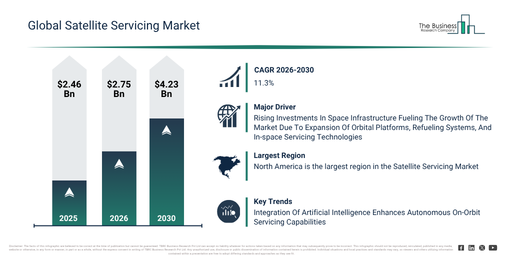
The satellite servicing market has experienced rapid expansion in recent years. Its valuation is predicted to increase from $2.46 billion in 2025 to $2.75 billion in 2026, achieving a compound annual growth rate (CAGR) of 11.8%. This growth observed in the past can be attributed to several factors, including the increasing need to extend the operational lifespans of satellites, the rising requirement to reduce satellite replacement costs, the expanding deployment of commercial and government satellite constellations, the growing accumulation of orbital debris, and the widening demand for maintaining critical space assets.
The satellite servicing market size is projected to experience substantial expansion in the coming years, set to reach $4.23 billion in 2030, exhibiting a compound annual growth rate (CAGR) of 11.3%. This expansion during the forecast period is driven by several factors, including the surging demand for in-orbit refueling, the heightened necessity for satellite repairs and performance enhancements, the increasing requirement for active debris removal and controlled deorbiting, the growing deployment of servicing spacecraft for satellite repositioning, and the escalating demand for sustainable and reusable space operations. Key developments anticipated in this period encompass the greater embrace of in-orbit satellite life extension services, the rising need for on-orbit satellite refueling options, a growing inclination towards satellite repair and upgrade missions, the expanding demand for satellite relocation and orbit adjustment services, and the increasing uptake of active satellite deorbiting services.
Get A Free Sample Report With In-Depth Market Insights:
Satellite Servicing Market Expansion Drivers: What’s Shaping Future Growth?
The escalating financial commitments to space infrastructure are poised to boost the growth of the satellite servicing market. Space infrastructure investment covers the allocation of funds for creating satellites, launch vehicles, orbital platforms, ground systems, and associated technologies vital for space missions and prolonged orbital activities. This increase in space infrastructure investment is spurred by rising government and commercial requirements for satellite communications, Earth observation, navigation, and national security capabilities. Such investments in space infrastructure facilitate satellite servicing by enhancing orbital platforms, refueling mechanisms, docking technologies, and ground-based resources essential for maintaining, repairing, upgrading, and prolonging the operational lifespan of satellites. For instance, in January 2026, Seraphim Space, a UK-based venture capital firm, reported that U.S. companies secured 60% of the total space tech investment in 2025, attracting $7.3 billion, which represented an approximate 130% increase compared with 2024. Therefore, the expanding investments in space infrastructure are significantly contributing to the satellite servicing market’s growth.
Satellite Servicing Market Segment Landscape And Growth Outlook
The satellite servicing market covered in this report is segmented –
1) By Service Type: Life Extension Services, In Orbit Refueling, Satellite Repair And Maintenance, Robotic Inspection
2) By Satellite Type: Small Satellites, Medium Satellites, Large Satellites
3) By Orbit: Low Earth Orbit, Medium Earth Orbit, Geostationary Earth Orbit
4) By Operation Mode: Autonomous Servicing, Teleoperated Servicing, Hybrid Human In The Loop Servicing
5) By End User: Commercial Satellite Operators, Government Space Agencies, Defense And Military Organizations
Subsegments:
1) By Life Extension Services: Mission Extension Vehicles, Propulsion Augmentation Services, Orbit Repositioning Services, Attitude Control Support Services
2) By In Orbit Refueling: Chemical Propellant Refueling, Electric Propulsion Refueling, Cryogenic Propellant Refueling, Multi Client Refueling Services
3) By Satellite Repair And Maintenance: Component Replacement, Mechanical Repair, Software Maintenance, Payload Maintenance
4) By Robotic Inspection: External Visual Inspection, Structural Integrity Inspection, Payload Inspection, Post Anomaly Inspection
Satellite Servicing Market Strategic Trends: What Defines The Next Growth Phase?
Major companies engaged in the satellite servicing market are prioritizing the integration of artificial intelligence, particularly AI-enabled autonomous rendezvous and proximity operations (RPO), to advance spacecraft navigation, inspection, and docking without requiring continuous ground intervention. AI-enabled autonomous rendezvous and proximity operations are sophisticated software systems that combine artificial intelligence, computer vision, sensor fusion, and autonomous guidance algorithms. These systems are designed to autonomously detect, track, inspect, approach, and dock with satellites, leading to enhanced navigation accuracy, reduced mission risks, and the facilitation of efficient in-orbit servicing and maintenance. For example, in February 2024, Astroscale, a Japan-based satellite servicing company, launched its ADRAS-J (Active Debris Removal by Astroscale-Japan) mission. This spacecraft utilizes autonomous guidance, navigation, and control (GNC) coupled with vision-based relative navigation to safely approach unprepared orbital objects. Additionally, it employs high-resolution inspection imaging to assess orbital debris and provide support for future satellite servicing and active debris removal missions.
Satellite Servicing Market Competitive Landscape: Who Leads The Industry?
Major companies operating in the satellite servicing market are Lockheed Martin Corporation, L3Harris Technologies Inc, Astroscale Holdings Inc, Redwire Corporation, D-Orbit S.p.A., Momentus Inc, Exotrail SA, Orbit Fab Inc, ClearSpace SA, Impulse Space Inc, Starfish Space Inc, Rogue Space Systems Corporation, Infinite Orbits SAS, Katalyst Space Technologies Inc, Turion Space Corp, Kall Morris Inc, SpaceTug Inc, Paladin Space Corporation, OrbitAID Aerospace Pvt. Ltd., Cosmoserve Space Technologies Pvt. Ltd., Northrop Grumman Corporation, The Boeing Company, Obruta Space Solutions
View The Full Satellite Servicing Market Report:
Satellite Servicing Market Geographic Landscape: Which Region Dominates Industry Growth?
North America was the largest region in the satellite servicing market in 2025. Asia-Pacific is expected to be the fastest-growing region in the forecast period. The regions covered in the satellite servicing market report are Asia-Pacific, South East Asia, Western Europe, Eastern Europe, North America, South America, Middle East, Africa.
Reach Out To Our Team:
The Business Research Company: https://www.thebusinessresearchcompany.com/
Americas: +1 310-496-7795
Asia: +44 7882 955267 & +91 8897263534
Europe: +44 7882 955267
Email us at: marketing@tbrc.info
Follow us on:
LinkedIn: https://in.linkedin.com/company/the-business-research-company
YouTube: https://www.youtube.com/channel/UC24_fI0rV8cR5DxlCpgmyFQ
Global Market Model: https://www.thebusinessresearchcompany.com/global-market-model

Wasay has over a decade of experience in market research, data modelling, and analytics, with prior experience at GlobalData and Decision Tree Consulting Services. At The Business Research Company , he leads research operations across syndicated studies, customized consulting engagements, and the Global Market Model platform. His professional experience includes supporting organizations such as Boston Consulting Group, KPMG, and Ernst & Young. Wasay holds a degree in Electronics and Communications Engineering, postgraduate management qualifications from International Management Institute Belgium and Indian School of Business and Entrepreneurship, and completed the Integrated Program in Business Analytics from Indian Institute of Management Indore.