
Backed by market attractiveness analysis, total addressable market sizing, company benchmarking matrices, interactive Excel dashboards, wider supply chain intelligence, emerging startup coverage, and detailed product-level insights, The Business Research Company’s 2026 market reports are designed to offer research that is more actionable and strategically valuable than ever.
Supersonic Passenger Jet Market Set To Climb From $2 Billion In 2026 To $3.45 Billion By 2030
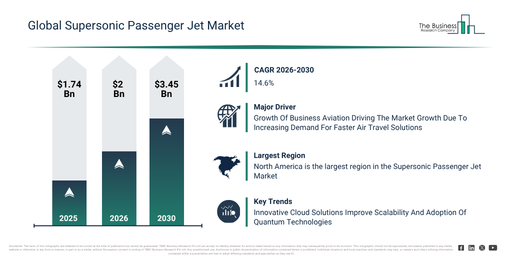
The supersonic passenger jet market has experienced rapid growth in recent years. This market is projected to expand from $1.74 billion in 2025 to $2 billion by 2026, exhibiting a compound annual growth rate (CAGR) of 15.0%. Historically, this expansion has been attributed to increased investment in supersonic aircraft development, a growing demand for reduced long-distance travel times, rising advancements in high-speed aircraft propulsion, the increasing development of advanced aerodynamic technologies, and growing interest in commercial supersonic aviation.
The supersonic passenger jet market is projected for substantial expansion over the coming years. It will grow to $3.45 billion in 2030 at a compound annual growth rate (CAGR) of 14.6%. This expansion during the forecast period is driven by several factors, including the increasing progress in fuel-efficient supersonic propulsion systems, a rise in the use of low-boom aircraft technologies, a heightened need for premium high-speed air travel, greater commercialization of advanced supersonic passenger aircraft, and the expanding creation of sustainable aviation technologies. Key developments expected within this period encompass cutting-edge supersonic propulsion systems, designs for low-boom supersonic aircraft, lightweight aerodynamic structures, specialized high-temperature materials suitable for supersonic flight, and sophisticated passenger cabin pressurization systems.
Get A Free Sample Report With In-Depth Market Insights:
Supersonic Passenger Jet Market Growth Factors Behind Sustained Expansion
The expansion of business aviation is projected to fuel the advancement of the supersonic passenger jet market in the future. Business aviation involves utilizing aircraft for corporate journeys, executive transport, and private flights, thus facilitating quicker and more effective global connections. This sector is expanding because of a growing need for shorter travel durations, with businesses and affluent individuals seeking swifter and adaptable transport options for effective long-distance journeys. Consequently, business aviation boosts the demand for supersonic passenger jets by necessitating sophisticated aircraft capable of providing quicker point-to-point transit, enhanced operational effectiveness, and greater passenger comfort for lengthy business trips. For instance, in August 2025, the Aircraft Performance Group, a US-based flight operations software solution provider, projected that roughly 8,700 new business jets are anticipated for global delivery over the subsequent decade, with North America expected to receive more than half of these aircraft. Hence, the expansion in business aviation is a key factor propelling the advancement of the supersonic passenger jet market.
Supersonic Passenger Jet Market Breakdown By Product Type And Application
The supersonic passenger jet market covered in this report is segmented –
1) By Aircraft Type: Business Jets, Commercial Jets
2) By Component: Airframe, Engine, Avionics, Landing Gear, Other Components
3) By Speed: Mach 1.0–1.5, Mach 1.5–2.0, Above Mach 2.0
4) By Range: Short Range, Medium Range, Long Range
5) By End User: Airlines, Private Operators, Government And Defense
Subsegments:
1) By Business Jets: Light Business Jets, Midsize Business Jets, Large Cabin Business Jets
2) By Commercial Jets: Narrow Body Passenger Jets, Wide Body Passenger Jets, Regional Passenger Jets
Supersonic Passenger Jet Market Industry Trends Fueling Future Revenue Growth
Major companies in the supersonic passenger jet market are concentrating on developing sophisticated solutions, such as advanced supersonic demonstrator aircraft technologies, to enhance high-speed air travel, fuel efficiency, passenger experience, and sustainable aviation capabilities. Advanced supersonic aircraft technologies integrate lightweight composite materials, digitally optimized aerodynamics, advanced avionics, and specialized propulsion systems to enable aircraft to achieve speeds beyond conventional commercial jets while improving operational efficiency and reducing environmental impact. For instance, in March 2024, Boom Supersonic, a US-based aerospace company, successfully completed the first flight of XB-1, an independently developed supersonic jet demonstrator aircraft designed to validate technologies for its upcoming supersonic passenger airliner, Overture. The XB-1 aircraft incorporates carbon fiber composite structures that provide a lightweight yet strong airframe, digitally optimized aerodynamics developed through computational fluid dynamics simulations, advanced avionics, and an augmented reality vision system to improve pilot visibility during takeoff and landing. The aircraft also features supersonic air intakes that efficiently manage airflow at high speeds, enabling conventional jet engines to support supersonic flight operations. The successful test flight demonstrated key technologies required for the development of Overture, which is designed to carry 64–80 passengers at Mach 1.7, approximately twice the speed of today’s subsonic passenger aircraft, while supporting the use of sustainable aviation fuel.
Supersonic Passenger Jet Market Competitive Overview And Top Companies
Major companies operating in the supersonic passenger jet market are The Boeing Company, Airbus SE, RTX Corporation, Lockheed Martin Corporation, GE Aerospace, Safran SA, Northrop Grumman Corporation, BAE Systems plc, Rolls-Royce Holdings plc, General Dynamics Corporation, Bombardier Inc., Dassault Aviation SA, Hermeus Corporation, Venus Aerospace Corporation, Destinus SA, Spike Aerospace Inc., Space Transportation Inc.
View The Full Supersonic Passenger Jet Market Report:
Supersonic Passenger Jet Market Top Region: Where Does Most Revenue Come From?
North America was the largest region in the supersonic passenger jet market in 2025. Asia-Pacific is expected to be the fastest-growing region in the forecast period. The regions covered in the supersonic passenger jet market report are Asia-Pacific, South East Asia, Western Europe, Eastern Europe, North America, South America, Middle East, Africa.
Reach Out To Our Team:
The Business Research Company: https://www.thebusinessresearchcompany.com/
Americas: +1 310-496-7795
Asia: +44 7882 955267 & +91 8897263534
Europe: +44 7882 955267
Email us at: marketing@tbrc.info
Follow us on:
LinkedIn: https://in.linkedin.com/company/the-business-research-company
YouTube: https://www.youtube.com/channel/UC24_fI0rV8cR5DxlCpgmyFQ
Global Market Model: https://www.thebusinessresearchcompany.com/global-market-model

Wasay has over a decade of experience in market research, data modelling, and analytics, with prior experience at GlobalData and Decision Tree Consulting Services. At The Business Research Company , he leads research operations across syndicated studies, customized consulting engagements, and the Global Market Model platform. His professional experience includes supporting organizations such as Boston Consulting Group, KPMG, and Ernst & Young. Wasay holds a degree in Electronics and Communications Engineering, postgraduate management qualifications from International Management Institute Belgium and Indian School of Business and Entrepreneurship, and completed the Integrated Program in Business Analytics from Indian Institute of Management Indore.