
The Business Research Company’s 2026 market reports are designed to deliver research that is more actionable and strategically valuable. Key offerings include market attractiveness scoring, total addressable market sizing, company benchmarking matrices, interactive Excel dashboards, deeper supply chain intelligence, emerging startup tracking, and granular product-level insights.
Additive Manufacturing For Rocket Engines Market Revenue Projected To Rise To $6.11 Billion By 2030
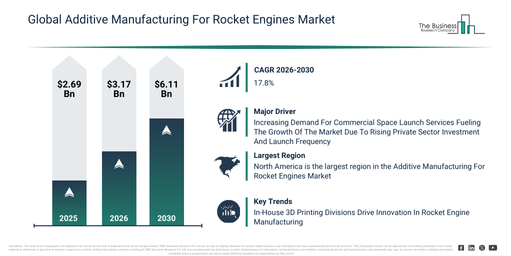
The additive manufacturing for rocket engines market has experienced rapid expansion in recent years. Its value is projected to climb from $2.69 billion in 2025 to $3.17 billion in 2026, at a compound annual growth rate (CAGR) of 17.8%. This historic growth can be attributed to the early adoption of 3D printing technologies in aerospace, increasing demand for lightweight rocket components, a concentrated effort to reduce production costs and lead times, the development of metal powder materials suitable for engine components, and the successful implementation of additive manufacturing in small-scale engine prototypes.
The additive manufacturing for rocket engines market is projected to experience substantial expansion in the coming years, reaching a valuation of $6.11 billion by 2030, driven by a compound annual growth rate (CAGR) of 17.8%. This anticipated growth during the forecast period is fueled by several factors, including heightened investment in new rocket initiatives, broader application of 3D printing for intricate engine designs, a stronger focus on improving performance and reducing weight, the increasing adoption of additive manufacturing by private space enterprises, and the incorporation of digital design and simulation tools to boost production efficiency. Key trends expected throughout this period encompass a rising need for additive manufacturing to lessen the weight of engine components, greater utilization of AM for quick prototyping of rocket parts, an increased application of complex shapes to enhance propulsion effectiveness, the expansion of reusable launch vehicle projects demanding AM components, and a greater dependency on advanced, high-performance alloys to withstand extreme thermal stresses.
Want Deeper Additive Manufacturing For Rocket Engines Market Insights? Get A Free Sample Report:
Primary Growth Driver Shaping The Additive Manufacturing For Rocket Engines Market Outlook
The future expansion of the additive manufacturing for rocket engines market is anticipated to be driven by the growing need for commercial space launch services. These services involve private rocket launch operations transporting satellites, cargo, or crew into orbit for diverse clients, offering dependable and economical alternatives to state-run missions. This surge in demand stems from increased private sector investment in satellite-based communication and Earth observation technologies, prompting companies to plan more frequent missions. Additive manufacturing for rocket engines improves commercial space launch services by facilitating the creation of lightweight, intricate component designs, boosting engine performance, and enhancing fuel economy. Furthermore, it cuts down on manufacturing time and expenses, thereby speeding up launch schedules and enhancing overall mission dependability. For example, the Federal Aviation Administration reported in November 2024 that commercial space operations surged by over 30% in 2023, reaching 148 launches, with forecasts suggesting a more than twofold increase by 2028. Consequently, the escalating need for commercial space launch services is fueling the expansion of the additive manufacturing for rocket engines market.
Additive Manufacturing For Rocket Engines Market Structure: A Detailed Look At Segments And Subsegments
The additive manufacturing for rocket engines market covered in this report is segmented –
1) By Material Type: Metals, Polymers, Ceramics, Other Material Types
2) By Technology: Selective Laser Melting, Electron Beam Melting, Fused Deposition Modeling, Other Technologies
3) By Application: Prototyping, Production, Research And Development (R&D)
4) By End-User: Aerospace, Defense, Other End Users
Subsegments:
1) By Metals: Titanium Alloys, Nickel-Based Superalloys, Stainless Steel, Aluminum Alloys
2) By Polymers: High-Performance Thermoplastics, Composite Polymers, Polyamide (Nylon)
3) By Ceramics: Silicon Carbide, Alumina-Based Ceramics, Zirconia-Based Ceramics
4) By Other Material Types: Hybrid Materials, Metal Matrix Composites, Functionally Graded Materials
Additive Manufacturing For Rocket Engines Market Innovation And Strategy Trends Among Leading Companies
Major companies operating in the additive manufacturing for rocket engines market are focusing on developing technologically advanced solutions, such as 3D printing additive manufacturing systems, to improve production scalability, reduce costs, and enhance performance in rocket engine components. These 3D printing additive manufacturing systems are technologies that build parts layer by layer from digital designs, enabling complex, efficient, and rapid production. For instance, in June 2025, Innospace, a South Korea-based aerospace and defense company, launched an advanced in-house 3D printing division to manufacture rocket engines and key components for its space launch vehicles, leveraging proprietary metal additive manufacturing technology. This is expected to significantly boost competitiveness by enabling faster, more precise, and cost-effective production, potentially reducing manufacturing costs by up to 50% compared to traditional methods. This division integrates all stages of production, from design to quality verification, and has already produced 13 critical components, including oxidizer pumps for the HANBIT launch vehicle.
Top Companies Competing In The Additive Manufacturing For Rocket Engines Market
Major companies operating in the additive manufacturing for rocket engines market are Northrop Grumman Corporation, General Electric Company, L3Harris Technologies Inc., TRUMPF SE + Co. KG, Space Exploration Technologies Corp., Blue Origin Enterprises L.P., DMG MORI Aktiengesellschaft, United Launch Alliance LLC (ULA), RUAG Holding AG, Sierra Space Corporation, Rocket Lab USA Inc., Firefly Aerospace Inc., MT Aerospace AG, Velo3D Inc., Gilmour Space Technologies Pty Ltd., Ursa Major Technologies Inc., Orbex Ltd., Sintavia LLC, Vast Space Corp., EOS GmbH, Equatorial Space Systems Pty Ltd., Skyrora Ltd.
View The Complete Additive Manufacturing For Rocket Engines Market Study With Segment And Regional Data:
Additive Manufacturing For Rocket Engines Market Regional Outlook Across Major Geographies
North America was the largest region in the additive manufacturing for rocket engines market in 2025. Asia-Pacific is expected to be the fastest-growing region in the forecast period. The regions covered in the additive manufacturing for rocket engines market report are Asia-Pacific, South East Asia, Western Europe, Eastern Europe, North America, South America, Middle East, Africa.
Reach Out To Our Team:
The Business Research Company: https://www.thebusinessresearchcompany.com/
Americas: +1 310-496-7795
Asia: +44 7882 955267 & +91 8897263534
Europe: +44 7882 955267
Email us at: marketing@tbrc.info
Follow us on:
LinkedIn: https://in.linkedin.com/company/the-business-research-company
YouTube: https://www.youtube.com/channel/UC24_fI0rV8cR5DxlCpgmyFQ
Global Market Model: https://www.thebusinessresearchcompany.com/global-market-model

Wasay has over a decade of experience in market research, data modelling, and analytics, with prior experience at GlobalData and Decision Tree Consulting Services. At The Business Research Company , he leads research operations across syndicated studies, customized consulting engagements, and the Global Market Model platform. His professional experience includes supporting organizations such as Boston Consulting Group, KPMG, and Ernst & Young. Wasay holds a degree in Electronics and Communications Engineering, postgraduate management qualifications from International Management Institute Belgium and Indian School of Business and Entrepreneurship, and completed the Integrated Program in Business Analytics from Indian Institute of Management Indore.

