
Designed to make market research more actionable and strategically valuable, The Business Research Company’s 2026 market reports feature market attractiveness scoring, total addressable market sizing, company benchmarking matrices, interactive Excel dashboards, deeper supply chain intelligence, emerging startup tracking, and granular product-level insights.
What Is The Projected CAGR Of The Advanced Authentication In Defense Market Through 2030?
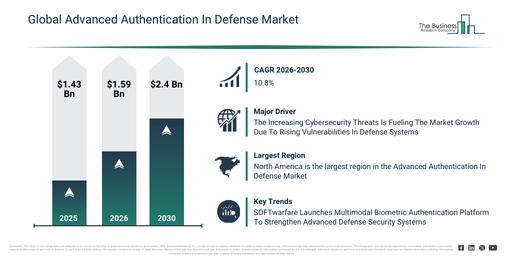
The advanced authentication in defense market size has experienced substantial expansion in recent years. It is projected to increase from $1.43 billion in 2025 to $1.59 billion in 2026, exhibiting a compound annual growth rate (CAGR) of 11.2%. Historically, this market’s expansion can be ascribed to factors such as increasing cyber threats targeting defense networks, the adoption of token-based and hardware authentication solutions, the implementation of identity and access management systems in military organizations, the deployment of smart cards and common access cards for personnel, and the integration of single sign-on (SSO) solutions to streamline secure access.
The market for advanced authentication in defense is projected to experience swift expansion over the coming years, reaching $2.4 billion in 2030 at a compound annual growth rate (CAGR) of 10.8%. This anticipated growth is driven by factors such as the increasing uptake of risk-based and behavioral analytics for authentication, the broadening of cloud-based authentication offerings within defense, the escalating need for mobile device authentication in operational settings, improvements in public key infrastructure (PKI) technologies, and a heightened emphasis on multi-layered and adaptive authentication to combat advanced cyber threats. Key developments expected during this forecast period involve a greater dependence on multi-layered defense authentication frameworks, a rising necessity for secure identity verification specifically for classified missions, a wider integration of token-based and card-based access solutions, an increased deployment of authentication tools to mitigate insider threats, and an expansion of authentication protocols across various joint military operations.
Claim Your Free Advanced Authentication In Defense Market Sample Report With Key Data And Trends:
Advanced Authentication In Defense Market Demand Analysis: The Driving Force Behind Expansion
The escalating cybersecurity threats are projected to fuel the expansion of advanced authentication within the defense market in the future. These threats refer to malicious attacks or unauthorized actions aimed at computer systems, networks, or data, intending to steal, damage, or disrupt digital operations. The rising cybersecurity threats in defense are largely due to the increasing dependence on interconnected digital systems, which broadens the attack surface and creates more entry points for potential cyber intrusions, data breaches, and system disruptions. Advanced authentication in defense improves cybersecurity by ensuring that only verified and authorized personnel can access sensitive military systems and networks, thereby reducing the risk of data breaches and cyberattacks. For instance, in November 2024, according to the report published by the Department of Defence, an Australia-based government department, the Australian Signals Directorate (ASD) received more than 36,700 cybercrime calls to its Australian Cyber Security Hotline in 2023–24, marking a 12% increase from the previous financial year. Therefore, the increasing cybersecurity threats are driving the growth of the advanced authentication in defense market.
Breaking Down The Advanced Authentication In Defense Market By Segment
The advanced authentication in defense market covered in this report is segmented –
1) By Component: Hardware Components, Software Solutions, Services
2) By Technology Type: Biometric Authentication, Multi-Factor Authentication (MFA), Public Key Infrastructure (PKI), Behavioral Biometrics
3) By Deployment Mode: On-Premises Authentication, Cloud-based Authentication
4) By Application Area: Identity Management, Access Control, Secure Communications, Data Protection
5) By User Type: Military Personnel, Government Agencies, Defense Contractors, Cybersecurity Professionals
Subsegments:
1) By Hardware Components: Biometric Scanners, Smart Cards, Security Tokens, Authentication Readers, Hardware Security Modules (HSMs)
2) By Software Solutions: Identity And Access Management (IAM) Software, Multi-Factor Authentication (MFA) Software, Public Key Infrastructure (PKI) Software, Biometric Authentication Software, Risk-Based Authentication Software
3) By Services: Consulting Services, Integration And Deployment Services, Support And Maintenance Services, Managed Authentication Services, Training And Education Services
Top Trend Influencing The Advanced Authentication In Defense Market Outlook
Leading companies active in the advanced authentication in defense market are prioritizing the development of innovative solutions, such as multimodal biometric authentication, to bolster security, enhance identity verification precision, and thwart unauthorized access. Multimodal biometric authentication is a security framework that authenticates a user’s identity by employing two or more biometric characteristics, including fingerprint, facial recognition, iris scan, or voice. It contributes to improved security and accuracy by mitigating the risk of spoofing or incorrect matches when relying solely on a single biometric factor. For instance, in October 2024, SOFTwarfare LLC, a US-based provider of Zero Trust Identity solutions, unveiled an innovative multimodal biometric authentication platform specifically engineered for Joint All-Domain Command and Control (JADC2) environments at the AUSA Annual Meeting & Exposition. This platform aims to strengthen security, refine identity verification accuracy, and prevent unauthorized access within Department of Defense operations. The system unifies several biometric modalities, such as fingerprint, facial recognition, and voice authentication, into a singular platform, significantly reducing the chance of identity deception or false positives. Moreover, it integrates sophisticated functionalities like User and Entity Behavioral Analytics (UEBA) for real-time risk assessment and supports implementation across air-gapped, cloud, and hybrid defense infrastructures.
Advanced Authentication In Defense Market Competitive Landscape And Major Players
Major companies operating in the advanced authentication in defense market are Dell Technologies Inc., Broadcom Inc., Fujitsu Limited, NEC Corporation, Thales Group S.A., Atos SE, Booz Allen Hamilton Inc., General Dynamics Information Technology Inc., IDEMIA Group, Ping Identity Holding Corp., OneSpan Inc., ForgeRock Inc., Accops Systems Pvt. Ltd., iProov Ltd., Sekoia.io SAS, Aware Inc., Secret Double Octopus Ltd., Veridium Ltd., SurePassID Corporation, Biometric Signature ID LLC
Read The Full Advanced Authentication In Defense Market Report By The Business Research Company:
Where Is The Advanced Authentication In Defense Market Largest? Key Regional Insights
North America was the largest region in the advanced authentication in defense market in 2025. Asia-Pacific is expected to be the fastest-growing region in the forecast period. The regions covered in the advanced authentication in defense market report are Asia-Pacific, South East Asia, Western Europe, Eastern Europe, North America, South America, Middle East, Africa.
Reach Out To Our Team:
The Business Research Company: https://www.thebusinessresearchcompany.com/
Americas: +1 310-496-7795
Asia: +44 7882 955267 & +91 8897263534
Europe: +44 7882 955267
Email us at: marketing@tbrc.info
Follow us on:
LinkedIn: https://in.linkedin.com/company/the-business-research-company
YouTube: https://www.youtube.com/channel/UC24_fI0rV8cR5DxlCpgmyFQ
Global Market Model: https://www.thebusinessresearchcompany.com/global-market-model

Wasay has over a decade of experience in market research, data modelling, and analytics, with prior experience at GlobalData and Decision Tree Consulting Services. At The Business Research Company , he leads research operations across syndicated studies, customized consulting engagements, and the Global Market Model platform. His professional experience includes supporting organizations such as Boston Consulting Group, KPMG, and Ernst & Young. Wasay holds a degree in Electronics and Communications Engineering, postgraduate management qualifications from International Management Institute Belgium and Indian School of Business and Entrepreneurship, and completed the Integrated Program in Business Analytics from Indian Institute of Management Indore.

