The Business Research Company’s 2026 market reports are designed to deliver research that is more actionable and strategically valuable. Key offerings include market attractiveness scoring, total addressable market sizing, company benchmarking matrices, interactive Excel dashboards, deeper supply chain intelligence, emerging startup tracking, and granular product-level insights.
Deep Space Optical Data Terminal Market Historical Growth Vs. Forecast Growth: How Do The Numbers Compare?
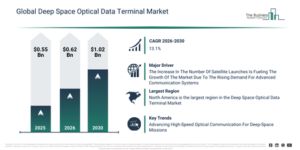
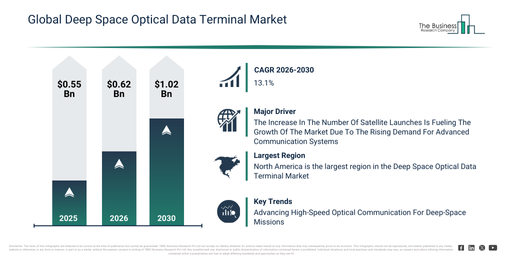
The deep space optical data terminal market has experienced rapid expansion over recent years. This market is projected to expand from $0.55 billion in 2025 to $0.62 billion by 2026, exhibiting a compound annual growth rate (CAGR) of 13.4%. Historically, this growth has been driven by factors such as the development of laser-based space communication, its adoption in interplanetary missions, advancements in optical detectors, the expansion of satellite communication infrastructure, and its early integration with ground station terminals.
The deep space optical data terminal market is projected to experience substantial expansion over the upcoming years. By 2030, this market is anticipated to reach a valuation of $1.02 billion, demonstrating a compound annual growth rate (CAGR) of 13.1%. This forecasted growth is attributable to several factors, including the increasing scope of high-capacity space missions, advancements in adaptive optics designed for deep space applications, the incorporation of AI-based signal optimization, a rise in space exploration initiatives, and the broader commercialization of optical communication networks. Key trends shaping this period involve the growing preference for optical communication over RF systems in deep space missions, ongoing progress in adaptive optics to lessen atmospheric distortion, an increase in high-power laser transmitters for extended data transmission, the creation of compact optical terminals for smaller spacecraft and probes, and an escalating demand for secure, high-throughput data connections crucial for scientific and interplanetary endeavors.
Start With A Free Sample Of The Deep Space Optical Data Terminal Market Research Report:
The Leading Growth Driver In The Deep Space Optical Data Terminal Market Explained
The rising demand for rapid data transfer is projected to drive the expansion of the deep space optical data terminal market in the future. High-speed data transmission involves the swift movement of extensive digital data, facilitated by sophisticated communication technologies capable of handling and delivering information at exceptional speeds. This growing demand primarily stems from the rapid proliferation of space missions and scientific tools, which produce vast quantities of data necessitating effective transfer back to Earth. The escalating requirement for fast data transfer encourages the use of advanced optical communication terminals, allowing spacecraft to send scientific data and high-definition images significantly quicker than older radio frequency systems. For example, in May 2023, the National Aeronautics and Space Administration (NASA), a US-based government space agency, reported that its Terabyte Infrared Delivery (TBIRD) system successfully transmitted data at 200 gigabits per second from space to ground, which is twice its prior achievement of 100 gigabits per second from June 2022. Consequently, the expanding necessity for high-speed data transmission is propelling the deep space optical data terminal market’s growth.
Key Segments Shaping The Deep Space Optical Data Terminal Market Landscape
The deep space optical data terminal market covered in this report is segmented –
1) By Component: Transmitter, Receiver, Modulator, Demodulator, Other Components
2) By Platform: Spacecraft, Ground Stations, Satellites, Probes, Other Platforms
3) By Application: Satellite Communication, Deep Space Exploration, Interplanetary Missions, Scientific Research, Military And Defense, Other Applications
4) By End-User: Government Agencies, Space Agencies, Commercial Space Companies, Research Institutes, Other End-Users
Subsegments:
1) By Transmitter: Laser Diode, Fiber Lasers, Solid-State Lasers
2) By Receiver: Photodetectors, Avalanche Photodiodes (APDs), Single-Photon Detectors
3) By Modulator: Electro-Optic Modulators, Acousto-Optic Modulators, Lithium Niobate Modulators
4) By Demodulator: Coherent Demodulators, Direct Detection Demodulators
5) By Other Components: Optical Amplifiers, Beam Steering Units, Control Electronics, Cooling Systems
Deep Space Optical Data Terminal Market Trend Spotlight: Key Shifts Shaping Future Demand
Leading companies operating in the deep space optical data terminal market are concentrating on developing sophisticated offerings, such as high-power fiber laser systems, to facilitate secure, rapid communication across vast deep-space distances. A high-power fiber laser system generates a narrow-linewidth, multi-kilowatt beam, enabling distant spacecraft to precisely locate and lock onto a ground station, thereby forming an optical link for data downlink and uplink. For instance, in July 2025, the European Space Agency (ESA), a France-based space exploration organization, established Europe’s inaugural deep-space optical communication link with NASA’s Psyche mission, employing a fiber laser system from NKT Photonics. This transmitter, positioned at the Kryoneri Observatory in Greece, successfully exchanged signals with the Psyche spacecraft, located 265 million kilometers away, thereby illustrating the system’s precision, power, and sensitivity. This significant event emphasizes the crucial role of fiber laser–based optical terminals in advancing future interplanetary missions and establishing a new benchmark for deep-space communication.
Deep Space Optical Data Terminal Market Competitive Analysis: Who Are The Main Competitors?
Major companies operating in the deep space optical data terminal market are Safran S.A., Thales Group, CACI International Inc., Mynaric AG, Viasat Inc., General Atomics Technologies Corporation, Hensoldt AG, Eutelsat Communications S.A., Hughes Network Systems LLC, TNO, NKT Photonics A/S, Honeywell Aerospace, TrellisWare Technologies Inc., Cailabs SAS, Transcelestial Technologies Pte Ltd, Bridgecomm Inc., Antrix Corporation Limited, MBryonics Inc., Odysseus Space Inc., Avantier Inc., FSO Instruments Inc.
Find The Complete Deep Space Optical Data Terminal Market Outlook In The Full Report:
Mapping The Deep Space Optical Data Terminal Market: Regional Leadership And Global Reach
North America was the largest region in the deep space optical data terminal market in 2025. Asia-Pacific is expected to be the fastest-growing region in the forecast period. The regions covered in the deep space optical data terminal market report are Asia-Pacific, South East Asia, Western Europe, Eastern Europe, North America, South America, Middle East, Africa.
Reach Out To Our Team:
The Business Research Company: https://www.thebusinessresearchcompany.com/
Americas: +1 310-496-7795
Asia: +44 7882 955267 & +91 8897263534
Europe: +44 7882 955267
Email us at: marketing@tbrc.info
Follow us on:
LinkedIn: https://in.linkedin.com/company/the-business-research-company
YouTube: https://www.youtube.com/channel/UC24_fI0rV8cR5DxlCpgmyFQ
Global Market Model: https://www.thebusinessresearchcompany.com/global-market-model

Wasay has over a decade of experience in market research, data modelling, and analytics, with prior experience at GlobalData and Decision Tree Consulting Services. At The Business Research Company , he leads research operations across syndicated studies, customized consulting engagements, and the Global Market Model platform. His professional experience includes supporting organizations such as Boston Consulting Group, KPMG, and Ernst & Young. Wasay holds a degree in Electronics and Communications Engineering, postgraduate management qualifications from International Management Institute Belgium and Indian School of Business and Entrepreneurship, and completed the Integrated Program in Business Analytics from Indian Institute of Management Indore.