Designed to make market research more actionable and strategically valuable, The Business Research Company’s 2026 market reports feature market attractiveness scoring, total addressable market sizing, company benchmarking matrices, interactive Excel dashboards, deeper supply chain intelligence, emerging startup tracking, and granular product-level insights.
How Fast Is The Deep Space Radiation Monitoring Market Growing? Market Size, CAGR And Forecast Insights
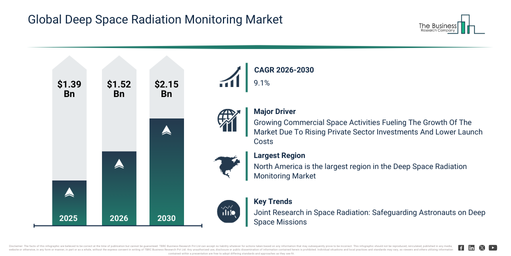
The deep space radiation monitoring market size has experienced significant growth in recent years. It is expected to expand from $1.39 billion in 2025 to $1.52 billion in 2026, achieving a compound annual growth rate (CAGR) of 9.4%. The historical increase in this market can be ascribed to an escalating number of deep space missions, the progress in developing advanced radiation sensors, rising investments in astronaut safety programs, the initial deployment of satellite-based monitoring instruments, and a growing understanding of cosmic radiation risks.
The deep space radiation monitoring market is anticipated to experience substantial expansion over the coming years. By 2030, this market is projected to reach $2.15 billion, demonstrating a compound annual growth rate (CAGR) of 9.1%. This projected growth is driven by several factors, including the increasing scope of crewed deep space exploration, the incorporation of AI-powered radiation analysis, the development of smaller radiation monitoring instruments, the expanded use of specialized radiation monitoring satellites, and a rising need for current space environment information. Key trends during this period are expected to feature progress in highly sensitive spaceborne radiation detection devices, a greater adoption of radiation-hardened electronics for deep space missions, the wider deployment of satellites and probes for extended radiation monitoring, the creation of portable and light dosimeters for safeguarding astronauts and spacecraft, and an increasing requirement for ongoing radiation environment evaluations for missions between planets.
Unlock Deep Space Radiation Monitoring Market Insights With A Free Sample Report:
Deep Space Radiation Monitoring Market Momentum: Key Driver Expected To Boost Growth Through 2030
The expansion of commercial space endeavors is anticipated to fuel the progress of deep space radiation monitoring in the future. These activities encompass profit-driven space operations and services carried out by private enterprises, covering areas such as satellite deployment, space tourism, exploration for resources, and associated technological developments. The increase in commercial space activities stems from heightened private sector investment, propelled by reduced launch expenses and innovations in space technology. Deep space radiation monitoring addresses this requirement by delivering real-time detection and dosimetry systems designed to safeguard astronauts, spacecraft electronic components, and payloads from damaging cosmic radiation and solar particle events. For example, data from January 2024, provided by The Space Foundation, a US-based nonprofit dedicated to fostering space innovation, education, and collaboration, indicates that global launch activity maintained its upward trend for the third year in a row, totaling 223 attempts with 212 successful missions, and commercial launches saw a significant increase of 50% compared to 2022. Consequently, the expanding commercial space activities are a primary catalyst for the growth of deep space radiation monitoring.
Deep Space Radiation Monitoring Market Segments: A Category-By-Category Overview
The deep space radiation monitoring market covered in this report is segmented –
1) By Component: Detectors, Sensors, Software, Services
2) By Radiation Type: Galactic Cosmic Rays, Solar Particle Events, Trapped Radiation Belts, Other Radiation Type
3) By Platform: Satellites, Spacecraft, Space Stations, Deep Space Probes, Other Platforms
4) By Application: Space Missions, Astronaut Safety, Scientific Research, Satellite Operations, Other Applications
5) By End-User: Space Agencies, Commercial Space Companies, Research Institutes, Defense, Other End Users
Subsegments:
1) By Detectors: Semiconductor Detectors, Scintillation Detectors, Solid-State Detectors, Gas-Filled Detectors
2) By Sensors: Particle Sensors, Neutron Sensors, Gamma-Ray Sensors, Dosimetry Sensors
3) By Software: Data Acquisition Software, Radiation Modeling And Simulation Software, Monitoring And Control Software, Data Analytics And Visualization Tools
4) By Services: Calibration Services, Radiation Testing Services, Data Analysis And Reporting Services, Maintenance And Support Services
Which Emerging Trends Are Gaining Traction In The Deep Space Radiation Monitoring Market?
Leading companies operating in the deep space radiation monitoring market are focusing on collaborative research into space radiation, with the goal of ensuring astronaut safety on deep space missions. Joint research into space radiation represents a cooperative endeavor among organizations or nations to investigate cosmic rays, solar particles, and their impacts on spacecraft, technology, and human health within space environments. For example, in June 2025, The German Aerospace Center (DLR), a Germany-based national research center for aeronautics, space, energy, and transportation, and The National Aeronautics and Space Administration (NASA), a US-based government agency responsible for civilian space exploration and research, signed a renewed agreement at the Paris Air Show to continue their joint research into space radiation. This research specifically targets astronaut safety in deep space missions, achieved through the integration of DLR’s advanced M-42 EXT radiation detectors on NASA’s Artemis II mission. This initiative aims to address the significant health risks posed by space radiation by deploying upgraded measurement instruments offering improved energy resolution, building upon the valuable dataset gathered from Artemis I, and enabling the development of more effective protective measures for future lunar and exploratory missions.
Deep Space Radiation Monitoring Market Key Participants: Prominent Companies At A Glance
Major companies operating in the deep space radiation monitoring market are Airbus Defence and Space GmbH, Lockheed Martin Corporation, Northrop Grumman Corporation, Honeywell International Inc., National Aeronautics and Space Administration (NASA), Renesas Electronics Corporation, Teledyne e2v Limited, Thales Alenia Space S.A.S., HORIBA Ltd., Mirion Technologies Inc., Exail Holding SAS, Deutsches Zentrum für Luft- und Raumfahrt e.V. (German Aerospace Center), Rocket Lab USA Inc., 3D PLUS SAS, Argotec S.r.l., Hubert Curien Laboratory (Laboratoire Hubert Curien – Université Jean Monnet / CNRS), ADVACAM s.r.o., ispace inc., StemRad Ltd., European Space Agency (ESA)
Get Detailed Deep Space Radiation Monitoring Market Forecasts In The Complete Report:
Top Region In The Deep Space Radiation Monitoring Market: A Global Perspective
North America was the largest region in the deep space radiation monitoring market in 2025. Asia-Pacific is expected to be the fastest-growing region in the forecast period. The regions covered in the deep space radiation monitoring market report are Asia-Pacific, South East Asia, Western Europe, Eastern Europe, North America, South America, Middle East, Africa.
Reach Out To Our Team:
The Business Research Company: https://www.thebusinessresearchcompany.com/
Americas: +1 310-496-7795
Asia: +44 7882 955267 & +91 8897263534
Europe: +44 7882 955267
Email us at: marketing@tbrc.info
Follow us on:
LinkedIn: https://in.linkedin.com/company/the-business-research-company
YouTube: https://www.youtube.com/channel/UC24_fI0rV8cR5DxlCpgmyFQ
Global Market Model: https://www.thebusinessresearchcompany.com/global-market-model

Wasay has over a decade of experience in market research, data modelling, and analytics, with prior experience at GlobalData and Decision Tree Consulting Services. At The Business Research Company , he leads research operations across syndicated studies, customized consulting engagements, and the Global Market Model platform. His professional experience includes supporting organizations such as Boston Consulting Group, KPMG, and Ernst & Young. Wasay holds a degree in Electronics and Communications Engineering, postgraduate management qualifications from International Management Institute Belgium and Indian School of Business and Entrepreneurship, and completed the Integrated Program in Business Analytics from Indian Institute of Management Indore.