Market attractiveness scoring, total addressable market sizing, company benchmarking matrices, interactive Excel dashboards, deeper supply chain intelligence, emerging startup tracking, and granular product-level insights are among the key offerings featured in The Business Research Company’s 2026 market reports, designed to deliver more actionable and strategically valuable research.
Defense Support and Auxiliary Equipment Market Valued At $169.37 Billion In 2026, Projected To Reach $227.7 Billion By 2030
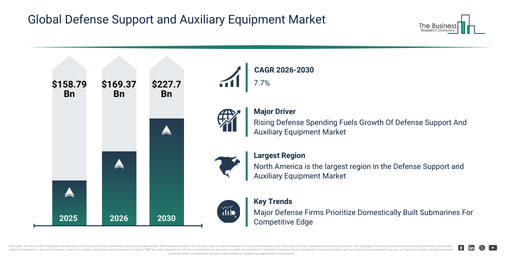
The market size for defense support and auxiliary equipment has shown strong growth in recent years. This sector is expected to grow from $158.79 billion in 2025 to $169.37 billion in 2026, achieving a compound annual growth rate (CAGR) of 6.7%. The expansion observed in the historical period was driven by factors such as the broadening of global defense infrastructure and military bases, advancements in radar and sonar technologies, the development of satellite-based defense communication systems, an increase in the procurement of mobile and fixed defense support equipment, and government defense contracts stimulating both production and innovation.
The defense support and auxiliary equipment market is projected to experience substantial expansion over the upcoming years. Its size is forecast to reach $227.7 billion by 2030, demonstrating a compound annual growth rate (CAGR) of 7.7%. Factors contributing to this growth during the forecast period include the increasing adoption of advanced radar, sonar, and satellite systems, the expansion of defense modernization initiatives worldwide, the incorporation of AI and autonomous technologies into defense support equipment, growing investments in portable and deployable defense solutions, and the broadening of maintenance and support offerings for defense auxiliary systems. Key trends anticipated in the same period involve the increasing use of ISR systems in military operations, an escalating demand for military communication and navigation tools, the development of satellite-dependent defense support systems, a surge in investment for naval and airborne defense auxiliary equipment, and improved logistics and transportation provisions for military deployments.
Request A Complimentary Defense Support and Auxiliary Equipment Market Research Sample:
Key Factor Propelling The Defense Support and Auxiliary Equipment Market Forward
The defense support and auxiliary equipment market is anticipated to expand due to increasing defense spending. Governments allocate financial resources, known as defense spending, to bolster their armed forces and military operations. This funding is crucial for supporting government investments in research and development initiatives for defense support and auxiliary equipment, as well as covering expenses related to the upkeep, repairs, and upgrades of existing equipment. An illustration of this trend is the UK’s projected defense spending, which, according to the UK Parliament’s House of Commons Library in December 2024, is set to reach £56.9 billion (approximately $70.5 billion) in the financial year 2024/25, increasing to £59.8 billion (about $73.9 billion) by 2025/26. Consequently, the rise in defense spending acts as a key driver for the growth of the defense support and auxiliary equipment market.
Defense Support and Auxiliary Equipment Market Segments And Subsegments Explained
The defense support and auxiliary equipment market covered in this report is segmented –
1) By Type: Military Radars, Military Satellites, Other Defense Support And Auxiliary Equipment
2) By Payload Type: Communication Payload, Navigation Payload, Imaging Payload, Others
3) By Application: Intelligence, Surveillance, And Reconnaissance (Isr), Communication, Navigation
Subsegments:
1) By Military Radars: Airborne Radars, Ground-Based Radars, Naval Radars, Space-Based Radars, Other Military Radars
2) By Military Satellites: Communication Satellites, Reconnaissance Satellites, Navigation Satellites, Earth Observation Satellites, Other Military Satellites
3) By Other Defense Support And Auxiliary Equipment: Military Communication Equipment, Military Sensors And Detectors, Defense Logistics Equipment, Military Transport Vehicles, Other Defense Support Equipment
Emerging Trends Transforming The Defense Support and Auxiliary Equipment Market
Leading firms within the defense support and auxiliary equipment market prioritize the introduction of indigenously manufactured submarines to secure a competitive advantage. An indigenously built submarine refers to one designed, developed, and constructed entirely within a nation’s own territory, independent of external technology or specialized knowledge. This submersible vessel serves as an essential part of defense auxiliary equipment, employed for safeguarding naval fleets and various assets against adversarial assaults in marine environments. In September 2023, Taiwan, an East Asian nation, unveiled its inaugural domestically constructed submarine, marking a significant milestone in modernizing its aging naval capabilities. This diesel-electric attack submarine, christened Hai Kun, named after a mythical creature from Chinese folklore, commenced its launch ceremony in Kaohsiung, a southern city, at the CSBC (China Shipbuilding Corporation) Shipyard. The vessel incorporates digital sonar systems, integrated combat systems, and various auxiliary equipment systems, which encompass periscopes.
Defense Support and Auxiliary Equipment Market Key Players: Major Companies In The 2026 Report
Major companies operating in the defense support and auxiliary equipment market are Raytheon Technologies Corporation, Thales Group, The Boeing Company, Leidos, Leonardo SpA, ManTech International Corp., L3 Technologies Inc., Rostec State Corporation, Bae Systems plc, RTX Corp, Lockheed Martin Corporation, General Dynamics Corporation, British Aerospace Engines Systems Plc, Northrop Grumman Corporation, Safran S.A, Honeywell International Inc., United Technologies Corporation, Elbit Systems Ltd., Rheinmetall AG, Harris Corporation, Cobham Ltd., Moog Inc., Meggitt Plc, Curtiss-Wright Corporation., Teledyne FLIR LLC, Ultra Electronics Holdings Plc, Esterline Technologies Corporation, Kongsberg Gruppen ASA, British Foreign & Colonial Automatic Light Controlling Company Ltd., QinetiQ Group Plc, Kratos Defense & Security Solutions Inc., AVAV – AeroVironment Inc., Textron Inc., Cubic Corp, Science Applications International Corporation
Explore The Full Defense Support and Auxiliary Equipment Market Report With Forecasts To 2030:
Defense Support and Auxiliary Equipment Market By Region: Where Is Demand Strongest?
North America was the largest region in defense support and auxiliary equipment market in 2025. Asia-Pacific is expected to be the fastest growing region in the forecast period. The regions covered in the defense support and auxiliary equipment market report are Asia-Pacific, South East Asia, Western Europe, Eastern Europe, North America, South America, Middle East, Africa.
Reach Out To Our Team:
The Business Research Company: https://www.thebusinessresearchcompany.com/
Americas: +1 310-496-7795
Asia: +44 7882 955267 & +91 8897263534
Europe: +44 7882 955267
Email us at: marketing@tbrc.info
Follow us on:
LinkedIn: https://in.linkedin.com/company/the-business-research-company
YouTube: https://www.youtube.com/channel/UC24_fI0rV8cR5DxlCpgmyFQ
Global Market Model: https://www.thebusinessresearchcompany.com/global-market-model

Wasay has over a decade of experience in market research, data modelling, and analytics, with prior experience at GlobalData and Decision Tree Consulting Services. At The Business Research Company , he leads research operations across syndicated studies, customized consulting engagements, and the Global Market Model platform. His professional experience includes supporting organizations such as Boston Consulting Group, KPMG, and Ernst & Young. Wasay holds a degree in Electronics and Communications Engineering, postgraduate management qualifications from International Management Institute Belgium and Indian School of Business and Entrepreneurship, and completed the Integrated Program in Business Analytics from Indian Institute of Management Indore.