
Through market attractiveness analysis, total addressable market evaluation, company benchmarking matrices, interactive Excel dashboards, expanded supply chain intelligence, emerging startup coverage, and detailed product insights, The Business Research Company’s 2026 market reports provide more actionable and strategically valuable research.
Defense Support and Auxiliary Equipment Market Value Analysis: What Growth Is Expected Over The Forecast Period?
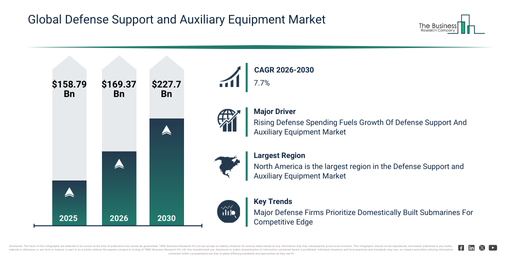
The defense support and auxiliary equipment market size has seen robust growth in recent years. It is anticipated to increase from $158.79 billion in 2025 to $169.37 billion in 2026, exhibiting a compound annual growth rate (CAGR) of 6.7%. The historical expansion of this market can be attributed to several factors, including the expansion of global defense infrastructure and military bases, technological advancements in radar and sonar systems, the growth in satellite-based defense communication systems, increased procurement of mobile and fixed defense support equipment, and government defense contracts that stimulate production and innovation.
The defense support and auxiliary equipment market size is projected to experience substantial expansion over the upcoming years. This market is anticipated to reach $227.7 billion by 2030, exhibiting a compound annual growth rate (CAGR) of 7.7%. Several factors will drive this growth during the forecast period, including the increased embrace of next-generation radar, sonar, and satellite systems, global advancements in defense modernization initiatives, the incorporation of AI and autonomous systems into defense support equipment, heightened investment in mobile and deployable defense solutions, and the broadening of maintenance and support services for defense auxiliary systems. Key trends anticipated over the forecast period encompass a greater uptake of ISR systems in defense operations, a heightened need for military communication and navigation equipment, the expansion of satellite-based defense support systems, increased capital allocation for naval and airborne defense auxiliary equipment, and improved logistics and transport solutions for military deployments.
Download A Free Sample Report For Comprehensive Market Insights:
Defense Support and Auxiliary Equipment Market Expansion Drivers: What Is Shaping Future Growth?
Increased defense spending is projected to stimulate the growth of the defense support and auxiliary equipment market in the future. Defense spending encompasses the financial resources governments allocate to sustain their armed forces and military activities. These funds provide essential capital for governmental investment in research and development initiatives focused on defense support and auxiliary equipment. Moreover, they cover costs associated with the upkeep, repairs, and enhancements of existing defense support and auxiliary equipment. As an illustration, the UK Parliament’s House of Commons Library, a UK-based government administration, reported in December 2024 that UK defense spending is expected to reach £56.9 billion (approximately $70.5 billion) in the financial year 2024/25, with a rise to £59.8 billion (about $73.9 billion) by 2025/26. Therefore, the expansion in defense spending is a key driver for the growth of the defense support and auxiliary equipment market.
Defense Support and Auxiliary Equipment Market Segment Outlook: Which Categories Are Expanding The Fastest?
The defense support and auxiliary equipment market covered in this report is segmented –
1) By Type: Military Radars, Military Satellites, Other Defense Support And Auxiliary Equipment
2) By Payload Type: Communication Payload, Navigation Payload, Imaging Payload, Others
3) By Application: Intelligence, Surveillance, And Reconnaissance (Isr), Communication, Navigation
Subsegments:
1) By Military Radars: Airborne Radars, Ground-Based Radars, Naval Radars, Space-Based Radars, Other Military Radars
2) By Military Satellites: Communication Satellites, Reconnaissance Satellites, Navigation Satellites, Earth Observation Satellites, Other Military Satellites
3) By Other Defense Support And Auxiliary Equipment: Military Communication Equipment, Military Sensors And Detectors, Defense Logistics Equipment, Military Transport Vehicles, Other Defense Support Equipment
Defense Support and Auxiliary Equipment Market Transformation Trends: Which Innovations Are Driving Change?
Major companies operating in the defense support and auxiliary equipment market are concentrating on introducing domestically built submarines to gain a competitive edge. An indigenously built submarine is designed, developed, and constructed within a nation’s borders, without dependence on foreign technology or expertise. This critical component of defense auxiliary equipment is utilized to safeguard naval vessels and other assets from hostile attacks in the maritime domain. In September 2023, Taiwan, an East Asian country, introduced its first domestically built submarine, marking a significant accomplishment in replacing its obsolete naval capacity. The diesel-electric attack submarine, named Hai Kun, after a legendary fish in Chinese folklore, was launched in the southern city of Kaohsiung at the CSBC (China Shipbuilding Corporation) Shipyard. This submarine features digital sonar systems, integrated combat systems, and auxiliary equipment systems, including periscopes.
Defense Support and Auxiliary Equipment Market Key Players And Strategic Industry Positioning
Major companies operating in the defense support and auxiliary equipment market are Raytheon Technologies Corporation, Thales Group, The Boeing Company, Leidos, Leonardo SpA, ManTech International Corp., L3 Technologies Inc., Rostec State Corporation, Bae Systems plc, RTX Corp, Lockheed Martin Corporation, General Dynamics Corporation, British Aerospace Engines Systems Plc, Northrop Grumman Corporation, Safran S.A, Honeywell International Inc., United Technologies Corporation, Elbit Systems Ltd., Rheinmetall AG, Harris Corporation, Cobham Ltd., Moog Inc., Meggitt Plc, Curtiss-Wright Corporation., Teledyne FLIR LLC, Ultra Electronics Holdings Plc, Esterline Technologies Corporation, Kongsberg Gruppen ASA, British Foreign & Colonial Automatic Light Controlling Company Ltd., QinetiQ Group Plc, Kratos Defense & Security Solutions Inc., AVAV – AeroVironment Inc., Textron Inc., Cubic Corp, Science Applications International Corporation
Access The Complete Defense Support and Auxiliary Equipment Market Report:
Defense Support and Auxiliary Equipment Market Regional Distribution: Which Areas Drive Market Expansion?
North America was the largest region in defense support and auxiliary equipment market in 2025. Asia-Pacific is expected to be the fastest growing region in the forecast period. The regions covered in the defense support and auxiliary equipment market report are Asia-Pacific, South East Asia, Western Europe, Eastern Europe, North America, South America, Middle East, Africa.
Access a Customized Defense Support and Auxiliary Equipment Market Report for Deeper Competitive Insights
https://www.thebusinessresearchcompany.com/customise?id=2111&type=smp
The Business Research Company: https://www.thebusinessresearchcompany.com/
Americas: +1 310-496-7795
Asia: +44 7882 955267 & +91 8897263534
Europe: +44 7882 955267
Email us at: marketing@tbrc.info
Follow us on:
LinkedIn: https://in.linkedin.com/company/the-business-research-company
YouTube: https://www.youtube.com/channel/UC24_fI0rV8cR5DxlCpgmyFQ
Global Market Model: https://www.thebusinessresearchcompany.com/global-market-model

Wasay has over a decade of experience in market research, data modelling, and analytics, with prior experience at GlobalData and Decision Tree Consulting Services. At The Business Research Company , he leads research operations across syndicated studies, customized consulting engagements, and the Global Market Model platform. His professional experience includes supporting organizations such as Boston Consulting Group, KPMG, and Ernst & Young. Wasay holds a degree in Electronics and Communications Engineering, postgraduate management qualifications from International Management Institute Belgium and Indian School of Business and Entrepreneurship, and completed the Integrated Program in Business Analytics from Indian Institute of Management Indore.