Designed to make market research more actionable and strategically valuable, The Business Research Company’s 2026 market reports feature market attractiveness scoring, total addressable market sizing, company benchmarking matrices, interactive Excel dashboards, deeper supply chain intelligence, emerging startup tracking, and granular product-level insights.
Electromagnetic Bomb Market Revenue Expansion Outlook For The 2026–2030 Forecast Period
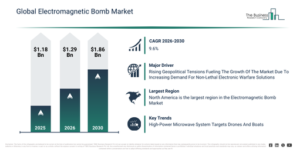
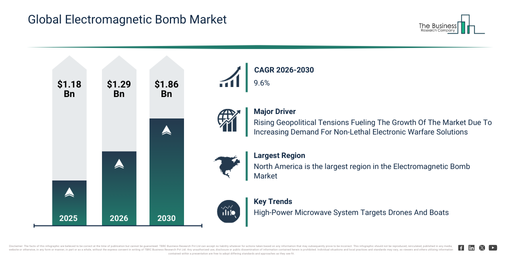
The electromagnetic bomb market has shown strong growth in recent years. It is anticipated to increase from $1.18 billion in 2025 to $1.29 billion in 2026, demonstrating a compound annual growth rate (CAGR) of 9.3%. Historically, this expansion has been driven by factors such as the increasing development of directed energy weapons designed to disable enemy electronic systems, the rising adoption of radio-frequency weapons for non-kinetic battlefield disruption, the expansion of electromagnetic disruption devices employed in electronic warfare programs, the development of vehicle-mounted EMP systems to protect strategic military assets, and the growth in research programs focused on high-power microwave technologies for electronic suppression.
The electromagnetic bomb market size is projected to experience substantial expansion over the coming years, reaching $1.86 billion in 2030, driven by a compound annual growth rate (CAGR) of 9.6%. This forecasted growth is primarily fueled by factors such as the increasing demand for advanced EMP systems to counter military platforms that are increasingly network-dependent, the rising incorporation of compact and mobile electromagnetic weapons for tactical field operations, the expansion of electronic warfare modernization programs promoting the adoption of next-generation disruption devices, greater investment in high-power microwave technologies for precision electronic neutralization, and the creation of hybrid electromagnetic systems that provide scalable, mission-specific electronic attack capabilities. Key trends anticipated during this period encompass progress in high-power microwave (HPM) pulse generation, the increasing deployment of non-nuclear electromagnetic pulse devices for tactical applications, enhanced government financing for directed energy research initiatives, the incorporation of EMP countermeasures into critical infrastructure, and a surging demand for vehicle-mounted electromagnetic disruption systems.
Download A Free Sample For In-Depth Electromagnetic Bomb Market Intelligence:
Electromagnetic Bomb Market Demand Driver: How It Is Shaping Industry Growth
The increasing geopolitical tensions are projected to boost the expansion of the electromagnetic bomb market. Geopolitical tensions denote disagreements, conflicts, or competition among nations or areas stemming from political, financial, territorial, or strategic motives. The escalation of these tensions often results from territorial disagreements that imperil national autonomy and command over vital regions. Electromagnetic bombs offer a solution to these geopolitical issues by supplying non-lethal mechanisms to neutralize adversaries’ electronic systems, thereby providing tactical benefits in areas of conflict. They improve defensive maneuvers by interfering with communication and command networks, lessening the necessity for traditional kinetic combat. For example, in October 2024, data from the U.S. Department of Homeland Security, a federal agency in the US, indicated that migrant encounters at the US-Canada border surpassed 181,000 in 2024, an increase of 6.5% from 170,000 recorded in 2023. Consequently, the escalating geopolitical tensions are propelling the growth of the electromagnetic bomb market.
Electromagnetic Bomb Market Segmentation Overview: Detailed Category Analysis
The electromagnetic bomb market covered in this report is segmented –
1) By Type: High-Power Electromagnetic Bombs, Nuclear Electromagnetic Pulse Weapons, Non-Nuclear Electromagnetic Pulse Devices, Microwave Weapons
2) By Platform: Airborne, Naval, Ground-Based
3) By Application Sector: Military And Defense, Civilian Protection And Disaster Relief, Cyber Warfare Operations, Telecommunication Disruption
4) By End User: Government, Defense Contractors, Research Organizations, Commercial Enterprises, Private Sector
Subsegments:
1) By High-Power Electromagnetic Bombs: Directed Energy Weapons, Flux Compression Generators, Radio Frequency (RF) Weapons, Vircator-Based Systems, Repetitive Pulse Power Systems
2) By Nuclear Electromagnetic Pulse Weapons: High-Altitude Nuclear Explosions, Tactical Electromagnetic Pulse Warheads, Strategic Electromagnetic Pulse Warheads
3) By Non-Nuclear Electromagnetic Pulse Devices: Portable Electromagnetic Pulse Generators, Improvised Electromagnetic Pulse Devices, Ground-Based Non-Nuclear Electromagnetic Pulse Systems, Vehicle-Mounted Non-Nuclear Electromagnetic Pulse Systems
4) By Microwave Weapons: Active Denial Systems, High-Power Microwave (HPM) Bombs, Millimeter Wave Weapons, Airborne Microwave Platforms
Top Electromagnetic Bomb Market Trends And Recent Industry Developments
Leading firms within the electromagnetic bomb market are concentrating on creating cutting-edge technological solutions, such as high-power microwave (HPM) systems, which aim to precisely and non-lethally disable adversary electronics and communication networks. An HPM system functions as a weapon that emits potent bursts of microwave energy, designed to incapacitate or destroy electronic equipment; thus, it represents a crucial technology within electromagnetic bombs for neutralizing enemy systems without causing physical harm. As an example, in April 2025, Epirus Inc., a US-based tech firm, introduced Leonidas H2O, a high-energy HPM system specifically designed for maritime interdiction and protection against unmanned aerial vehicles (UAVs) and smaller vessels, including unmanned surface vessels. This particular system is engineered to non-kinetically incapacitate the electronics of such targets, offering a scalable, reusable, and secure solution for tasks related to maritime security and anti-drone operations. Leonidas H2O features an unlimited magazine capacity and an open architecture, having shown its capability to disable vessel engines at exceptional distances during U.S. Navy exercises, even when functioning at lower power levels.
Electromagnetic Bomb Market Company Landscape: Key Players To Watch
Major companies operating in the electromagnetic bomb market are Raytheon Technologies Corporation, The Boeing Company, Lockheed Martin Corporation, General Dynamics Corporation, Northrop Grumman Corporation, Honeywell International, BAE Systems plc, Thales S.A., L3Harris Technologies Inc., Leonardo S.p.A, Israel Aerospace Industries Ltd., General Atomics, Diehl Defence GmbH And Co. KG, Kratos Defense And Security Solutions Inc., Rafael Advanced Defense Systems Ltd., MTI Technologies, Epirus Inc., Electro Magnetic Applications Inc., TechnoKontrol Technologies S.A., Xtreme Alternative Defense Systems, Ltd.
Explore The Electromagnetic Bomb Global Market Report For Full Insights:
Electromagnetic Bomb Market Region-Wise Analysis: Largest Regional Market Identified
North America was the largest region in the electromagnetic bomb market in 2025. Asia-Pacific is expected to be the fastest-growing region in the forecast period. The regions covered in the electromagnetic bomb market report are Asia-Pacific, South East Asia, Western Europe, Eastern Europe, North America, South America, Middle East, Africa.
Reach Out To Our Team:
The Business Research Company: https://www.thebusinessresearchcompany.com/
Americas: +1 310-496-7795
Asia: +44 7882 955267 & +91 8897263534
Europe: +44 7882 955267
Email us at: marketing@tbrc.info
Follow us on:
LinkedIn: https://in.linkedin.com/company/the-business-research-company
YouTube: https://www.youtube.com/channel/UC24_fI0rV8cR5DxlCpgmyFQ
Global Market Model: https://www.thebusinessresearchcompany.com/global-market-model

Wasay has over a decade of experience in market research, data modelling, and analytics, with prior experience at GlobalData and Decision Tree Consulting Services. At The Business Research Company , he leads research operations across syndicated studies, customized consulting engagements, and the Global Market Model platform. His professional experience includes supporting organizations such as Boston Consulting Group, KPMG, and Ernst & Young. Wasay holds a degree in Electronics and Communications Engineering, postgraduate management qualifications from International Management Institute Belgium and Indian School of Business and Entrepreneurship, and completed the Integrated Program in Business Analytics from Indian Institute of Management Indore.