The Business Research Company’s 2026 market reports are designed to deliver research that is more actionable and strategically valuable. Key offerings include market attractiveness scoring, total addressable market sizing, company benchmarking matrices, interactive Excel dashboards, deeper supply chain intelligence, emerging startup tracking, and granular product-level insights.
Which Factors Will Shape The Electric-Driven Fixed-Wing UAV Market Size Through 2030?
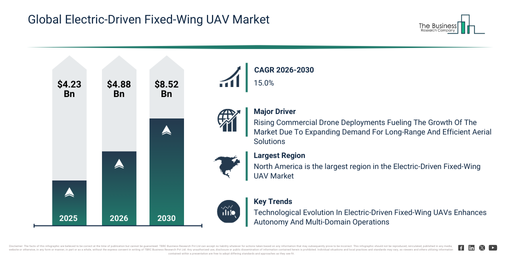
The electric-driven fixed-wing uav market size has seen substantial growth recently. This market is expected to increase from $4.23 billion in 2025 to $4.88 billion in 2026, demonstrating a compound annual growth rate (CAGR) of 15.3%. The expansion observed in prior periods can be attributed to various factors, including the rising adoption of electric-driven fixed-wing UAVs for long-duration aerial surveying and mapping, the growing implementation of autonomous navigation systems that improve mission accuracy and efficiency, the broadened application of agricultural monitoring leading to increased demand for payload cameras and sensor packages, the development of ground control stations enabling more advanced multi-mission operations, and advancements in battery technology enhancing flight duration and operational reliability.
The electric-driven fixed-wing uav market is projected for substantial expansion in the coming years, with its size anticipated to reach $8.52 billion in 2030, demonstrating a compound annual growth rate (CAGR) of 15.0%. This market’s growth during the forecast period stems from factors such as increasing demand for low-emission and quiet UAVs for environmental tracking and urban applications, the expanding adoption of fixed-wing electric UAVs for extensive infrastructure inspection and disaster relief efforts, the enhanced integration of rapid-charging stations and swappable battery systems to prolong mission durations, the broadening scope of delivery and logistics applications that necessitate long-range electric propulsion, and the ongoing development of advanced data processing software that facilitates real-time analytics and mission automation. Significant trends anticipated in this period encompass the wider availability of regulatory approvals for beyond-visual-line-of-sight (BVLOS) operations in civil and commercial sectors, the surging uptake of electric fixed-wing UAVs for long-range environmental and climate surveillance initiatives, the augmented utilization of UAV-based aerial surveying and mapping in large-scale infrastructure and construction projects, a transition from one-time UAV purchases to UAV-as-a-service models across logistics, agriculture, and inspection applications, and the increasing specialization of UAV platforms and payloads designed for specific sector requirements like precision agriculture, pipeline inspection, and disaster evaluation.
Request A Free Electric-Driven Fixed-Wing UAV Market Sample To Support Your Strategic Planning:
What Is Propelling The Electric-Driven Fixed-Wing UAV Market Toward $8.52 Billion By 2030?
The expanding need within the commercial drone sector is anticipated to drive the expansion of the electric-driven fixed-wing unmanned aerial vehicle (UAV) market in the future. This sector encompasses the industry dedicated to creating, manufacturing, and deploying unmanned aerial vehicles (UAVs) for commercial, non-military uses. The surge in demand for commercial drones stems from an increasing requirement for quicker and more effective delivery solutions, given that drones facilitate rapid, touch-free deliveries across urban and isolated regions. Electric-driven fixed-wing UAVs prove beneficial for the commercial drone sector by providing extended flight endurance and superior range compared to multirotor drones. This makes them perfectly suited for extensive surveying, mapping, and delivery operations, all while operating more quietly and with reduced environmental impact. As an illustration, a report released by Airservices Australia, an Australian government body, in February 2024 projected that annual drone flights in Australia would climb from 1.5 million in 2023 to 60.4 million by 2043. This projection includes 500,000 flights for agricultural crop monitoring and 1.5 million for household food deliveries. Consequently, the expanding demand within the commercial drone sector is propelling the development of the electric-driven fixed-wing unmanned aerial vehicle (UAV) market.
What Are The Key Segments And Subsegments In The Electric-Driven Fixed-Wing UAV Market?
The electric-driven fixed-wing uav market covered in this report is segmented –
1) By Type: Small Type, Medium Type, Large Type
2) By Technology: Fixed-Wing Electric Unmanned Aerial Vehicles, Hybrid Electric Unmanned Aerial Vehicles, Fully Autonomous Unmanned Aerial Vehicles, Remotely Piloted Unmanned Aerial Vehicles
3) By Application: Military Use, Civil Use
4) By End-User Industry: Agriculture, Military And Defense, Logistics And Transportation, Construction, Energy And Utilities, Environmental Monitoring
Subsegments:
1) By Small Type: Micro UAVs, Mini UAVs, Tactical UAVs
2) By Medium Type: Medium Altitude Long Endurance UAVs, VTOL-Capable Fixed-Wing UAVs, Hybrid-Electric UAVs
3) By Large Type: High Altitude Long Endurance UAVs, Strategic Surveillance UAVs, Cargo And Heavy-Lift Fixed-Wing UAVs
Electric-Driven Fixed-Wing UAV Market Trends Behind The 15% CAGR Forecast
Leading firms in the electric-powered fixed-wing unmanned aerial vehicle (UAV) sector are concentrating on creating advanced offerings, specifically electric fixed-wing vertical take-off and landing drones, aimed at improving operational adaptability, decreasing carbon footprint, and boosting flight duration. An electric fixed-wing vertical take-off and landing (eVTOL) drone is defined as a UAV that integrates the aerodynamic advantages of fixed-wing operation with the vertical take-off and landing functions typically found in rotary-wing setups, powered entirely by electric systems. As an example, during September 2024, T-DRONES, a Chinese manufacturer specializing in heavy payload unmanned aerial vehicles, introduced the VA17. This model is a fixed-wing VTOL (vertical take-off and landing) drone, incorporating a tilt-rotor design enabling smooth shifts between vertical and horizontal flight modes. Boasting a wingspan of 1,680 mm and a robust yet light frame constructed from carbon fiber and EPP foam, the VA17 is designed for extended missions, providing up to 120 minutes of flight time when carrying an 800 g payload and achieving a maximum range of 125 km. Its sophisticated power management, strong wind resistance, and easy tool-free assembly render it highly versatile and dependable for numerous industrial and commercial uses, such as mapping, surveying, and surveillance.
Major Companies Profiled In The Electric-Driven Fixed-Wing UAV Market Report
Major companies operating in the electric-driven fixed-wing uav market are Lockheed Martin Corporation, Northrop Grumman Corporation, BAE Systems plc, AgEagle Aerial Systems Inc., Thales Group, Leonardo S.p.A., Textron Systems, Elbit Systems Ltd., Saab AB, General Atomics Aeronautical, Teledyne FLIR LLC, Kratos Defense & Security Solutions, AeroVironment Inc., Zipline International Inc., Insitu Inc., Quantum Systems GmbH, Baykar Technologies, Wingtra AG, Delair Tech, ALTI UAS
Explore The Business Research Company’s Complete Electric-Driven Fixed-Wing UAV Market Report:
Where Does The Electric-Driven Fixed-Wing UAV Market Generate The Most Revenue?
North America was the largest region in the electric-driven fixed-wing unmanned aerial vehicle (UAV) market in 2025. Asia-Pacific is expected to be the fastest-growing region in the forecast period. The regions covered in the electric-driven fixed-wing uav market report are Asia-Pacific, South East Asia, Western Europe, Eastern Europe, North America, South America, Middle East, Africa.
Reach Out To Our Team:
The Business Research Company: https://www.thebusinessresearchcompany.com/
Americas: +1 310-496-7795
Asia: +44 7882 955267 & +91 8897263534
Europe: +44 7882 955267
Email us at: marketing@tbrc.info
Follow us on:
LinkedIn: https://in.linkedin.com/company/the-business-research-company
YouTube: https://www.youtube.com/channel/UC24_fI0rV8cR5DxlCpgmyFQ
Global Market Model: https://www.thebusinessresearchcompany.com/global-market-model

Wasay has over a decade of experience in market research, data modelling, and analytics, with prior experience at GlobalData and Decision Tree Consulting Services. At The Business Research Company , he leads research operations across syndicated studies, customized consulting engagements, and the Global Market Model platform. His professional experience includes supporting organizations such as Boston Consulting Group, KPMG, and Ernst & Young. Wasay holds a degree in Electronics and Communications Engineering, postgraduate management qualifications from International Management Institute Belgium and Indian School of Business and Entrepreneurship, and completed the Integrated Program in Business Analytics from Indian Institute of Management Indore.