With a focus on actionable insights and strategic value, The Business Research Company’s 2026 market reports include market attractiveness scoring, total addressable market sizing, company benchmarking matrices, interactive Excel dashboards, deeper supply chain intelligence, emerging startup tracking, and granular product-level insights.
Flight Management Systems (FMS) And Stable Market Size Snapshot: 2026 Valuation, 2030 Projection And Key Growth Factors
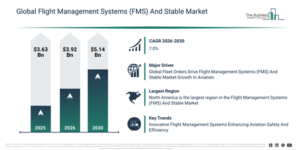
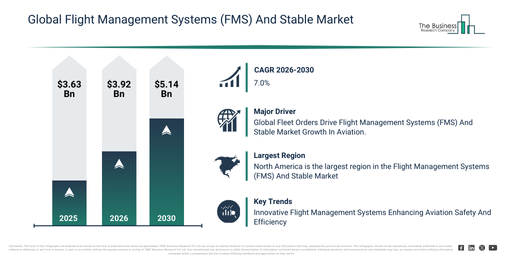
The market size for flight management systems (fms) has experienced significant expansion over recent years. It is anticipated to increase from $3.63 billion in 2025 to $3.92 billion in 2026, reflecting a compound annual growth rate (CAGR) of 7.8%. Historically, this growth can be attributed to several factors including the early adoption of GPS and inertial navigation technologies, the expansion of both commercial and military aviation, continuous advancements in autopilot and avionics systems, a rising demand for fuel-efficient flight operations, and the extended provision of maintenance, repair, and overhaul (MRO) services for fms.
The market for flight management systems (fms) is projected to experience substantial growth in the upcoming years. Its size is anticipated to reach $5.14 billion by 2030, exhibiting a compound annual growth rate (CAGR) of 7.0%. This expansion during the forecast period is driven by factors such as the incorporation of artificial intelligence and machine learning for improved flight planning, the growing uptake of interconnected avionics systems, the creation of advanced navigation sensors, the broadening of software update and upgrade offerings, and a heightened need for pilot training and simulation initiatives. Key trends expected within this period involve the increased implementation of sophisticated navigation and autopilot integration, a surging requirement for solutions that enhance fuel efficiency and optimize performance, an increase in retrofit installations across older commercial aircraft, improved adherence to regulations for aviation safety and flight oversight, and an enlargement of pilot training and decision-making support functions.
Get A No-Cost Sample Of The Flight Management Systems (FMS) And Stable Market Study:
Major Factor Fueling The Flight Management Systems (FMS) And Stable Market Through 2030
Global increases in fleet orders are anticipated to drive the expansion of flight management systems (FMS) and foster a consistent market moving forward. Fleet orders comprise the combined purchases of new aircraft by airlines, leasing firms, or operators, intended for fleet expansion or replacement. The rise in global fleet orders stems from heightened air travel demand and airline growth, creating a need for modern, more efficient aircraft. The importance of flight management systems (FMS) and reliable technology for increasing fleet orders is evident as they boost operational effectiveness, guarantee accurate navigation and flight planning, improve fuel efficiency, and uphold stable flight parameters. As an example, the General Aviation Manufacturers Association (GAMA), a US-based trade association, reported in July 2023 that airplane shipments in 2023 saw an uplift from 2022 levels. More precisely, piston airplane deliveries climbed by 11.8%, reaching a total of 1,682 units. Turboprop airplane deliveries rose by 9.6% to 638 units, while business jet deliveries grew to 730 units from 712. The overall value of airplane deliveries in 2023 amounted to $23.4 billion, reflecting a 2.2% increment. Consequently, the global surge in fleet orders is propelling the flight management systems (FMS) and contributing to a stable market.
Flight Management Systems (FMS) And Stable Market Segment Landscape: Main Categories And Subcategories Covered
The flight management systems (fms) and stable market covered in this report is segmented –
1) By Aircraft Type: Narrow Body Aircraft, Wide Body Aircraft, Very Large Aircraft, Regional Transport Aircraft
2) By Fit: Line Fit, Retrofit
3) By Hardware: Visual Display Unit (VDU), Control Display Unit (CDU), Flight Management Computers (FMC)
Subsegments:
1) By Narrow Body Aircraft: Single-Aisle Jetliners, Short-Haul Narrow Body Aircraft, Medium-Haul Narrow Body Aircraft, Low-Cost Carrier Aircraft
2) By Wide Body Aircraft: Twin-Aisle Jetliners, Long-Haul Wide Body Aircraft, Ultra-Long-Haul Wide Body Aircraft, Freighter Wide Body Aircraft
3) By Very Large Aircraft: Passenger Jumbo Jets, Cargo Jumbo Jets, Ultra-High Capacity Aircraft
4) By Regional Transport Aircraft: Regional Jets, Turboprop Aircraft, Short-Haul Regional Aircraft, Commuter Aircraft
How Are Emerging Trends Influencing The Flight Management Systems (FMS) And Stable Market’s Growth Path?
Leading companies active in the flight management systems (FMS) and stable market are increasingly focusing on introducing innovative products like guided visual procedures to offer pilots enhanced direction during visual approaches. Guided visual procedures in aviation leverage advanced flight management systems to deliver precise navigational support during visual approaches and landings, thereby improving safety and efficiency. For example, in October 2023, Honeywell International Inc., a US-based technology company, revealed the availability of Flight Management System Guided Visual Procedures as a stand-alone offering. This option provides both lateral and vertical guidance during visual approaches, which enhances the consistency of approaches and lessens the pilot’s workload. This breakthrough demonstrates Honeywell’s commitment to boosting aviation safety and efficiency by addressing issues related to unstable approaches, thus reinforcing its place in flight management systems (FMS) and a stable market for innovative technologies.
Flight Management Systems (FMS) And Stable Market Leading Players And Key Industry Participants In 2026
Major companies operating in the flight management systems (fms) and stable market are Raytheon Technologies Corporation, Boeing Company, General Electric Company, Northrop Grumman Corporation, Honeywell International Inc., Lufthansa Systems, Innovative Solutions & Support, BAE Systems, Thales Group, Leonardo S.p.A., Elbit Systems, Curtiss-Wright Corporation, Esterline CMC Electronics, Universal Avionics Systems Corporation, Genesys Aerosystems, FreeFlight Systems, BendixKing, Comsoft GmbH, Safran Electronics & Defense, DAC International Inc., Avidyne Corporation
Check Out The Full Flight Management Systems (FMS) And Stable Market Report 2026:
Flight Management Systems (FMS) And Stable Market By Geography: Revenue Leaders Among Global Regions
North America was the largest region in the flight management systems (FMS) and stable market in 2025. The regions covered in the flight management systems (fms) and stable market report are Asia-Pacific, South East Asia, Western Europe, Eastern Europe, North America, South America, Middle East, Africa.
Reach Out To Our Team:
The Business Research Company: https://www.thebusinessresearchcompany.com/
Americas: +1 310-496-7795
Asia: +44 7882 955267 & +91 8897263534
Europe: +44 7882 955267
Email us at: marketing@tbrc.info
Follow us on:
LinkedIn: https://in.linkedin.com/company/the-business-research-company
YouTube: https://www.youtube.com/channel/UC24_fI0rV8cR5DxlCpgmyFQ
Global Market Model: https://www.thebusinessresearchcompany.com/global-market-model

Wasay has over a decade of experience in market research, data modelling, and analytics, with prior experience at GlobalData and Decision Tree Consulting Services. At The Business Research Company , he leads research operations across syndicated studies, customized consulting engagements, and the Global Market Model platform. His professional experience includes supporting organizations such as Boston Consulting Group, KPMG, and Ernst & Young. Wasay holds a degree in Electronics and Communications Engineering, postgraduate management qualifications from International Management Institute Belgium and Indian School of Business and Entrepreneurship, and completed the Integrated Program in Business Analytics from Indian Institute of Management Indore.