The Business Research Company’s 2026 market reports are designed to deliver research that is more actionable and strategically valuable. Key offerings include market attractiveness scoring, total addressable market sizing, company benchmarking matrices, interactive Excel dashboards, deeper supply chain intelligence, emerging startup tracking, and granular product-level insights.
Which Factors Will Shape The Flight Route Optimization Market Size Through 2030?
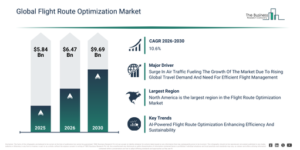
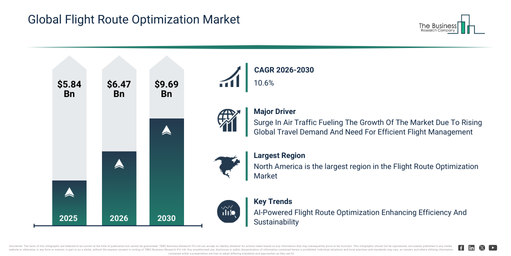
The flight route optimization market has experienced significant expansion recently, projected to increase from $5.84 billion in 2025 to $6.47 billion in 2026, demonstrating a compound annual growth rate (CAGR) of 10.9%. This historical growth stems from several factors, including the increasing adoption of performance-based navigation that improves route accuracy and efficiency, a rising need for fuel-saving strategies which drives the use of advanced flight planning tools, the expansion of crew scheduling and route integration systems for enhanced airline operational efficiency, the development of mobile flight planning apps supporting real-time decision-making, and the integration of weather analysis tools that enhance safety and route predictability.
The flight route optimization market is projected to grow significantly over the next few years, reaching a valuation of $9.69 billion in 2030, exhibiting a compound annual growth rate (CAGR) of 10.6%. This anticipated expansion can be attributed to the increasing application of AI-driven decision support systems for optimizing complex flight parameters, a rising demand for dynamic, real-time route adjustments in response to volatile weather patterns, the expansion of cargo and payload optimization solutions tailored for logistics-focused aviation, a greater adoption of cloud-based flight planning platforms enabling global fleet coordination, and the development of next-generation predictive analytics tools to enhance long-haul and transcontinental route efficiency. Major trends foreseen for this period include the integration of flight route optimization with airline operations control, crew scheduling, and maintenance planning; a growing embrace of performance-based navigation (PBN) and advanced airspace concepts such as free-route airspace; increased utilization of mobile and EFB-based flight planning tools for real-time route adjustments by pilots and dispatchers; an elevated regulatory focus on safety, resilience, and compliance within flight planning and route selection workflows; and a notable shift toward subscription-based and managed-service models for flight planning and optimization solutions.
Request A Free Flight Route Optimization Market Sample To Support Your Strategic Planning:
What Is Propelling The Flight Route Optimization Market Toward $9.69 Billion By 2030?
The expanding volume of air traffic is anticipated to fuel the expansion of the flight route optimization market in the future. Air traffic encompasses all aircraft movements within managed airspace, including takeoffs, landings, and flights between destinations, all coordinated for safe and efficient journeys. This surge in air traffic stems from a growing global demand for travel, as the faster and more efficient movement of individuals and goods across regions enhances connectivity and stimulates economic growth. Flight route optimization supports the rising air traffic by allowing airlines to devise more effective, fuel-efficient paths, thereby alleviating congestion, enhancing punctuality, and safely managing larger flight volumes. For instance, in January 2025, the International Air Transport Association, a Canada-based trade association, reported a significant increase in air travel demand; RPKs saw a rise of 10.4–13.6%, capacity grew by 5.6- 12.8%, international demand climbed by 10.6%, and domestic demand increased by 5.5% year-on-year. Consequently, the uptick in air traffic is a key factor driving the growth of the flight route optimization market.
What Are The Key Segments And Subsegments In The Flight Route Optimization Market?
The flight route optimization market covered in this report is segmented –
1) By Component: Software, Service
2) By Deployment: On-Premise, Cloud-Based
3) By End-User: Commercial Airlines, Business Jets, Other End-users
Subsegments:
1) By Software: Route Planning Software, Navigation System Software, Performance Monitoring Software, Fuel Management Software, Weather Data Integration Software
2) By Service: Consulting Services, Support And Maintenance Services, Integration And Deployment Services, Training And Education Services, Managed Services
Flight Route Optimization Market Trends Behind The 10.6% CAGR Forecast
Leading companies in the flight route optimization market are focusing on developing technological advancements, such as artificial intelligence (AI)-enabled route optimization tools, to enhance fuel efficiency, reduce carbon emissions, and improve overall flight operational performance. These AI-powered tools leverage artificial intelligence and real-time data to compute the most efficient flight paths, thereby minimizing fuel consumption and environmental impact. For instance, in October 2023, Dassault Aviation, a France-based aircraft business company, introduced Falcon Ways, an AI-powered tool designed for optimizing flight routes. This system aims to reduce fuel consumption and carbon emissions by providing real-time, weather-informed routing suggestions tailored to each aircraft’s performance. Falcon Ways assists pilots in making smarter in-flight decisions, improving overall flight efficiency. It enhances situational awareness and enables more sustainable flight operations, supporting Dassault’s commitment to eco-friendly aviation practices.
Major Companies Profiled In The Flight Route Optimization Market Report
Major companies operating in the flight route optimization market are Airbus SE, International Business Machines Corporation (IBM), Honeywell International Inc., Collins Aerospace, Amadeus IT Group S.A., Sabre GLBL Inc., NAV CANADA, Société Internationale de Télécommunications Aéronautiques (SITA), Jeppesen Sanderson Inc., Lufthansa Systems AG, Optym LLC, FlightAware LLC, PDC Aviation, Seabury Solutions, OpenAirlines SAS, Laminar Data Ltd., FL3XX GmbH, AIMS International Ltd., Caliper Corporation, Air Support A/S.
Explore The Business Research Company’s Complete Flight Route Optimization Market Report:
Where Does The Flight Route Optimization Market Generate The Most Revenue?
North America was the largest region in the flight route optimization market in 2025. The regions covered in the flight route optimization market report are Asia-Pacific, South East Asia, Western Europe, Eastern Europe, North America, South America, Middle East, Africa.
Reach Out To Our Team:
The Business Research Company: https://www.thebusinessresearchcompany.com/
Americas: +1 310-496-7795
Asia: +44 7882 955267 & +91 8897263534
Europe: +44 7882 955267
Email us at: marketing@tbrc.info
Follow us on:
LinkedIn: https://in.linkedin.com/company/the-business-research-company
YouTube: https://www.youtube.com/channel/UC24_fI0rV8cR5DxlCpgmyFQ
Global Market Model: https://www.thebusinessresearchcompany.com/global-market-model

Wasay has over a decade of experience in market research, data modelling, and analytics, with prior experience at GlobalData and Decision Tree Consulting Services. At The Business Research Company , he leads research operations across syndicated studies, customized consulting engagements, and the Global Market Model platform. His professional experience includes supporting organizations such as Boston Consulting Group, KPMG, and Ernst & Young. Wasay holds a degree in Electronics and Communications Engineering, postgraduate management qualifications from International Management Institute Belgium and Indian School of Business and Entrepreneurship, and completed the Integrated Program in Business Analytics from Indian Institute of Management Indore.