
Market attractiveness scoring, total addressable market sizing, company benchmarking matrices, interactive Excel dashboards, deeper supply chain intelligence, emerging startup tracking, and granular product-level insights are among the key offerings featured in The Business Research Company’s 2026 market reports, designed to deliver more actionable and strategically valuable research.
Low-Band Electronic Warfare Systems Market Growth Outlook: How Much Bigger Will The Market Be By 2030?
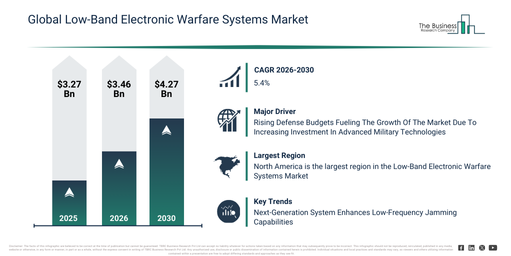
The market size for low-band electronic warfare systems has experienced significant growth in recent years. It is forecast to rise from $3.27 billion in 2025 to $3.46 billion in 2026, at a compound annual growth rate (CAGR) of 5.8%. The historical growth of this market can be attributed to increasing military dependence on low-frequency bands for long-range signal detection, the development of initial electromagnetic spectrum monitoring and interception systems, the rising deployment of airborne low-band electronic warfare pods, advancements in anti-radiation missile technologies specifically targeting low-band emitters, and the expansion of electronic intelligence programs that necessitate low-band threat identification.
The low-band electronic warfare systems market is projected to experience substantial expansion in the coming years, reaching a valuation of $4.27 billion by 2030, demonstrating a compound annual growth rate (CAGR) of 5.4%. This anticipated growth can be linked to several factors, including the increasing need for autonomous electronic warfare drones suited for broad low-band operations, heightened investment in advanced spectrum dominance and jamming technologies, the spread of integrated electronic warfare suites across various military domains such as land, air, and sea, continuous technological improvements in low-frequency signal analysis and geolocation, and the ongoing modernization of defense communication countermeasure systems to confront new low-band threats. Key developments expected during this period involve a rising call for multi-domain, joint-force integration of low-band electronic warfare systems, a move towards modular, open-architecture low-band EW platforms for quicker updates and personalization, a greater emphasis on low-frequency spectrum dominance to counteract long-range surveillance and over-the-horizon radars, increased implementation of low-band EW systems for purposes like homeland security, border monitoring, and protecting vital infrastructure, and an expansion of training, simulation, and lifecycle support services for personnel operating and maintaining low-band electronic warfare systems.
Request A Free Low-Band Electronic Warfare Systems Market Sample From The Business Research Company:
How Is The Key Growth Driver Influencing The Low-Band Electronic Warfare Systems Market?
The expansion of defense spending is anticipated to fuel the progression of the low-band electronic warfare systems market in the future. Defense budgets represent the total government funds allocated for military personnel, assets, operations, and related activities aimed at safeguarding national security. These budgets are escalating due to increasing geopolitical tensions, compelling countries to bolster their military capacities for dissuasion and strategic protection. Growing defense allocations boost low-band electronic warfare systems by facilitating increased investment in cutting-edge technologies and improving national security defenses. They facilitate the creation of adaptive jamming and threat detection instruments, thereby reinforcing electronic defense tactics. For example, a report from the Stockholm International Peace Research Institute (SIPRI), a Sweden-based international research institute, indicated in April 2024 that worldwide military expenditure hit $2.443 trillion in 2023, representing a 6.8% rise in real terms from 2022. Consequently, the uptick in defense budgets is stimulating the expansion of the low-band electronic warfare systems market.
Low-Band Electronic Warfare Systems Market Segmentation By Category: What Does The 2026 Report Cover?
The low-band electronic warfare systems market covered in this report is segmented –
1) By Type: Electronic Attack, Electronic Protection, Electronic Support
2) By Platform: Airborne, Naval, Ground, Space
3) By Application: Communication Jamming, Radar Jamming And Deception, Surveillance And Signal Intelligence
4) By End-Use: Military, Homeland Security, Commercial
Subsegments:
1) By Electronic Attack: Communication Jamming, Radar Jamming, Deception Jamming, Anti-Radiation Missiles
2) By Electronic Protection: Emission Control (EMCON), Frequency Hopping, Low Probability of Intercept (LPI) Techniques, Electromagnetic Shielding, Spectrum Management, Electronic Counter-Countermeasures (ECCM)
3) By Electronic Support: Signal Intelligence (SIGINT), Electronic Surveillance Measures (ESM), Direction Finding, Threat Detection and Classification, Spectrum Monitoring, Electronic Intelligence (ELINT)
How Are Industry Players Changing The Low-Band Electronic Warfare Systems Market Landscape?
Companies operating in the low-band electronic warfare system market are prioritizing the development of sophisticated solutions, such as software-driven active electronically scanned array systems, to improve threat detection and adaptive jamming functionalities. Software-driven active electronically scanned array (AESA) systems refer to radar or jamming technologies that employ software to manage the direction, frequency, and waveform of electronically steered beams without the need for moving parts. For example, in September 2024, L3 Technologies, a US-based aerospace and defense technology company, unveiled a next-generation jammer low-band (NGJ-LB) system intended for the EA-18G Growler aircraft. The NGJ-LB system is an advanced electronic attack solution that broadens the aircraft’s jamming capabilities into lower frequency ranges, thereby enhancing its capacity to neutralize enemy air defenses and communications. This system integrates state-of-the-art digital and software-defined technologies, enabling rapid adjustment to evolving threats and ensuring superior electronic warfare performance.
Low-Band Electronic Warfare Systems Market Global Key Players And Competitive Overview
Major companies operating in the low-band electronic warfare systems market are Raytheon Technologies Corporation, Lockheed Martin Corporation, Northrop Grumman Corporation, Honeywell International Inc., BAE Systems plc, Thales Group, L3Harris Technologies Inc., Leonardo S.P.A, Airbus Defense and Space, Rheinmetall AG, Elbit Systems Ltd., Israel Aerospace Industries Ltd., Saab AB, Rohde & Schwarz GmbH & Co KG, Bharat Electronics Limited, Aselsan A.S, HENSOLDT AG, Mercury Systems Inc., Kratos Defense & Security Solutions Inc., Cobham plc
Explore Comprehensive Low-Band Electronic Warfare Systems Market Coverage In The Full Report:
Regional Analysis Of The Low-Band Electronic Warfare Systems Market: Where Is The Industry Concentrated?
North America was the largest region in the low-band electronic warfare systems market in 2025. Asia-Pacific is expected to be the fastest-growing region in the forecast period. The regions covered in the low-band electronic warfare systems market report are Asia-Pacific, South East Asia, Western Europe, Eastern Europe, North America, South America, Middle East, Africa.
Reach Out To Our Team:
The Business Research Company: https://www.thebusinessresearchcompany.com/
Americas: +1 310-496-7795
Asia: +44 7882 955267 & +91 8897263534
Europe: +44 7882 955267
Email us at: marketing@tbrc.info
Follow us on:
LinkedIn: https://in.linkedin.com/company/the-business-research-company
YouTube: https://www.youtube.com/channel/UC24_fI0rV8cR5DxlCpgmyFQ
Global Market Model: https://www.thebusinessresearchcompany.com/global-market-model

Wasay has over a decade of experience in market research, data modelling, and analytics, with prior experience at GlobalData and Decision Tree Consulting Services. At The Business Research Company , he leads research operations across syndicated studies, customized consulting engagements, and the Global Market Model platform. His professional experience includes supporting organizations such as Boston Consulting Group, KPMG, and Ernst & Young. Wasay holds a degree in Electronics and Communications Engineering, postgraduate management qualifications from International Management Institute Belgium and Indian School of Business and Entrepreneurship, and completed the Integrated Program in Business Analytics from Indian Institute of Management Indore.


