
Designed to make market research more actionable and strategically valuable, The Business Research Company’s 2026 market reports feature market attractiveness scoring, total addressable market sizing, company benchmarking matrices, interactive Excel dashboards, deeper supply chain intelligence, emerging startup tracking, and granular product-level insights.
Low Earth Orbit (LEO) Satellites Market Forecast 2026–2030: Size, Value And Compound Annual Growth Rate
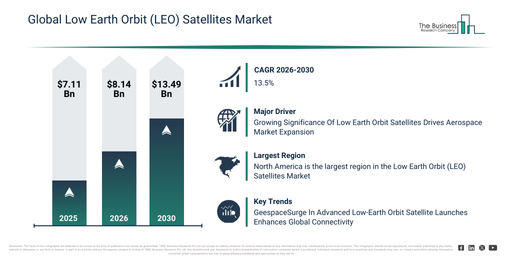
The low earth orbit (leo) satellites market has experienced substantial growth recently. Projections indicate it will expand from $7.11 billion in 2025 to reach $8.14 billion by 2026, demonstrating a compound annual growth rate (CAGR) of 14.5%. This past growth can be ascribed to several factors, including the increased deployment of small and mini-satellites for communication and earth observation, innovations in lightweight satellite components facilitating mass production, the increasing application of LEO satellites for military reconnaissance and imaging, the broadening of commercial satellite imaging and data services, and the enhanced affordability of launch services which supports LEO constellation deployment.
The low earth orbit (leo) satellites market is projected to experience substantial expansion over the coming years. This market is forecast to reach $13.49 billion by 2030, exhibiting a compound annual growth rate (CAGR) of 13.5%. Key drivers for this growth during the forecast period include the increasing need for high-speed, low-latency global connectivity through LEO constellations, the enlargement of mega-constellation initiatives by commercial entities, progress in satellite propulsion and on-orbit maneuvering capabilities, the greater incorporation of AI-powered imaging and analytics into LEO satellite operations, and enhanced government and defense spending on robust LEO-based communication and surveillance infrastructure. Significant trends anticipated for the forecast period encompass the escalating deployment of small satellite constellations, a growing requirement for real-time earth observation information, an uptick in military reconnaissance and surveillance activities, the proliferation of economical launch services, and improvements in miniaturized satellite components.
Try Before You Buy: Free Sample Of The Low Earth Orbit (LEO) Satellites Market Report:
Low Earth Orbit (LEO) Satellites Market Growth Engine: The Factor Boosting Demand Globally
The growing integration of low-earth orbit (LEO) satellites across diverse industries is anticipated to propel the aerospace market forward during the projected timeframe. LEO satellites are crucial facilitators for planetary safeguarding, security, and endurance, and they are instrumental in earth observation applications, particularly within the agricultural sector. Through earth observation, information derived from LEO satellites is utilized to monitor and quantify biological, chemical, and physical components worldwide. A notable instance is OneWeb’s successful deployment of approximately 650 Low Earth Orbit (LEO) satellites as of October 2025. The majority of these satellites function within 12 synchronized orbital planes, situated at an approximate altitude of 1,200 km above Earth. Additionally, OneWeb partners with Arianespace for launching satellites from diverse spaceports. This recent expansion by the LEO satellite communications firm seeks to deliver high-speed, low-latency internet connectivity across global land, sea, and air domains.
Which Categories And Subcategories Shape The Low Earth Orbit (LEO) Satellites Market?
The low earth orbit (leo) satellites market covered in this report is segmented –
1) By Type: Femto, Pico, Nano, Micro, Mini
2) By Sub-System: Payload, Structure, Telecommunication, On-Board Computer, Power System, Attitude Control, Propulsion System
3) By Application: Technology Development, Earth Observation And Remote Sensing, Communication, Space Exploration, Surveillance
4) By End-User: Commercial, Civil, Government, Other End-Users
Subsegments:
1) By Femto: Ultra-Small Femto Satellites
2) By Pico: Standard Pico Satellites, Pico-Satellite Swarms
3) By Nano: CubeSats, Nanosatellite Constellations
4) By Micro: Small Micro Satellites, Advanced Micro Satellites With Enhanced Payloads
5) By Mini: Mini Satellites With Standard Payloads, High-Performance Mini Satellites
Low Earth Orbit (LEO) Satellites Market Trend Insights: Strategic Focus Areas Of Leading Companies
Advanced low-earth orbit satellite deployments are becoming notably popular within the low-earth orbit satellites market. Key entities in the low earth orbit satellite domain are prioritizing satellite launches to facilitate worldwide connectivity. An example of this is Geespace, a Chinese satellite technology firm, which deployed 10 low Earth orbit (LEO) satellites from the Taiyuan Satellite Launch Centre in September 2024. These particular satellites incorporate unique attributes that enhance their performance and effectiveness. By operating at altitudes ranging from 300 to 2,000 kilometers, they enable reduced latency essential for real-time communication. Furthermore, the deployment and upkeep of LEO satellites are typically more cost-effective compared to conventional geostationary satellites. Their broad coverage, backed by a satellite network, guarantees uninterrupted service even in isolated areas, while ongoing technological improvements support high-speed broadband and mobile connectivity to address growing requirements.
Leading Organizations In The Low Earth Orbit (LEO) Satellites Market
Major companies operating in the low earth orbit (leo) satellites market are Thales, Northrop Grumman Corporation, Lockheed Martin Corporation, The Boeing Company, Airbus SE (Surrey Satellite Technology Ltd), L3Harris Technologies, Kepler Communications Inc., Blue Canyon Technologies Inc., Blue Origin, SpaceX, One Space Tech, Land Space Technology Corporation Ltd, ExPace Technology Corporation, CASIC, Beijing Commsat Technology Development Co. Ltd, Telstra, Quberider Pty Ltd, Innova Space, Telespazio S.p.A., GomSpace Group AB, EnduroSat, AAC Clyde Space, OneWeb, Speedcast International Limited, Raytheon, Honeywell International Inc., Telesat, Amazon, Starlink satellite constellation, Hughes Network Systems, Empresa Argentina de Soluciones Satelitales AR-SAT SA, Al Yah Satellite Communications (YAHSAT), Arabsat, Es’hailSat, QSat Communications, Saman Satellite Communications, Thuraya Satellite, DragonFly Aerospace, NETLOXH, ETSE CubeCom, Omarichet, Simera Sense
Continue Reading: The Full Low Earth Orbit (LEO) Satellites Market Report:
Low Earth Orbit (LEO) Satellites Market Regional Spotlight: Top Geography And Report Coverage
North America was the largest region in the low earth orbit satellites market in 2025. North America is expected to be the fastest-growing region in the forecast period. The regions covered in the low earth orbit (leo) satellites market report are Asia-Pacific, South East Asia, Western Europe, Eastern Europe, North America, South America, Middle East, Africa.
Reach Out To Our Team:
The Business Research Company: https://www.thebusinessresearchcompany.com/
Americas: +1 310-496-7795
Asia: +44 7882 955267 & +91 8897263534
Europe: +44 7882 955267
Email us at: marketing@tbrc.info
Follow us on:
LinkedIn: https://in.linkedin.com/company/the-business-research-company
YouTube: https://www.youtube.com/channel/UC24_fI0rV8cR5DxlCpgmyFQ
Global Market Model: https://www.thebusinessresearchcompany.com/global-market-model

Wasay has over a decade of experience in market research, data modelling, and analytics, with prior experience at GlobalData and Decision Tree Consulting Services. At The Business Research Company , he leads research operations across syndicated studies, customized consulting engagements, and the Global Market Model platform. His professional experience includes supporting organizations such as Boston Consulting Group, KPMG, and Ernst & Young. Wasay holds a degree in Electronics and Communications Engineering, postgraduate management qualifications from International Management Institute Belgium and Indian School of Business and Entrepreneurship, and completed the Integrated Program in Business Analytics from Indian Institute of Management Indore.


