With a focus on actionable insights and strategic value, The Business Research Company’s 2026 market reports include market attractiveness scoring, total addressable market sizing, company benchmarking matrices, interactive Excel dashboards, deeper supply chain intelligence, emerging startup tracking, and granular product-level insights.
How Much Will The Aircraft Health Monitoring System Market Be Worth By 2030?
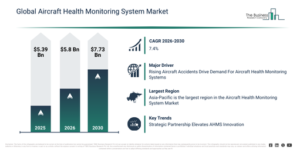
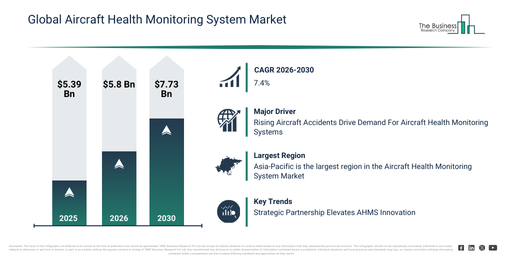
The aircraft health monitoring system market has experienced significant expansion recently. Its size is projected to increase from $5.39 billion in 2025 to $5.8 billion in 2026, demonstrating a compound annual growth rate (CAGR) of 7.5%. This historical growth can be linked to several factors, including the early integration of sensors and data processing units for monitoring essential aircraft parts, a rising need for real-time engine parameter tracking to enhance operational safety, the creation of diagnostic capabilities that allow for prompt identification of airframe and gearbox problems, an increased application of health monitoring solutions for auxiliary power unit evaluations, and the expansion of commercial aviation necessitating ongoing surveillance of aircraft performance.
The market for aircraft health monitoring systems is projected to experience substantial expansion in the coming years. By 2030, this market is anticipated to reach a valuation of $7.73 billion, demonstrating a compound annual growth rate (CAGR) of 7.4%. This anticipated growth during the forecast period stems from several factors, including the increasing implementation of predictive maintenance solutions powered by advanced analytics and artificial intelligence, the greater incorporation of cloud-based platforms for managing real-time aircraft health data, a rising need for improved monitoring systems to support future aircraft designs, the broadened use of digital twin technology for simulating and forecasting component performance, and technological progress leading to more precise sensors and thorough aircraft condition surveillance. Key trends identified for this period encompass predictive maintenance for aircraft engines, real-time data analytics for monitoring airframes, the integration of AHMS with auxiliary power units, the strategic deployment of advanced sensors across various aircraft components, and the development of fleet-wide health monitoring systems.
Get Access To A Free Aircraft Health Monitoring System Market Report Sample:
The Key Driver Behind The Aircraft Health Monitoring System Market’s 7.4% CAGR
The rising frequency of aircraft accidents is anticipated to stimulate expansion in the aircraft health monitoring system market in the future. An aircraft accident refers to any occurrence involving an aircraft that results in injury or damage to the aircraft itself, individuals, property, or other objects. Aircraft Health Monitoring Systems (AHMS) are designed to detect faults and irregularities in crucial systems instantaneously, facilitating proactive maintenance and preventing in-flight failures that could cause accidents. For example, data from The International Air Transport Association, a Canadian international trade body, revealed in February 2024 that the overall accident rate climbed from 0.56 per million sectors in 2022 to 0.78 in 2023, although this figure stayed below the regional five-year average of 1.06. Concurrently, the fatality risk rate for Asia-Pacific operators, measured per million sectors, increased from 0.00 in 2022 to 0.16, attributed to a deadly incident in Nepal in January 2023 stemming from a loss of control during flight. Consequently, the growing occurrence of aircraft accidents acts as a key driver for the aircraft health monitoring system market.
Aircraft Health Monitoring System Market Classification: Main Segments And Detailed Subsegments
The aircraft health monitoring system market covered in this report is segmented –
1) By System: Engine Health Monitoring, Structural Health Monitoring, Component Health Monitoring
2) By Subsystem: Aero-propulsion, Avionics, Ancillary Systems, Aircraft Structures
3) By Installation: On Board, On Ground
4) By Technology: Prognostics System, Diagnostics System, Detection System, Adaptive Control, Other Technologies
5) By End User: Commercial, Military
Subsegments:
1) By Engine Health Monitoring: Real-Time Monitoring Systems, Data Acquisition Systems, Engine Performance Analysis Tools
2) By Structural Health Monitoring: Sensor-Based Monitoring Systems, Fatigue Monitoring Systems, Damage Detection Systems
3) By Component Health Monitoring: Avionics Health Monitoring Systems, Landing Gear Monitoring Systems, Fuel System Monitoring System
Aircraft Health Monitoring System Market Strategic Shifts: What Leading Players Are Prioritizing
Leading companies in the aircraft health monitoring system market are employing strategic collaborations to maintain their competitive standing. These alliances boost the AHMS market’s success by encouraging teamwork, speeding up innovation, and broadening market penetration within the evolving aviation sector. As an illustration, in December 2023, SIPAL S.P.A, an engineering services firm based in Italy, partnered with ODYSIGHT.AI, a US-based visualization and AI platform, to develop a sophisticated visual health monitoring system. This joint effort seeks to facilitate real-time visual checks of aircraft internal components without needing to remove panels, by leveraging Odysight’s video sensors and AI algorithms in conjunction with SIPAL’s Head Mounted Display technology. The objective is to transform Prognostic Health Management, thereby improving maintenance precision, decreasing operational downtime, and elevating safety standards for aerospace activities.
Aircraft Health Monitoring System Market Company Analysis: Major Industry Participants
Major companies operating in the aircraft health monitoring system market are General Electric Company, Raytheon Technologies Corporation, The Boeing Company, Airbus SE, Honeywell International Inc., Mitsubishi Heavy Industries Ltd., Safran Group, Rolls-Royce Holdings PLC, Textron Aviation Inc., Amphenol Corporation, Bombardier Inc., Lufthansa Technik AG, AMETEK Inc., Collins Aerospace (United Technologies Corporation), Teledyne Technologies Inc., Embraer S.A., Air France Industries KLM Engineering & Maintenance Group, Curtiss-Wright Corporation, Zodiac Aerospace, Meggitt PLC, SITA N.V., Ultra Electronics Holdings PLC, eInfochips, Intelsat S.A., GE Engine Services LLC, FLYHT Aerospace Solutions Ltd, Avionica Inc., RSL Electronics Ltd, Acellent Technologies Inc., Ventura Aerospace Inc.
Get Full Access To The Aircraft Health Monitoring System Market Report 2026:
Aircraft Health Monitoring System Market Global Regional Breakdown: Key Regions Analyzed
Asia-Pacific was the largest region in the aircraft monitoring system market in 2025 and is expected to be the fastest-growing region in the forecast period. The regions covered in the aircraft health monitoring system market report are Asia-Pacific, South East Asia, Western Europe, Eastern Europe, North America, South America, Middle East, Africa.
Reach Out To Our Team:
The Business Research Company: https://www.thebusinessresearchcompany.com/
Americas: +1 310-496-7795
Asia: +44 7882 955267 & +91 8897263534
Europe: +44 7882 955267
Email us at: marketing@tbrc.info
Follow us on:
LinkedIn: https://in.linkedin.com/company/the-business-research-company
YouTube: https://www.youtube.com/channel/UC24_fI0rV8cR5DxlCpgmyFQ
Global Market Model: https://www.thebusinessresearchcompany.com/global-market-model

Wasay has over a decade of experience in market research, data modelling, and analytics, with prior experience at GlobalData and Decision Tree Consulting Services. At The Business Research Company , he leads research operations across syndicated studies, customized consulting engagements, and the Global Market Model platform. His professional experience includes supporting organizations such as Boston Consulting Group, KPMG, and Ernst & Young. Wasay holds a degree in Electronics and Communications Engineering, postgraduate management qualifications from International Management Institute Belgium and Indian School of Business and Entrepreneurship, and completed the Integrated Program in Business Analytics from Indian Institute of Management Indore.