The Business Research Company’s 2026 market reports combine market attractiveness scoring, total addressable market sizing, company benchmarking matrices, interactive Excel dashboards, deeper supply chain intelligence, emerging startup tracking, and granular product-level insights to deliver research that is more actionable and strategically valuable.
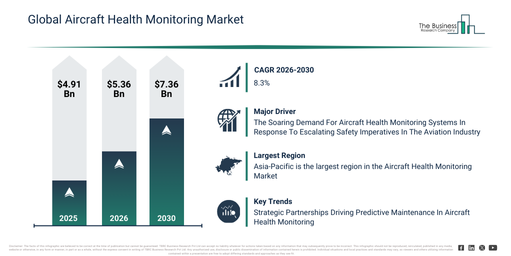
Aircraft Health Monitoring Market Revenue Forecast: $5.36 Billion In 2026 Rising To $7.36 Billion In 2030
The aircraft health monitoring market has experienced strong growth in recent years. It is forecast to increase from $4.91 billion in 2025 to $5.36 billion in 2026, exhibiting a compound annual growth rate (CAGR) of 9.2%. The expansion witnessed in the historic period can be ascribed to the increasing uptake of remote monitoring systems to enhance aircraft maintenance efficiency, the broader implementation of fault diagnostics tools to reduce unexpected component failures, the rising integration of wireless sensor networks for continuous aircraft data collection, advancements in high-speed communication facilitating real-time health status reporting, and the expansion of digital maintenance programs supporting data-driven decision-making.
The aircraft health monitoring market is projected to experience substantial expansion over the upcoming years. It is anticipated to reach $7.36 billion in 2030, exhibiting a compound annual growth rate (CAGR) of 8.3%. This projected expansion is fueled by several factors, including the increasing application of artificial intelligence and machine learning for proactive aircraft upkeep, a growing need for cohesive health monitoring platforms across both commercial and defense aviation, the wider adoption of advanced sensors for more accurate system diagnostics, airlines’ intensified efforts to minimize operational interruptions using automated health data, and the broadening of cloud-based analytical frameworks that support fleet-wide health surveillance. Key developments expected during this period encompass AI-powered predictive maintenance to enhance aircraft performance, the incorporation of real-time wireless sensor networks for aircraft observation, cloud-based solutions for aircraft health monitoring, the utilization of big data analytics for identifying faults and optimizing operations, and remote monitoring capabilities for both existing and upgraded aircraft systems.
Free Sample Report: Aircraft Health Monitoring Market Size, Trends And Forecast To 2030:
Aircraft Health Monitoring Market Growth Catalyst: What Is Creating New Demand?
The rising demand for safety and operational efficiency in the aviation sector, driven by accidents, is anticipated to accelerate the aircraft health monitoring market. A core aim of safety management in aviation is to prevent human injuries or deaths, as well as damage to property and the environment. Given the various risks involved with aircraft for both passengers and the surroundings, several aviation companies have begun investing in aircraft health and safety to ensure safer travel and reduce aircraft-related fatalities. These escalating safety concerns for aircraft from governments and corporations have increased the necessity for aircraft health monitoring systems, which help decrease maintenance and operational costs while improving overall aircraft safety. For instance, in February 2025, according to the International Air Transport Association (IATA), a Canada-based trade association, in 2024, there were seven fatal accidents out of 40.6 million flights, surpassing both the single fatal accident reported in 2023 and the five-year average of five fatal accidents per year. Therefore, the increasing demand for safety and efficiency in the aviation industry due to accidents will propel the growth of the aircraft health monitoring market.
Aircraft Health Monitoring Market Segment Overview: Categories Covered In The 2026 Report
The aircraft health monitoring market covered in this report is segmented –
1) By Solution: Hardware, Software, Services
2) By System: Engine Health Monitoring, Structural Health Monitoring, Component Monitoring
3) By Operation Mode: Real time, Non-real-time
4) By Fit: Line fit, Retro fit
5) By End User: OEMs, MRO, Airlines
Subsegments:
1) By Hardware: Sensors, Data Acquisition Systems, Communication Equipment
2) By Software: Predictive Maintenance Software, Data Analytics Tools, Health Monitoring Systems
3) By Services: Consulting Services, Maintenance And Support Services, Training Services
How Are Leading Companies Shaping Aircraft Health Monitoring Market Trends?
Leading companies within the aircraft health monitoring market are prioritizing the formation of strategic partnerships to improve predictive maintenance capabilities, thereby enhancing aircraft safety and operational efficiency. A strategic partnership involves a long-term alliance between organizations, combining their respective strengths, resources, or expertise to achieve shared business objectives, stimulate innovation, and create mutual competitive advantages. For example, in July 2023, Israel Aerospace Industries (IAI), an Israel-based aerospace and defense firm, joined forces with Odysight.ai, an Israel-based camera-as-a-sensor technology provider, to introduce a visual-based health monitoring system technology for UH60 Black Hawk helicopters. This system employs a multicamera setup, alongside advanced visual sensing, video analytics, AI, and machine learning, to facilitate real-time monitoring and predictive maintenance. It achieves this by identifying component degradation and incipient malfunctions before they become serious, thus ensuring peak safety and availability during operations.
Aircraft Health Monitoring Market Players: Key Companies Shaping Competition
Major companies operating in the aircraft health monitoring market are Airbus SAS, Safran SA, Honeywell International Inc., Teledyne Technologies Inc., The Boeing Company, General Electric Company, Rolls-Royce Holdings PLC, Flyth Aerospace Solutions Ltd., Raytheon Technologies Corporation, Curtiss-Wright Corporation, RSL Electronics Ltd., Deutsche Lufthansa AG, Acellent Technologies Inc., Societe Internationale de Telecommunications Aeronautiques, Embraer SA, AMETEK Inc., Tech Mahindra Limited, Ventura Aerospace Inc., Meggitt PLC, Lufthansa Technik AG, FLYHT Aerospace Solutions Ltd., Esterline Technologies Corporation, Ultra Electronics Holdings PLC, Thales Group, BAE Systems PLC, Moog Inc., SKF AB, LORD Corporation, Goodrich Corporation, Eaton Corporation
Access Complete Aircraft Health Monitoring Market Data, Forecasts And Competitive Insights:
Aircraft Health Monitoring Market Regional Performance And Geographic Coverage
Asia-Pacific was the largest region in the aircraft health monitoring market in 2025. Asia-Pacific is expected to be the fastest-growing region in the forecast period. The regions covered in the aircraft health monitoring market report are Asia-Pacific, South East Asia, Western Europe, Eastern Europe, North America, South America, Middle East, Africa.
Reach Out To Our Team:
The Business Research Company: https://www.thebusinessresearchcompany.com/
Americas: +1 310-496-7795
Asia: +44 7882 955267 & +91 8897263534
Europe: +44 7882 955267
Email us at: marketing@tbrc.info
Follow us on:
LinkedIn: https://in.linkedin.com/company/the-business-research-company
YouTube: https://www.youtube.com/channel/UC24_fI0rV8cR5DxlCpgmyFQ
Global Market Model: https://www.thebusinessresearchcompany.com/global-market-model

Wasay has over a decade of experience in market research, data modelling, and analytics, with prior experience at GlobalData and Decision Tree Consulting Services. At The Business Research Company , he leads research operations across syndicated studies, customized consulting engagements, and the Global Market Model platform. His professional experience includes supporting organizations such as Boston Consulting Group, KPMG, and Ernst & Young. Wasay holds a degree in Electronics and Communications Engineering, postgraduate management qualifications from International Management Institute Belgium and Indian School of Business and Entrepreneurship, and completed the Integrated Program in Business Analytics from Indian Institute of Management Indore.