Designed to make market research more actionable and strategically valuable, The Business Research Company’s 2026 market reports feature market attractiveness scoring, total addressable market sizing, company benchmarking matrices, interactive Excel dashboards, deeper supply chain intelligence, emerging startup tracking, and granular product-level insights.
How Big Is The Aircraft Strut Market In 2026, And How Fast Will It Grow?
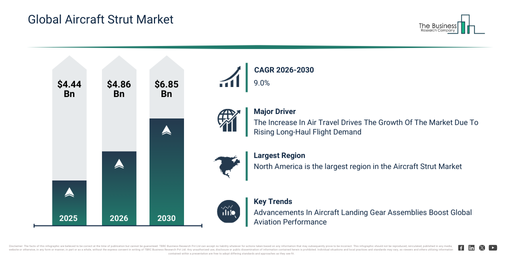
The aircraft strut market has experienced substantial expansion in recent years. This market is expected to increase from $4.44 billion in 2025 to $4.86 billion in 2026, demonstrating a compound annual growth rate (CAGR) of 9.3%. The historical growth was primarily due to the expansion of commercial and military aircraft fleets, the adoption of composite and lightweight materials, technological improvements in energy absorption, the growth of maintenance and retrofit services, and regulatory standards for landing safety.
The aircraft strut market is anticipated to experience significant expansion in the coming years. Its valuation is projected to reach $6.85 billion by 2030, exhibiting a compound annual growth rate (CAGR) of 9.0%. This projected growth is driven by several factors, including the advancement of smart struts incorporating monitoring sensors, their wider adoption in next-generation and unmanned aircraft, the broadening of aftermarket services, integration with energy-efficient landing systems, and the rising demand for customized and high-performance strut solutions. Key trends anticipated during this period encompass a heightened dependence on specialized suppliers for the design and production of landing gear and structural struts, an escalating need for aircraft strut maintenance, repair, and overhaul (MRO) services spurred by an aging global aircraft fleet, greater customization of strut solutions to fulfill the distinct performance and load specifications of new aircraft projects, the increasing complexity and expense of certifying landing gear and structural struts owing to more stringent safety and compliance regulations, and a trend towards consolidation and strategic alliances among OEMs, Tier-1 suppliers, and MRO providers within the aircraft strut value chain.
Download A Free Aircraft Strut Market Sample Report With Size And Forecast Data:
Aircraft Strut Market Growth Driver: The Key Factor Behind Rising Demand
The growing need for air transportation is anticipated to boost the expansion of the aircraft strut market in the future. Air travel involves moving passengers or cargo via airplanes, usually across considerable distances, utilizing either commercial or private aviation services. This rise in air travel demand stems from an increase in long-haul flights, allowing a greater number of individuals to access air transportation for both business and recreational activities. Aircraft struts are crucial for air travel, offering vital structural stability and strength, aiding in the absorption of landing impacts, preserving wing alignment, and guaranteeing secure and efficient flight operations. For example, data from January 2025 provided by the International Air Transport Association (IATA), a Canada-based trade organization, indicated that international air traffic experienced a 13.6% surge in 2024 compared to 2023, with total flight capacity expanding by 12.8% over the identical timeframe. Consequently, the heightened demand for air travel directly fuels the growth of the aircraft strut market.
Aircraft Strut Market Segmentation: Key Segments And Subsegments Covered
The aircraft strut market covered in this report is segmented –
1) By Strut Type: Landing Gear Struts, Wing Struts, Fuselage Struts, Engine Struts, Cabin Struts
2) By Aircraft Types: Commercial Aircraft, Military Aircraft, Business Jets, Helicopters, General Aviation Aircraft, Other Aircraft Types
3) By Material: Steel Alloys, Aluminum Alloys, Titanium Alloys, Composites, Other Materials
4) By End-User: Original Equipment Manufacturers (OEMs), Aftermarket Or Maintenance, Repair, And Overhaul (MRO)
Subsegments:
1) By Landing Gear Struts: Hydraulic Struts, Pneumatic Struts, Telescopic Struts, Shock Absorber Struts
2) By Wing Struts: Braced Wing Struts, Cantilever Wing Struts, Lift Struts, Support Struts
3) By Fuselage Struts: Load Bearing Struts, Reinforcement Struts, Cross Bracing Struts, Attachment Struts
4) By Engine Struts: Pylon Struts, Mounting Struts, Vibration Isolation Struts, Support Struts
5) By Cabin Struts: Structural Support Struts, Interior Mounting Struts, Partition Struts, Seat Support Struts
Aircraft Strut Market Trends: Key Developments Shaping 2026 And Beyond
Leading companies within the aircraft strut market are concentrating on developing innovative offerings, such as aircraft landing gear systems, to address the increasing worldwide demand for high-performance aircraft support solutions. An aircraft landing gear assembly serves as a crucial structural framework, designed to support an aircraft during ground movements, absorb the impact of landing, and enable controlled motion throughout taxiing, takeoff, and landing phases. For example, in September 2025, Collins Aerospace, an aerospace and defense technology company based in the US, announced the expansion of its Tajecina Landing Gear System. This expansion is set to enhance production capabilities for main, nose, and wing landing gear assemblies, which are constructed from high-strength metals to withstand rigorous operational conditions. The facility improvements are significant, as they integrate steering, braking, and control systems directly into these assemblies, consequently improving performance, reducing maintenance requirements, and supporting global aircraft operations.
Leading Companies Operating In The Aircraft Strut Market
Major companies operating in the aircraft strut market are The Boeing Company, Delta Strut LLC, Collins Aerospace Systems (RTX Corporation), Safran SA, Parker-Hannifin Corporation, Liebherr-Aerospace Lindenberg GmbH., Bell Textron, SKF AB, Lufthansa Technik, Spirit AeroSystems, Embraer S.A., Airbus SE, Moog Inc., Sikorsky Aircraft Corporation, AAR Corp., Magellan Aerospace Corporation, Aircraft Spruce & Specialty Co., CIRCOR Aerospace Inc., AvtechTyee Inc., Cox Airparts LLC, Kubick Aviation Services Inc., Wicks Aircraft Supply
Access The Full Aircraft Strut Market Research Report:
Aircraft Strut Market Regional Analysis: Largest Region And Key Geographies Covered
North America was the largest region in the aircraft strut market in 2025. Asia-Pacific is expected to be the fastest-growing region in the forecast period. The regions covered in the aircraft strut market report are Asia-Pacific, South East Asia, Western Europe, Eastern Europe, North America, South America, Middle East, Africa.
Reach Out To Our Team:
The Business Research Company: https://www.thebusinessresearchcompany.com/
Americas: +1 310-496-7795
Asia: +44 7882 955267 & +91 8897263534
Europe: +44 7882 955267
Email us at: marketing@tbrc.info
Follow us on:
LinkedIn: https://in.linkedin.com/company/the-business-research-company
YouTube: https://www.youtube.com/channel/UC24_fI0rV8cR5DxlCpgmyFQ
Global Market Model: https://www.thebusinessresearchcompany.com/global-market-model

Wasay has over a decade of experience in market research, data modelling, and analytics, with prior experience at GlobalData and Decision Tree Consulting Services. At The Business Research Company , he leads research operations across syndicated studies, customized consulting engagements, and the Global Market Model platform. His professional experience includes supporting organizations such as Boston Consulting Group, KPMG, and Ernst & Young. Wasay holds a degree in Electronics and Communications Engineering, postgraduate management qualifications from International Management Institute Belgium and Indian School of Business and Entrepreneurship, and completed the Integrated Program in Business Analytics from Indian Institute of Management Indore.