Market attractiveness scoring, total addressable market sizing, company benchmarking matrices, interactive Excel dashboards, deeper supply chain intelligence, emerging startup tracking, and granular product-level insights are among the key offerings featured in The Business Research Company’s 2026 market reports, designed to deliver more actionable and strategically valuable research.
Aircraft Survivability Equipment Market Valued At $4.93 Billion In 2026, Projected To Reach $6.39 Billion By 2030
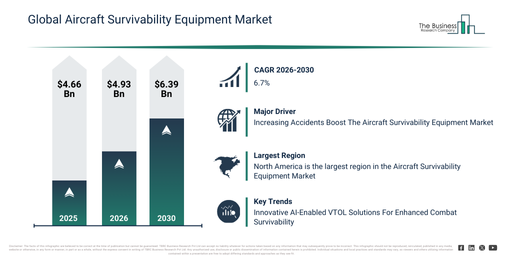
The aircraft survivability equipment market has experienced robust expansion in recent years. This market is projected to expand from $4.66 billion in 2025 to $4.93 billion in 2026, demonstrating a compound annual growth rate (CAGR) of 5.7%. Historically, this expansion has been driven by several key factors, including increased military aircraft modernization programs leading to the procurement of missile detection and warning systems, a rise in operational deployments elevating demand for armor plating, self-sealing fuel tanks, and ice protection systems, advancements in electronic countermeasure technologies enhancing aircraft survivability performance, growth in manufacturer-provided warranty-period maintenance and system integration services, and the expanded adoption of lightning strike protection and emergency escape systems across both fixed- and rotary-wing fleets.
The aircraft survivability equipment market is anticipated to experience substantial expansion over the coming years. It is projected to reach $6.39 billion in 2030, exhibiting a compound annual growth rate (CAGR) of 6.7%. This expansion during the forecast period is driven by factors such as the increasing need for advanced survivability suites that can counter sophisticated guided missile threats, the greater adoption of multi-sensor detection and tracking systems for immediate threat responses, the rising acquisition of lightweight but highly durable protective materials to boost aircraft efficiency, the wider deployment of survivability equipment in unmanned aerial systems, and an anticipated rise in all-encompassing lifecycle service packages, including upgrades, diagnostics, and predictive maintenance for this equipment. Key developments expected during this period include the incorporation of sophisticated missile and threat detection systems, the reduction in size of survivability equipment for lighter aircraft, improved situational awareness via sensor fusion, the creation of multi-layered electronic countermeasures, and the implementation of predictive maintenance alongside performance monitoring.
Request A Complimentary Aircraft Survivability Equipment Market Research Sample:
Key Factor Propelling The Aircraft Survivability Equipment Market Forward
The escalating occurrence of air incidents is anticipated to stimulate the expansion of the aircraft survivability equipment market. Air accidents are defined as events associated with an aircraft’s operation that take place after someone has boarded. Aircraft survivability equipment (ASE) refers to a comprehensive set of systems engineered to defend aircraft against attacks through missile detection, warning, and tracking systems, signal jamming, chaff and flare dispensers, and infrared laser beam countermeasures. For instance, in September 2024, the International Civil Aviation Organization, a Canada-based United Nations agency, reported an accident rate of 0.80 per million flights in 2023, which means one accident occurred for every 1.26 million flights. Furthermore, a 3.1% increase in the overall number of accidents was noted from 2022 to 2023. Therefore, the rise in the number of aircraft is fueling the growth of the aircraft survivability equipment market.
Aircraft Survivability Equipment Market Segments And Subsegments Explained
The aircraft survivability equipment market covered in this report is segmented –
1) By Component: Hardware, Software, Services
2) By Technology: Active, Passive
3) By Fit: Line, Forward
4) By Application: Combat Aircraft, Combat Helicopter, Special Mission Aircraft, Unmanned Aerial Vehicle (UAV)
Subsegments:
1) By Hardware: Electronic Warfare Systems, Countermeasure Systems, Sensors And Detectors, Ballistic Protection Systems
2) By Software: Threat Detection Software, Situational Awareness Software, Data Analysis And Fusion Software
3) By Services: Installation And Integration Services, Maintenance And Support Services, Training Services
Emerging Trends Transforming The Aircraft Survivability Equipment Market
Major companies within the aircraft survivability equipment market are prioritizing the development of innovative solutions, such as AI-piloted vertical takeoff and landing (VTOL) fighter jets, to bolster mission survivability, refine autonomous threat responses, and maximize tactical operational efficiency. An AI-piloted vertical takeoff and landing (VTOL) fighter jet is characterized as a combat aircraft capable of vertical takeoff and landing without a runway, operating autonomously or semi-autonomously using artificial intelligence to manage navigation, flight control, and mission execution. For instance, in October 2025, Shield AI, Inc., a US-based aerospace and defense company, unveiled an X-BAT, engineered for expeditionary and maritime operations in contested environments. The X-BAT is notable for its runway-independent design, which provides persistence, reach, and survivability in combat scenarios, especially where traditional runway access is restricted or unavailable.
Aircraft Survivability Equipment Market Key Players: Major Companies In The 2026 Report
Major companies operating in the aircraft survivability equipment market are United Technologies Corporation, Lockheed Martin Corporation, Boeing Rotorcraft Systems, Raytheon Company, Airbus SE, Northrop Grumman Corporation, BAE Systems plc, Harris Corporation, Thales Group, L3 Technologies Inc., Leonardo S.p.A., Textron Inc., Rheinmetall AG, Elbit Systems Ltd., Israel Aerospace Industries Ltd., Saab AB, General Dynamics Corporation, Sikorsky Aircraft, Moog Inc., Curtiss-Wright Corporation, Cobham Limited, Orbital ATK Inc., FLIR Systems Inc., Ultra Electronics Holdings plc, Chemring Group, Cobham plc., Aselsan A.S., Terma A/S, Esterline Technologies Corporation, Edo Corporation Ltd.
Explore The Full Aircraft Survivability Equipment Market Report With Forecasts To 2030:
Aircraft Survivability Equipment Market By Region: Where Is Demand Strongest?
North America was the largest region in the aircraft survivability equipment market in 2025. The regions covered in the aircraft survivability equipment market report are Asia-Pacific, South East Asia, Western Europe, Eastern Europe, North America, South America, Middle East, Africa.
Reach Out To Our Team:
The Business Research Company: https://www.thebusinessresearchcompany.com/
Americas: +1 310-496-7795
Asia: +44 7882 955267 & +91 8897263534
Europe: +44 7882 955267
Email us at: marketing@tbrc.info
Follow us on:
LinkedIn: https://in.linkedin.com/company/the-business-research-company
YouTube: https://www.youtube.com/channel/UC24_fI0rV8cR5DxlCpgmyFQ
Global Market Model: https://www.thebusinessresearchcompany.com/global-market-model

Wasay has over a decade of experience in market research, data modelling, and analytics, with prior experience at GlobalData and Decision Tree Consulting Services. At The Business Research Company , he leads research operations across syndicated studies, customized consulting engagements, and the Global Market Model platform. His professional experience includes supporting organizations such as Boston Consulting Group, KPMG, and Ernst & Young. Wasay holds a degree in Electronics and Communications Engineering, postgraduate management qualifications from International Management Institute Belgium and Indian School of Business and Entrepreneurship, and completed the Integrated Program in Business Analytics from Indian Institute of Management Indore.