
With a focus on actionable insights and strategic value, The Business Research Company’s 2026 market reports include market attractiveness scoring, total addressable market sizing, company benchmarking matrices, interactive Excel dashboards, deeper supply chain intelligence, emerging startup tracking, and granular product-level insights.
Anti-Radiation Missile Market Size Analysis: Historical Growth And Future Revenue Projections
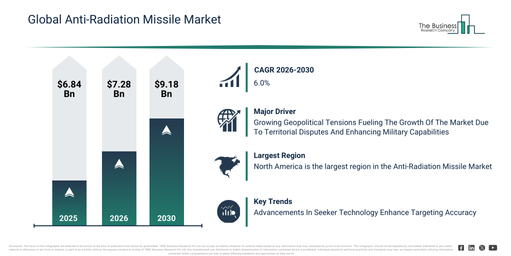
The anti-radiation missile market has experienced significant expansion in recent times. This market is projected to expand from $6.84 billion in 2025 to $7.28 billion in 2026, exhibiting a compound annual growth rate (CAGR) of 6.4%. This historical growth can be linked to factors such as the increasing use of passive radar homing missiles for targeting adversary radar systems, the creation of active radar homing missiles for accurate strikes, the deployment of ship-launched anti-radiation missiles for naval combat, the application of radar site targeting missiles to neutralize enemy air defenses, and the incorporation of electronic warfare system targeting features for enhanced mission effectiveness.
The market for anti-radiation missiles is anticipated to experience substantial growth in the near future, with projections indicating a value of $9.18 billion by 2030, expanding at a compound annual growth rate (CAGR) of 6.0%. This expansion during the forecast period is fueled by several factors, including increasing investment in advanced anti-radiation missile technologies, the development of multi-sensor guidance and electronic counter-countermeasure systems, the increasing use of networked and AI-enhanced targeting solutions, a rise in procurement for integrated air, naval, and missile defense operations, and an emphasis on extended-range and high-speed anti-radiation missiles crucial for contemporary combat situations. Key trends expected over the forecast period encompass enhanced development of SEAD (Suppression of Enemy Air Defenses)-oriented missiles, an increase in long-range anti-radiation missile capabilities, greater integration of multi-mode seekers, the broadening of naval and airborne anti-radiation platforms, and the ongoing modernization of electronic warfare suppression systems.
Preview The Anti-Radiation Missile Market Report With A Free Sample:
Anti-Radiation Missile Market Drivers: What Is Fueling Demand Through 2030?
The expansion of geopolitical conflicts is anticipated to fuel the growth of the anti-radiation missile market in the coming years. Geopolitical tensions are defined as disagreements, struggles, or competition among nations or territories stemming from political, economic, land-related, or strategic objectives. The increase in these tensions often arises from territorial disputes, which jeopardize national independence and dominance over critical areas. Anti-radiation missiles assist in managing geopolitical tensions by neutralizing adversary radar systems, thereby boosting combat efficiency in conflict areas. These missiles offer strategic benefits by enhancing the effectiveness of air missions and mitigating risks from enemy air defenses. For instance, in October 2024, data from the U.S. Department of Homeland Security, a US-based federal agency, indicated that migrant encounters at the US-Canada border surpassed 181,000 in 2024, representing a 6.5% rise from 170,000 in 2023. Consequently, the escalating geopolitical tensions are a primary factor driving the expansion of the anti-radiation missile market.
Anti-Radiation Missile Market Segmentation Analysis: Core Categories And Subcategories
The anti-radiation missile market covered in this report is segmented –
1) By Type of Missile: Air-to-Surface Missiles, Surface-to-Air Missiles, Ship-to-Shore Missiles, Multi-Role Missiles
2) By Guidance System: Active Guidance, Passive Guidance, Infrared Guidance, Multi-Mode Guidance
3) By Payload Type: High-Explosive Warhead, Cluster Munitions, Precision-Guided Munitions, Electronic Warfare Payloads
4) By Application Area: Military Applications, Civilian Applications
5) By End-User: Defense, Homeland Security
Subsegments:
1) By Air-to-Surface Missiles: Short-Range, Medium-Range, Long-Range
2) By Surface-to-Air Missiles: Short-Range, Medium-Range, Long-Range
3) By Ship-to-Shore Missiles: Anti-Ship, Coastal Defense, Land Attack
4) By Multi-Role Missiles: Anti-Radiation or Anti-Ship, Anti-Radiation or Anti-Aircraft, Anti-Radiation or Land Attack
Which Trends Will Define The Anti-Radiation Missile Market Through 2030?
Leading companies in the anti-radiation missile market are concentrating on developing technologically advanced solutions, such as sophisticated seeker technology, to enhance targeting precision, bypass radar shutdown strategies, and improve performance in electronic warfare situations. This advanced seeker technology in anti-radiation missiles involves using complex sensors and algorithms that enable the missile to detect, track, and accurately home in on radar emissions. For instance, in May 2023, JSC Rosoboronexport, a Russia-based defense export company, introduced the Kh-31PD medium-range supersonic anti-radiation missile. It is designed to neutralize radars of medium- and long-range SAM systems, air operations control radars, and early warning radars, achieving high supersonic speeds through a scramjet with an integrated booster. The Kh-31PD is equipped with an upgraded passive radar seeker, offering improved targeting and a longer engagement range compared to earlier versions. Its modular design allows it to be compatible with various fighter jets, thereby boosting operational flexibility.
Anti-Radiation Missile Market Major Companies And Industry Participants
Major companies operating in the anti-radiation missile market are RTX Corporation, Lockheed Martin Corporation, Northrop Grumman Corporation, BAE Systems plc, Thales S.A., Israel Aerospace Industries Ltd., MBDA UK Limited, Saab Aktiebolag, Bharat Electronics Limited, Defence Research and Development Organisation (DRDO), ASELSAN Anonim Sirketi, LIG Nex1 Co. Ltd., Roketsan Roket Sanayi ve Ticaret Anonim Sirketi, Denel Dynamics, Bharat Dynamics Limited, Tactical Missiles Corporation Joint Stock Company, Centum Electronics Limited, Adani Aerospace and Defence Limited, Walchandnagar Industries Limited, Joint Stock Company Concern Almaz-Antey, Rafael Advanced Defense Systems Ltd.
Buy The Full Anti-Radiation Missile Global Market Report 2026:
Anti-Radiation Missile Market Geographic Analysis: Which Region Accounts For The Biggest Share?
North America was the largest region in the anti-radiation missile market in 2025. Asia-Pacific is expected to be the fastest-growing region in the forecast period. The regions covered in the anti-radiation missile market report are Asia-Pacific, South East Asia, Western Europe, Eastern Europe, North America, South America, Middle East, Africa.
Reach Out To Our Team:
The Business Research Company: https://www.thebusinessresearchcompany.com/
Americas: +1 310-496-7795
Asia: +44 7882 955267 & +91 8897263534
Europe: +44 7882 955267
Email us at: marketing@tbrc.info
Follow us on:
LinkedIn: https://in.linkedin.com/company/the-business-research-company
YouTube: https://www.youtube.com/channel/UC24_fI0rV8cR5DxlCpgmyFQ
Global Market Model: https://www.thebusinessresearchcompany.com/global-market-model

Wasay has over a decade of experience in market research, data modelling, and analytics, with prior experience at GlobalData and Decision Tree Consulting Services. At The Business Research Company , he leads research operations across syndicated studies, customized consulting engagements, and the Global Market Model platform. His professional experience includes supporting organizations such as Boston Consulting Group, KPMG, and Ernst & Young. Wasay holds a degree in Electronics and Communications Engineering, postgraduate management qualifications from International Management Institute Belgium and Indian School of Business and Entrepreneurship, and completed the Integrated Program in Business Analytics from Indian Institute of Management Indore.

