
Enhanced with market attractiveness analysis, total addressable market evaluation, company benchmarking matrices, interactive Excel dashboards, expanded supply chain intelligence, emerging startup coverage, and detailed product insights, The Business Research Company’s 2026 market reports deliver more actionable and strategically valuable research.
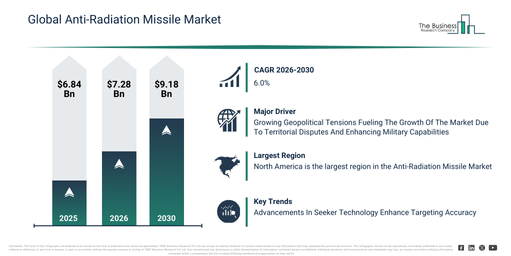
Anti-Radiation Missile Market Forecast Highlighting Growth From $7.28 Billion To $9.18 Billion
The anti-radiation missile market has experienced significant growth over recent years. It is projected to expand from $6.84 billion in 2025 to $7.28 billion in 2026, demonstrating a compound annual growth rate (CAGR) of 6.4%. Historically, this expansion has been attributed to the adoption of passive radar homing missiles for targeting enemy radar systems, the development of active radar homing missiles for precise engagement, the deployment of ship-launched anti-radiation missiles for naval operations, the use of radar site targeting missiles to suppress enemy air defenses, and the integration of electronic warfare system targeting capabilities for mission effectiveness.
The anti-radiation missile market is projected to experience substantial expansion in the coming years. This market is forecast to reach $9.18 billion by 2030, exhibiting a compound annual growth rate (CAGR) of 6.0%. Drivers for this anticipated growth during the forecast timeframe include increased investment in advanced anti-radiation missile technologies, the broadening of multi-sensor guidance and electronic counter-countermeasure systems, a surge in the integration of networked and AI-powered targeting solutions, heightened acquisition for combined air, naval, and missile defense activities, and an emphasis on longer-range and high-velocity anti-radiation missiles suited for contemporary warfare. Key trends projected for this period encompass advancements in sead-oriented missile development, an increase in the capabilities of long-range anti-radiation missiles, greater incorporation of multi-mode seekers, the proliferation of naval and airborne anti-radiation platforms, and ongoing modernization of electronic warfare suppression systems.
Download A Free Sample Report For Comprehensive Market Insights:
Anti-Radiation Missile Market Growth Drivers: What Factors Are Accelerating Expansion?
Expanding geopolitical instability is anticipated to drive the expansion of the anti-radiation missile market in the future. Such tensions denote disagreements, clashes, or competition among nations or areas stemming from political, economic, territorial, or strategic motives. An increase in these geopolitical strains often originates from territorial disagreements, which endanger a nation’s sovereignty and its command over vital strategic locations. Anti-radiation missiles aid in managing geopolitical friction by incapacitating adversary radar systems, thereby improving combat efficacy in areas of conflict. These missiles offer significant strategic benefits through better aerial mission outcomes and by mitigating dangers posed by air defense mechanisms. For example, as reported by the U.S. Department of Homeland Security, a federal agency located in the U.S., in October 2024, migrant encounters at the US-Canada border surpassed 181,000 during 2024. This represented a 6.5% rise from the 170,000 recorded in 2023. Consequently, the escalating geopolitical unrest is fueling the expansion of the anti-radiation missile market.
Anti-Radiation Missile Market Segment Performance And Strategic Opportunities
The anti-radiation missile market covered in this report is segmented –
1) By Type of Missile: Air-to-Surface Missiles, Surface-to-Air Missiles, Ship-to-Shore Missiles, Multi-Role Missiles
2) By Guidance System: Active Guidance, Passive Guidance, Infrared Guidance, Multi-Mode Guidance
3) By Payload Type: High-Explosive Warhead, Cluster Munitions, Precision-Guided Munitions, Electronic Warfare Payloads
4) By Application Area: Military Applications, Civilian Applications
5) By End-User: Defense, Homeland Security
Subsegments:
1) By Air-to-Surface Missiles: Short-Range, Medium-Range, Long-Range
2) By Surface-to-Air Missiles: Short-Range, Medium-Range, Long-Range
3) By Ship-to-Shore Missiles: Anti-Ship, Coastal Defense, Land Attack
4) By Multi-Role Missiles: Anti-Radiation or Anti-Ship, Anti-Radiation or Anti-Aircraft, Anti-Radiation or Land Attack
Anti-Radiation Missile Market Trends Driving Strategic Industry Expansion
Major companies in the anti-radiation missile market are concentrating on creating technologically advanced solutions, such as sophisticated seeker technology, to achieve precise targeting, bypass radar shutdown tactics, and enhance effectiveness in electronic warfare scenarios. This advanced seeker technology in anti-radiation missiles utilizes complex sensors and algorithms, enabling the missile to precisely detect, track, and home in on radar signals. As an illustration, in May 2023, JSC Rosoboronexport, a defense export firm from Russia, introduced the Kh-31PD medium-range supersonic anti-radiation missile. It is engineered to neutralize radars of medium- and long-range SAM systems, air operations control units, and early warning systems, achieving high supersonic speeds through a scramjet incorporating a built-in booster. The Kh-31PD incorporates an enhanced passive radar seeker for better targeting capabilities and an extended engagement range compared to its predecessors. Its modular construction ensures compatibility with a variety of fighter aircraft, boosting operational flexibility.
Anti-Radiation Missile Market Leading Companies: Who Holds Significant Market Presence?
Major companies operating in the anti-radiation missile market are RTX Corporation, Lockheed Martin Corporation, Northrop Grumman Corporation, BAE Systems plc, Thales S.A., Israel Aerospace Industries Ltd., MBDA UK Limited, Saab Aktiebolag, Bharat Electronics Limited, Defence Research and Development Organisation (DRDO), ASELSAN Anonim Şirketi, LIG Nex1 Co. Ltd., Roketsan Roket Sanayi ve Ticaret Anonim Şirketi, Denel Dynamics, Bharat Dynamics Limited, Tactical Missiles Corporation Joint Stock Company, Centum Electronics Limited, Adani Aerospace and Defence Limited, Walchandnagar Industries Limited, Joint Stock Company Concern Almaz-Antey, Rafael Advanced Defense Systems Ltd.
Access The Complete Anti-Radiation Missile Market Report:
Anti-Radiation Missile Market Geographic Distribution And Regional Opportunities
North America was the largest region in the anti-radiation missile market in 2025. Asia-Pacific is expected to be the fastest-growing region in the forecast period. The regions covered in the anti-radiation missile market report are Asia-Pacific, South East Asia, Western Europe, Eastern Europe, North America, South America, Middle East, Africa.
Access a Customized Anti-Radiation Missile Market Report for Deeper Competitive Insights
https://www.thebusinessresearchcompany.com/customise?id=25223&type=smp
Get in touch with us:
The Business Research Company: https://www.thebusinessresearchcompany.com/
Americas: +1 310-496-7795
Asia: +44 7882 955267 & +91 8897263534
Europe: +44 7882 955267
Email us at: marketing@tbrc.info
Follow us on:
LinkedIn: https://in.linkedin.com/company/the-business-research-company
YouTube: https://www.youtube.com/channel/UC24_fI0rV8cR5DxlCpgmyFQ
Global Market Model: https://www.thebusinessresearchcompany.com/global-market-model

Wasay has over a decade of experience in market research, data modelling, and analytics, with prior experience at GlobalData and Decision Tree Consulting Services. At The Business Research Company , he leads research operations across syndicated studies, customized consulting engagements, and the Global Market Model platform. His professional experience includes supporting organizations such as Boston Consulting Group, KPMG, and Ernst & Young. Wasay holds a degree in Electronics and Communications Engineering, postgraduate management qualifications from International Management Institute Belgium and Indian School of Business and Entrepreneurship, and completed the Integrated Program in Business Analytics from Indian Institute of Management Indore.
